
A generic online insurance quote is often little more than a false sense of security until the moment you actually need to make a claim. We understand the frustration of watching premiums climb while restrictive sub-limits leave your most valuable assets exposed. It is exhausting to sift through pages of complex jargon only to feel more anxious about risks like rent default than when you started. Finding the right landlord insurance in Australia should not feel like a gamble with your financial future.
We recognise that as an investor, you are looking for a steady hand to help manage the increasing complexity of the rental market. This guide moves beyond superficial comparisons to help you find a tailored policy that actually protects your rental income and assets. We will clarify the vital differences between standard home cover and specialised landlord protection, while explaining how the latest 2026 tenancy law changes affecting rental properties throughout the country impact your risk profile. By the end, you will have a clear path to securing your investment and achieving the lasting peace of mind you deserve.
Key Takeaways
- Identify why standard home insurance leaves property investors exposed and how specialised cover bridges the “risk gap” for your assets.
- Discover the essential components of landlord insurance, from protecting the physical structure to securing your rental income against tenant default.
- Understand how your duty of care and legal liability shift when a property is tenanted, ensuring you aren’t caught out by restrictive occupancy clauses.
- Learn to evaluate specific property risks, including the nuances of strata-titled units versus freestanding houses and regional environmental factors.
- Move beyond generic online quotes by adopting a consultative approach that identifies hidden risks before they lead to a declined claim.
Beyond the Basics: Why Landlord Insurance is Vital for Australian Property Investors
For most Australians, a rental property represents years of disciplined saving and a vision for future security. It is likely your most significant asset, yet we often see investors treat its protection as a secondary administrative task. This “set and forget” mentality creates a dangerous vulnerability. While standard home insurance covers the structure you live in, it rarely accounts for the unique exposures that arise the moment a tenant moves in. Relying on a basic policy is a gamble that assumes your risks are the same as a regular homeowner, which simply isn’t the case.
In the 2026 market, where investor borrowing has grown by $42 billion in a single year, the stakes for your portfolio have never been higher. A standard policy often contains an occupancy clause that can void a claim if the insurer wasn’t notified the property is being used for commercial gain. Specialised landlord insurance bridges this gap, providing a safety net for risks that go far beyond a leaking pipe or a broken window. It is a strategic tool designed to protect your cash flow as much as your physical building.
The Reality of Property Investment Risks
We view risk through three distinct lenses: physical damage, financial loss, and legal liability. A simple “tick and flick” policy might cover fire or storm damage, but it often falls short when dealing with the nuances of Rent Insurance Explained and the complexities of the modern legal environment. With 2026 legislative reforms in Victoria banning no-reason evictions and Western Australia limiting rent increases to once every 12 months, your ability to recover lost income through traditional means is becoming more restricted. You need a policy that understands these shifting obligations and provides a methodical way to recover when things go wrong.
The Financial Consequences of Underinsurance
A single incident, such as a significant period of rent default or a liability claim following an injury on-site, can wipe out years of rental yield in weeks. With the lowest variable investment rates currently starting at 5.74%, your margins are likely already under pressure. Choosing the lowest premium often means accepting restrictive sub-limits that don’t reflect the true cost of legal disputes or property restoration. The hidden costs of legal disputes with tenants or third parties can escalate quickly, especially with new 2026 requirements for landlords to provide mandatory payment options like Centrepay in several states. We believe in looking beneath the surface to ensure that when a crisis occurs, your landlord insurance policy actually pays out, turning a high-friction experience into one that feels managed and secure.
Decoding the Policy: Key Coverages for Building, Contents, and Rental Income
A robust landlord insurance policy is a specialised instrument designed to shield you from the specific financial shocks inherent in the rental market. Unlike a standard home policy, this cover addresses three critical areas: the physical structure, the internal assets you own, and the continuity of your cash flow. It’s about more than just replacing a roof after a storm; it’s about ensuring your investment remains a viable source of wealth rather than a liability.
Building cover remains the foundation, protecting against fire, storm, and vehicle impact. However, we often find that investors overlook contents cover for unfurnished properties. Even if you aren’t providing furniture, you still own the carpets, curtains, blinds, and light fittings. These items are frequently excluded from building-only policies, yet they are the most likely to sustain damage during a tenancy. Protecting these smaller assets is a matter of precision that prevents out-of-pocket expenses from eroding your yield.
Legal liability is perhaps the most vital component for protecting your personal wealth. If a tenant or guest is injured on your property, the resulting legal fees and compensation can be astronomical. Most policies provide cover up to A$20 million, but the true value lies in having an insurer manage the complex legal process on your behalf, providing stability when you feel most exposed.
Rental Income Protection and Rent Default
The “fine print” of rent default is where many generic policies fail. For a claim to be successful, you must typically demonstrate that you have a valid, written lease agreement in place and have followed due process for arrears. This is why the NSW Fair Trading Landlord Statement and similar state guidelines are so important; they establish the legal framework for your claim. Rent default cover triggers when a tenant stops paying and is evicted, while “loss of rent” protects your income if the property becomes uninhabitable after an insured event like a flood. Understanding these distinctions is essential for maintaining your mortgage repayments during a crisis. If you’re unsure how these clauses apply to your specific situation, the team at MyGen can help you investigate the details.
Malicious vs. Accidental Damage
Distinguishing between wear and tear and insurable damage requires a seasoned eye. Accidental damage might be a spilled glass of red wine on the carpet, whereas malicious damage involves intent. Within a Product Disclosure Statement (PDS), malicious damage is defined as a wrongful act motivated by ill will or a desire to cause harm, committed without the owner’s consent. While most landlord insurance policies include cover for tenant-related vandalism or theft, they won’t cover “scuff marks” or “dirty walls” that fall under general maintenance. For more significant issues like chemical contamination, Methamphetamine Testing Services NZ Limited provides the professional screening required to validate claims and ensure the property is safe for future residents. We recommend keeping meticulous entry and exit reports to ensure your evidence is indisputable when making a claim.
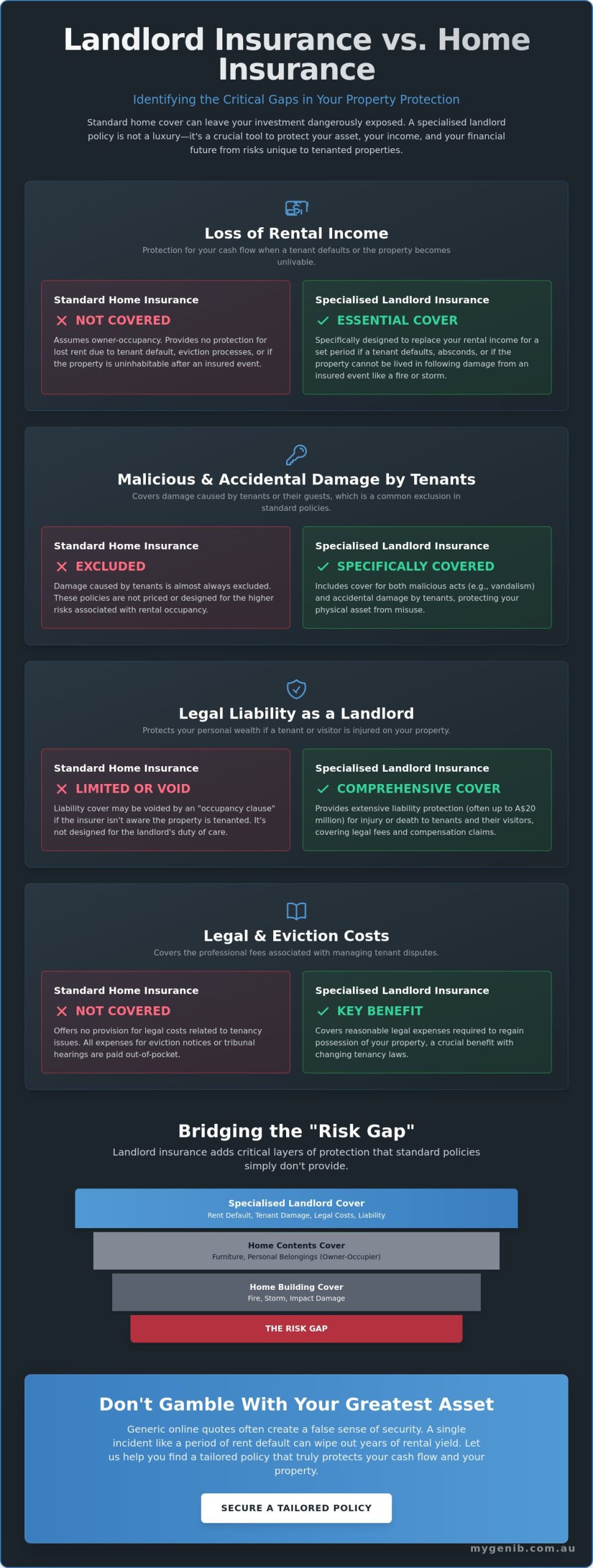
Landlord Insurance vs Home Insurance: Identifying the Critical Protection Gaps
Many investors assume their existing home insurance policy will simply stretch to cover a rental arrangement. This is a dangerous misunderstanding that often only comes to light when a claim is rejected. Standard home insurance is built on the premise of owner-occupancy; it assumes you are there to maintain the property and mitigate risks personally. Once you transition to a rental model, you have entered a commercial arrangement. Most home policies explicitly exclude business activities, meaning your protection could be voided simply because the property’s primary purpose has shifted from a private residence to an income-generating asset.
The “Occupancy Clause” is the most common point of failure for unwary landlords. If your insurer is not aware that the property is tenanted, you are likely paying for a policy that is technically invalid. Landlord insurance is specifically underwritten to account for the owner’s absence. It acknowledges that you cannot oversee every minor repair or tenant action in real time. Generic online policies often hide “silent” exclusions in the fine print, such as refusing cover for properties left vacant for more than 30 or 60 days between tenancies. We believe in looking beneath the surface to ensure these gaps do not leave you vulnerable during a transition period or a prolonged vacancy.
The Legal Liability Chasm
Your duty of care changes fundamentally when you become a landlord. You are now responsible for ensuring the premises are safe for someone else to live in, which includes everything from balcony railings to smoke alarm compliance. In Australia, the industry standard for legal liability is A$20 million; a figure that reflects the potentially catastrophic costs of a third-party injury claim. Landlord-specific liability covers incidents occurring within the tenanted area, whereas a standard home policy may only cover the owner’s personal actions or common areas. Working with a professional property manager helps mitigate these risks by ensuring regular inspections are documented, providing the vital evidence needed if a liability claim ever arises.
Short-Stay and Airbnb Considerations
Short-stay rentals present a unique set of challenges that traditional landlord insurance may not address. High-turnover occupancy increases the frequency of accidental damage and the complexity of identifying who is responsible for a loss. If you are using platforms like Airbnb, you must ensure your policy aligns with this specific use. Many standard landlord policies are designed for long-term leases of six to twelve months and may exclude “commercial holiday letting” entirely. We take the time to investigate your specific rental model, ensuring your protection is as dynamic as your investment strategy and that you aren’t left exposed by a policy designed for a different type of tenant.
Evaluating Your Risk: A Strategic Checklist for Property Owners
Risk assessment shouldn’t be a guessing game. We often see landlords rely on a “best guess” approach, which leaves them exposed when a disaster strikes. Assessing your property’s risk profile requires looking beyond the postcode to understand the specific variables of your investment. Whether you own a freestanding house in a bushfire-prone area or a city apartment, your landlord insurance needs to be as unique as the property itself.
Location is a primary driver of risk in the Australian market. We have seen the impact of floods and cyclones on rental yields, making it vital to ensure your policy doesn’t have restrictive exclusions for the very events likely to occur in your region. Similarly, your tenant profile dictates your exposure. A short-stay rental carries a higher risk of accidental damage compared to a long-term family lease, and your cover must reflect this reality to remain valid. Understanding these nuances allows you to move from a state of uncertainty to one of managed control.
The Strata Unit Complexity
If you own a unit, you might assume the body corporate has everything handled. While the strata insurance typically covers the building’s shell and common areas, it stops at your front door. You are still responsible for the internal fixtures like floorboards, split-system air conditioners, and kitchen cabinetry. Most importantly, you need your own liability cover for incidents that happen inside your unit, as the body corporate policy will not protect you if a tenant trips over a loose carpet in your lounge room. We recommend a thorough investigation of your strata bylaws to identify exactly where your personal responsibility begins.
Setting Your Sum Insured
Many landlords fall into the trap of setting their sum insured based on the property’s market value. In reality, you need to insure for the total replacement cost, which includes demolition, debris removal, and professional fees for architects and surveyors. These costs have risen significantly in recent years. Standard home insurance calculators often fall short for landlords because they don’t factor in the extended timeframe required to rebuild a tenanted property while simultaneously covering your lost rental income. To ensure your investment is accurately protected, you can review your specific risk profile with the MyGen team. Taking this step now prevents a devastating financial shortfall later.
The Broker Advantage: Navigating Complex Claims and Tailored Policies with MyGen
Speed is often the enemy of security. While automated platforms offer the convenience of a quote in minutes, they rarely provide the depth required to protect a sophisticated property portfolio. We see many landlords discover the hard way that a generic landlord insurance policy, bought via a three-minute online form, contains exclusions that leave them entirely exposed when it matters most. MyGen Insurance Brokers operates differently. We take a methodical, consultative approach to identify the specific risks your property faces, ensuring your protection is built on reality rather than assumptions.
Having a seasoned expert in your corner is most valuable during the claims process. When a crisis occurs, you shouldn’t have to navigate the fine print of an insurance company’s internal procedures alone. We act as your advocate, managing the investigation and placement process with a level of diligence that automated systems simply cannot replicate. Our team also provides access to specialised insurance markets that aren’t available to the general public, allowing us to source cover that truly aligns with your financial goals.
Beyond the “Online Quote” Culture
A broker looks beneath the surface of a standard Product Disclosure Statement (PDS) to find the clauses that might affect your specific claim. We provide professional advice on choosing an appropriate excess that balances your immediate costs with long-term security. This isn’t just about a single transaction; it’s about building a partnership that protects your entire property portfolio as it grows. We take the time to understand your long-term strategy, ensuring your cover evolves alongside your investment journey.
For investors who also manage assets internationally, particularly in the United Kingdom, independent brokers like justquoteme.co.uk offer a similarly bespoke approach to personal and business insurance solutions.
Your Protective Mentor in Insurance
MyGen Insurance Brokers simplifies the complex world of risk management, acting as a protective mentor for Australian investors. We provide a vision of security and clarity, turning what is often a high-friction experience into one that feels managed and effortless. Our goal is to remove the anxiety associated with tenant risks and property damage by providing a steady, experienced hand to guide you. If you are ready to move beyond generic quotes and secure your financial future, you can organise a consultation with MyGen Insurance Brokers to secure your investment. We will do the heavy lifting so you can focus on growing your assets with peace of mind.
Take Control of Your Property Portfolio
Securing a property is a long-term commitment that deserves more than a surface-level insurance policy. We have explored how the critical gaps in standard home cover can leave you exposed, especially when navigating the complexities of strata units or the shifting legislative landscape of 2026. True protection comes from looking beneath the surface to ensure your landlord insurance aligns perfectly with your specific tenant profile and rebuild costs.
At MyGen, we believe in a methodical approach to risk that prioritises your peace of mind over quick transactions. Broker Anthony Simpson brings over 20 years of industry experience to every personalised, consultative risk assessment. We focus exclusively on Australian property risks, providing the depth of investigation needed to secure your assets against the unexpected. You don’t have to manage these complexities alone. Discover how MyGen Insurance Brokers can protect your property investment and provide the clarity you need to grow your wealth with confidence. Your hard work deserves the protection of a seasoned expert who cares as much about your security as you do.
Frequently Asked Questions
Is landlord insurance compulsory in Australia?
No, landlord insurance is not legally compulsory in Australia, though it is often a requirement for investment property loans. While you aren’t mandated by law to hold a policy, the financial risks of fire, flood, or tenant default make it a vital component of a responsible investment strategy. It acts as a protective shield for your capital, ensuring a single incident doesn’t derail your long-term wealth goals.
Does landlord insurance cover damage caused by pets?
Many specialised policies do cover pet damage, but you should check the specific sub-limits and conditions in your Product Disclosure Statement. With Tasmania’s March 2026 law changes preventing blanket “no pets” rules, this cover is becoming increasingly important for owners across the country. We recommend ensuring your policy accounts for both accidental damage and malicious acts by animals to maintain full peace of mind.
What is the difference between building cover and landlord contents cover?
Building cover protects the physical structure of your property, while landlord contents cover is for the internal items you own, such as carpets, curtains, and light fittings. Even if your property is unfurnished, you still have significant assets inside that building-only policies often exclude. Contents cover ensures these fixtures are replaced if they’re damaged by a tenant or an insured event like a storm.
Can I claim for rent default if I don’t have a written lease?
Most insurers require a valid, written lease agreement to process a claim for rent default. Without a formal document outlining the rent amount and terms, it is difficult to provide the evidence needed to prove a financial loss occurred. Ensuring your paperwork is in order before a tenancy begins is a simple but essential step in securing your claim eligibility.
How much does landlord insurance typically cost?
The cost of landlord insurance varies significantly based on your property’s location, the type of dwelling, and the specific level of cover you choose. Factors such as regional environmental risks and the chosen excess will influence your premium. We believe in looking at the depth of the protection provided rather than just the lowest price, as a policy that fails to pay out during a claim represents the highest long-term risk to your portfolio.
Does landlord insurance cover the property if it is vacant between tenants?
Most policies provide cover during short vacancies, but they usually include a clause that limits this protection to a specific timeframe, often between 30 and 60 days. If your property remains empty for longer than the period specified in your policy, you must notify your insurer to ensure your protection remains active. We can help you navigate these vacancy clauses to prevent a “silent” exclusion from leaving your asset vulnerable between tenancies.
What happens if my property is part of a strata scheme?
If your property is under a strata scheme, the body corporate typically manages the building insurance for the entire complex. However, you are still responsible for your own legal liability, internal contents, and loss of rent. A specialised landlord insurance policy for strata units bridges the gap between common property cover and your personal investment risks inside the four walls of your unit.
How do I know if my sum insured is high enough to cover a total loss?
Your sum insured should reflect the total replacement cost, including current construction rates, demolition fees, and professional expenses like architect fees. We suggest avoiding market value as a guide, as it doesn’t account for the actual price of rebuilding in today’s market. A thorough investigation of your property’s specific requirements will help you set a limit that provides a true vision of security in the event of a total loss.