
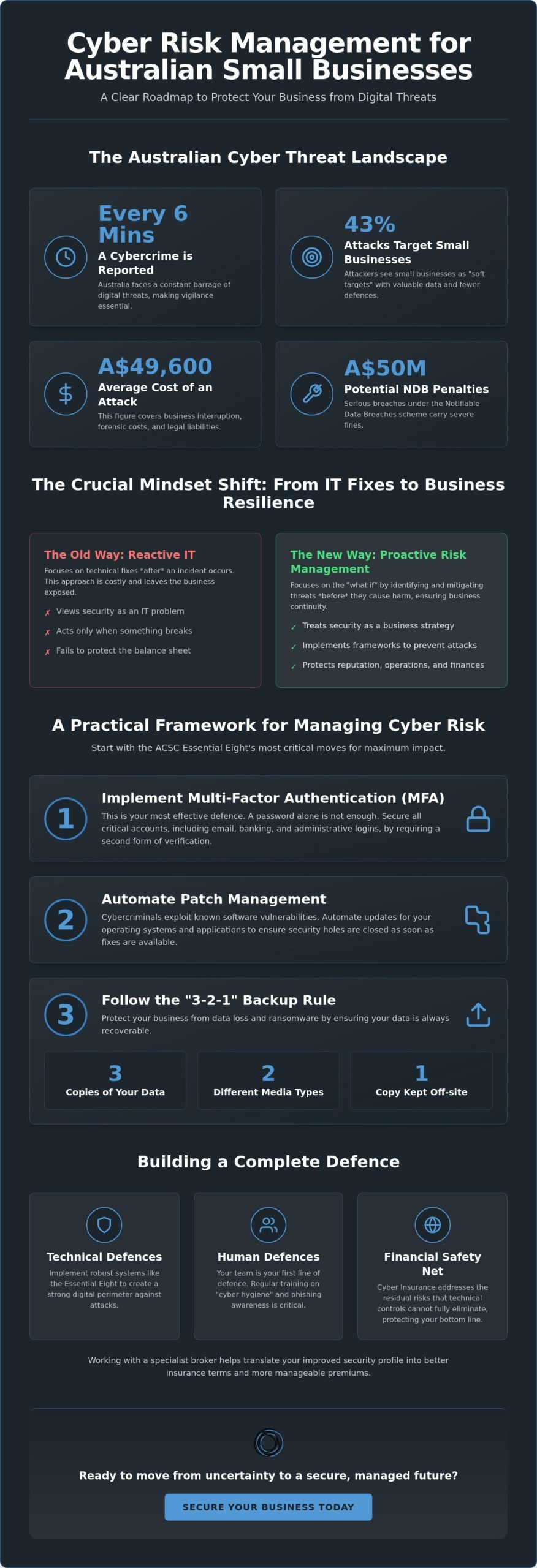
Did you know that a cybercrime is reported every six minutes in Australia, and that 43% of these attacks specifically target small businesses? We understand that the technical complexity of modern security can feel like a moving target, especially when you’re also managing the rising costs of insurance premiums. It’s completely natural to feel concerned about the impact a data breach could have on your reputation and your bottom line. We believe that robust cyber risk management for small business should be accessible, logical, and deeply protective of what you’ve built.
You’ll learn how to protect your Australian small business from digital threats using a strategic risk management framework and expert insurance advocacy. We’ve designed this guide to provide a clear, actionable roadmap that moves you away from technical confusion and toward a state of calm certainty. We will explore how to improve your risk profile to secure better insurance terms while ensuring your operations remain fully compliant with Australian privacy laws. Let’s transition from the stress of the unknown to a secure, managed future for your business.
Key Takeaways
- Understand why Australian small businesses are often viewed as “soft targets” and how to shift your mindset from reactive IT fixes to proactive business resilience.
- Discover how the ACSC Essential Eight provides a clear roadmap for security, prioritising high-impact actions like multi-factor authentication and patch management.
- Implement a practical framework for cyber risk management for small business that balances technical protection with the everyday realities of your local operation.
- Learn how cyber insurance serves as a vital safety net, addressing the residual risks that technical defences alone cannot fully mitigate.
- Explore how working with a specialist broker can help translate your improved security profile into better insurance terms and more manageable premiums.
Understanding the Cyber Threat Landscape for Australian Small Businesses
Effective cyber risk management for small business is far more than a simple software update; it is a methodical process of identifying, assessing, and mitigating digital threats to ensure your business continuity. In the local market, we often see small firms targeted by global syndicates who view Australian enterprises as “soft targets” with potentially weaker defences than larger corporations. These attackers often use a sophisticated framework for managing cyber risk to exploit vulnerabilities in supply chains, knowing that one small entry point can lead to a wealth of sensitive data.
To better understand the core principles of this process, watch this helpful video:
We distinguish between “hazard risks”, which are accidental events like hardware failure or employee error, and “adversarial risks”, which involve targeted, malicious attacks. Under the Notifiable Data Breaches (NDB) scheme, the consequences of failing to manage these risks are severe. Serious or repeated privacy breaches can now attract penalties of up to A$50 million for bodies corporate. This shift in legislation means digital security is now a matter of legal survival and brand reputation rather than just a technical preference.
The High Cost of Digital Vulnerability
The financial fallout from a breach often extends far beyond the initial incident. Ransomware can paralyse your daily operations, leading to significant business interruption that many small firms struggle to recover from. With the average self-reported cost of cybercrime for Australian small businesses reaching A$49,600 in the 2023-2024 financial year, the forensic costs and legal liabilities can quickly escalate. Protecting your cash flow requires a deeper look at your digital vulnerabilities before they are exploited.
Why Your “IT Guy” Isn’t a Risk Manager
There is a fundamental difference between maintaining your systems and managing the financial risk of those systems failing. While your IT professional focuses on the technical “how”, a risk manager focuses on the “what if”. This distinction is why Why Expert Insurance Brokers Provide More Value Than Automated Quotes in 2026, as they offer a consultative approach to protecting your balance sheet from the unexpected. We believe in moving beyond simple maintenance to achieve true peace of mind through professional advocacy.
A Step-by-Step Framework for Managing Cyber Risk
We recognise that staring at a list of technical requirements can feel overwhelming. However, building a resilient foundation for your business involves adopting the ACSC Essential Eight. This framework is widely regarded as the gold standard for Australian business security. It isn’t about doing everything at once; it’s about prioritising the actions that provide the most protection for your specific operation. By Understanding the Cyber Threat Landscape through this lens, you can move from a state of vulnerability to one of calculated resilience.
The Essential Eight: Where to Start
Effective cyber risk management for small business begins with three critical moves. First, implement Multi-factor Authentication (MFA) across all business email, banking, and administrative accounts. Second, automate your patch management to ensure software vulnerabilities are closed as soon as updates are released. Third, strictly follow the “3-2-1” backup rule:
- Keep three copies of your data.
- Store them on two different media types.
- Keep one copy off-site or in a disconnected, immutable cloud environment.
Your team is your first line of defence. Regular “cyber hygiene” programmes and awareness training help staff spot phishing attempts before they click. We recommend documenting these training sessions and security protocols thoroughly. This documentation creates a robust “risk profile” that underwriters respect, which is a key step when seeking competitive terms for your Cyber Insurance policy.
Assessing Your Third-Party Risks
Your security is only as strong as your weakest link, which often includes your cloud providers and software vendors. When you select a new digital service, you are essentially inheriting their risk level. For businesses looking to integrate health and safety compliance, choosing an award-winning platform like Be-Safe Technologies Ltd ensures that your operational risk management is supported by robust digital infrastructure. It’s vital to review contracts for cyber liability clauses to ensure you aren’t left exposed by a partner’s oversight. Taking these deliberate, methodical steps transforms security from a source of constant anxiety into a managed, professional business process.
How Cyber Insurance and Expert Advocacy Complete Your Defence
No matter how diligently you implement technical controls, it is impossible to eliminate digital risk entirely. We view insurance as the essential “residual risk” solution; it is the safety net that catches your business when a sophisticated threat manages to bypass your primary defences. Integrating a robust policy into your cyber risk management for small business strategy ensures that a single incident doesn’t become a terminal event for your operation. By following professional guidance, such as CPA Australia’s cybersecurity tips, you build a foundation that makes your business far more attractive to the insurance market.
A comprehensive Cyber Insurance policy provides much more than just a financial payout. It offers immediate access to specialised incident response teams, including forensic investigators, PR consultants, and legal experts who specialise in Australian privacy law. We take a consultative approach, looking beneath the surface of your daily operations to find a level of cover that is truly suitable for your specific needs, rather than a one size fits all solution.
The Broker Advantage in a Hard Market
The current insurance market is increasingly selective about the risks it chooses to cover. At MyGen, we act as your protective mentor and advocate, presenting a superior risk profile to a panel of underwriters to secure the best possible terms. Generic, automated quotes often fail to account for specific digital liabilities or the nuances of your industry. We do the heavy lifting to ensure your technical security efforts are translated into lower premiums and broader protection.
Preparing for Renewal: The 60-Day Review
We recommend a proactive review of your security controls at least 60 days before your policy is due for renewal. This timeframe allows us to identify any gaps in your cyber risk management for small business and address them before underwriters assess your application. It’s also a vital time to ensure your Professional Indemnity Insurance is correctly aligned, as these two areas often overlap in the event of a data-related claim. This methodical approach turns a complex renewal process into a moment of clarity and renewed security.
Securing Your Business Legacy for the Digital Age
We’ve explored how the landscape of digital threats is evolving and why a structured approach to cyber risk management for small business is no longer optional. By adopting the Essential Eight and understanding your regulatory obligations under the NDB scheme, you’ve already taken the first steps toward protecting your livelihood. It’s about moving from a state of constant worry to one where you are in control of your digital destiny. We understand that this journey requires a steady, experienced hand to ensure no detail is overlooked.
We believe that every Australian business deserves a protective mentor who looks beneath the surface of generic policies. Led by Anthony Simpson, who brings over 20 years of industry experience, our team provides specialist expertise in Cyber Insurance and Professional Indemnity. We reject the “tick and flick” nature of automated quotes in favour of a personalised, consultative approach that truly secures your future. You don’t have to navigate these complexities alone.
To ensure your business remains resilient and ready for whatever comes next, secure a personalised cyber risk consultation with MyGen Insurance Brokers. We are here to help you turn technical confusion into professional certainty, giving you the peace of mind to focus on growing your business with confidence.
Frequently Asked Questions
What is the ACSC Essential Eight and does my small business really need it?
The ACSC Essential Eight is a prioritised set of mitigation strategies developed by the Australian Signals Directorate to protect organisations against various cyber threats. While it serves as the baseline for government agencies, it’s a vital framework for any local business looking to build a resilient defence. Implementing these strategies significantly reduces your vulnerability, making it a cornerstone of effective cyber risk management for small business.
Will my standard business insurance cover a cyber attack or data breach?
Most standard business insurance policies don’t provide comprehensive cover for cyber incidents and often contain specific exclusions for digital theft or ransomware. Traditional property or liability policies were never designed to handle the complexities of data recovery, forensic investigations, or mandatory notification costs. To ensure your balance sheet is truly protected, you need a dedicated policy that specifically addresses these modern digital liabilities.
How much does cyber insurance typically cost for an Australian small business?
The cost of your premium is influenced by several factors, including your annual turnover, the volume of sensitive data you manage, and the maturity of your internal security controls. We avoid generic, one size fits all pricing because every business has a unique risk profile. By demonstrating a commitment to cyber risk management for small business, such as reaching a higher maturity level in the Essential Eight, you can often secure more competitive terms from underwriters.
What is the most common cyber threat facing Australian businesses in 2026?
Ransomware and sophisticated, AI-driven phishing attacks remain the most persistent threats to Australian enterprises this year. With a cybercrime now reported every six minutes across the country, attackers are using increasingly personalised methods to bypass traditional filters. These adversarial risks are designed to exploit human curiosity or urgency, which is why we emphasise that your staff training is just as protective as your technical software.