
Imagine arriving at your warehouse on a Monday morning to find a fire has decimated your inventory and halted your operations for months. While your property insurance might replace the physical assets, it’s the silent, compounding loss of revenue that often poses the greatest threat to your future. We know the gut-wrenching anxiety of watching your cash flow vanish while the pressure to pay your loyal staff and meet fixed costs remains unchanged. It’s a heavy burden to carry, especially when you’re already trying to make sense of complex ATO documentation and conflicting financial definitions.
To help you find a sense of certainty, we’ve gathered several business interruption insurance claim examples australia wide to show you exactly how this protection works in practice. We’ll guide you through the confusing gap between accounting and insurance gross profit, explain how to choose a realistic indemnity period, and provide a clear framework for surviving a catastrophic event with your business intact. By looking beneath the surface of these real-world scenarios, we can help you move from a state of confusion to a position of quiet confidence.
Key Takeaways
- Understand how business interruption insurance acts as a vital financial bridge, replacing the revenue your assets would have generated during a recovery period.
- Explore real-world business interruption insurance claim examples australia wide to see how policies respond to everything from local fires to major supplier disruptions.
- Learn to navigate the “Gross Profit Trap” by distinguishing between standard accounting definitions and the specific calculations required for an accurate insurance claim.
- Identify hidden “Dependency Risks” within your supply chain that could halt your operations even if your own physical premises remain untouched.
- Discover the long-term value of a professional risk assessment over generic automated quotes when protecting your business’s unique cash flow requirements.
What is Business Interruption Insurance? Defining Continuity in Australia
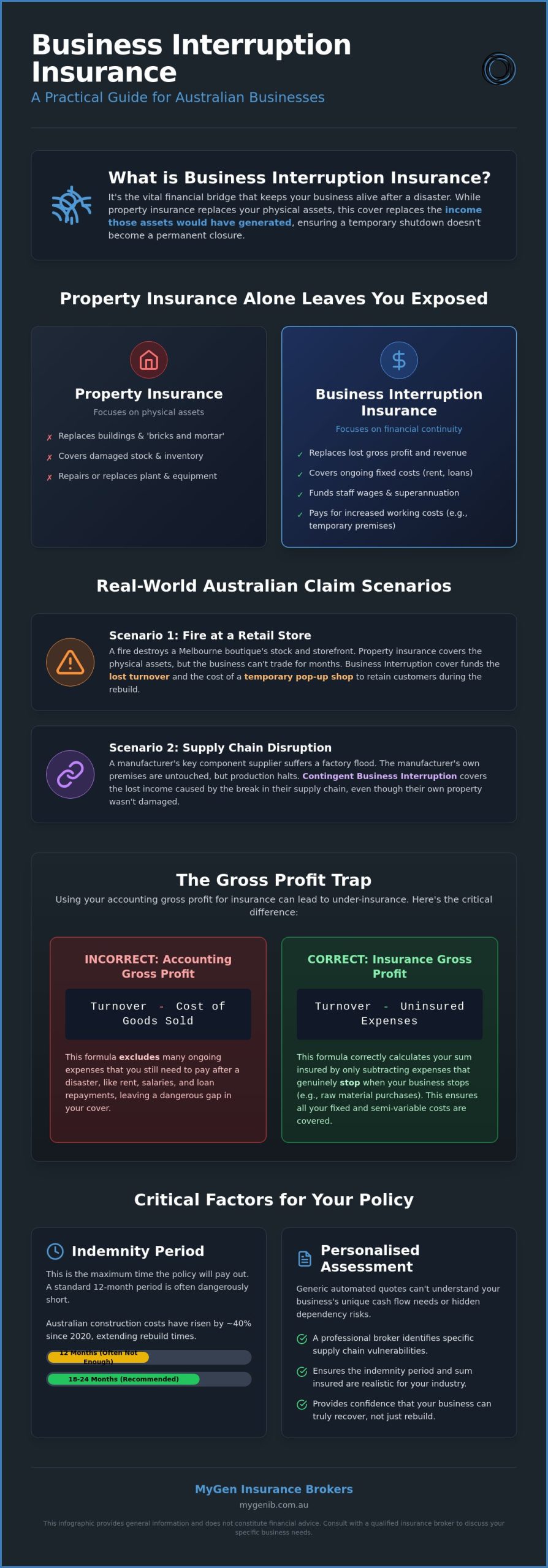
We often see business owners focus solely on their physical assets, but Business interruption insurance is the vital financial bridge that keeps your operation alive when those assets are damaged. While property insurance focuses on the bricks and mortar, this cover is specifically designed to replace the revenue those assets would have generated. It ensures that a temporary shutdown doesn’t become a permanent closure by maintaining your cash flow when you need it most.
When we look at business interruption insurance claim examples australia wide, the triggers are often sudden and devastating. Whether it’s a devastating storm, a fire at your premises, or other unforeseen events, the physical damage is only the beginning of the story. The true value of this cover lies in the concept of Business Continuity. This is the methodical process of returning your business to the exact financial position it would have occupied had the loss never occurred, rather than just replacing a few pieces of equipment.
To help you visualise how this fits into your recovery plan, watch this breakdown of the claims process:
Why Property Insurance Alone Leaves You Exposed
Rebuilding a physical storefront might take six months, but reclaiming your customer base can take much longer. During that period, your fixed costs don’t simply vanish. You still need to manage rent, interest on business loans, and your payroll. We find that many Australian SMEs struggle with staff retention during a claim. Having the funds to pay wages and meet superannuation obligations is critical for keeping your skilled team together while you rebuild, ensuring you have a business left to run once the repairs are finished.
Who Needs This Protection?
Any business where downtime leads to an immediate loss of income should consider this a priority. This is particularly true for retail, hospitality, and manufacturing sectors where a single day of closure can disrupt complex supply chains or lead customers to a competitor. Securing this cover is a cornerstone of a robust business insurance strategy, providing the peace of mind that your cash flow is protected even when your doors are temporarily closed.
Business Interruption Claim Examples and the Gross Profit Trap
Understanding how these policies function in practice is the best way to prepare your own business for the unexpected. Consider a boutique retail store in a Melbourne shopping centre that suffers a significant fire. While property cover replaces the charred stock, the business interruption component covers the lost turnover while the storefront is rebuilt. It also funds the “additional increase in cost of working,” such as the expenses involved in relocating to a temporary pop-up site to keep your customers engaged. If you are planning a high-end restoration using materials like natural stone cladding, click here to explore the premium options available from Korbon Kft. These business interruption insurance claim examples australia wide demonstrate that survival depends on much more than just replacing physical goods.
Another common scenario involves a manufacturer whose primary component supplier suffers a catastrophic loss. Even if the manufacturer’s own premises are untouched, they cannot produce their goods because their supply chain has been severed. This is known as Contingent Business Interruption. When making a business interruption claim, your Business Activity Statements (BAS) become critical evidence. They provide the insurer with a transparent, historical record of your trading performance to justify the payout. However, with Australian construction costs rising by approximately 40% since 2020, a standard 12-month indemnity period is often a dangerous underestimate. Rebuilding and regaining your market share now frequently takes 18 to 24 months.
Accounting vs. Insurance Gross Profit: The Critical Difference
The most frequent mistake we see is using standard accounting “Gross Profit” for your sum insured. In insurance terms, Gross Profit is your turnover minus only those “uninsured working expenses” that genuinely stop when you stop trading, such as raw materials or freight. Many businesses inadvertently use their P&L figures, which often leads to a 30-50% underinsurance shortfall. If you’re unsure if your current policy reflects your true risk, we recommend you speak with us about your business insurance to ensure your calculations are accurate.
Retaining Your Team: Payroll and Superannuation
Your team is your most valuable asset. Losing them during a shutdown can be a death knell for your company. A well-structured policy allows you to continue paying staff salaries and essential superannuation obligations even while revenue is zero. This prevents your skilled employees from seeking work with competitors, ensuring that when your doors finally reopen, you have the experienced hands on deck required to hit the ground running.
The Broker Advantage: Personalised Risk Assessment vs. Automated Quotes
While an automated online quote might seem like a time-saver, it often operates on a “tick and flick” basis that ignores the nuances of your specific operation. We believe that true protection requires a deep-dive into your business’s unique DNA. A consultative broker doesn’t just look at your turnover; they investigate the intricate web of your supply chain and the physical environment surrounding your premises. This level of diligence transforms your insurance from a generic expense into a precision tool for survival.
A critical part of this process is identifying “Dependency Risks.” You might assume you’re safe if your building is fire-resistant, but what happens if a major fire at a neighbouring warehouse blocks access to your street for three weeks? By studying business interruption insurance claim examples australia wide, we’ve seen how precinct closures and utility failures can be just as damaging as a direct fire. A professional risk assessment uncovers these hidden vulnerabilities before they become a crisis, ensuring your policy is triggered even when the damage isn’t on your doorstep.
When a loss does occur, your broker steps in as your dedicated claims advocate. Navigating the complex investigation process and documentation requirements can be overwhelming when you’re already trying to manage a recovery. We take on that heavy lifting, using resources like the Insurance Council of Australia claim checklist to ensure your submission is thorough and accurate. This allows you to focus on your staff and operations while we work to secure your full entitlement.
Looking Beneath the Surface: Supply Chain Extensions
For Australian trade and logistics businesses, “Suppliers and Customers Extensions” are often the difference between a successful claim and a total loss. Automated systems frequently miss these extensions, leaving you exposed if a key client or supplier goes offline. We identify these dependencies to ensure your policy covers the full scope of your trading relationships, providing a safety net that reaches far beyond your own front door.
Why Expertise Matters in 2026
The Australian market is currently facing a unique set of challenges, from shifting economic conditions to the rising frequency of extreme weather events. Since 2020, these disasters have led to over $4.5 billion in insurance claims, putting immense pressure on premiums and policy wording. We understand that insurance brokers are more essential than ever in this climate, providing the expert guidance needed to ensure your cover remains fit for purpose as conditions change. Investing in professional advice today provides the certainty you’ll need when the unexpected happens.
Protecting Your Future with Precision and Care
Understanding the nuances of your cash flow is the first step toward true resilience. We’ve seen how the right calculations for insurance gross profit and a realistic indemnity period can mean the difference between a temporary setback and a permanent closure. By exploring these business interruption insurance claim examples australia wide, you’ve taken a significant step toward moving from uncertainty to a place of managed risk and professional clarity.
At MyGen Insurance Brokers, we bring over 20 years of industry experience to every consultation. Our national team takes a deeply personal approach to complex risk management, ensuring that your specific supply chain vulnerabilities are identified and protected. We don’t believe in generic solutions; we believe in doing the heavy lifting to secure your peace of mind. To ensure your business is genuinely prepared for whatever the future holds, speak with a MyGen Insurance Brokers expert for a personalised risk assessment today. We’re here to act as your steady, experienced hand, guiding you toward a simplified and secure outcome.
Frequently Asked Questions
What is the difference between accounting and insurance gross profit?
In Australian accounting, gross profit is traditionally calculated as sales minus the cost of goods sold, but insurance definitions are much broader to ensure your fixed costs are fully covered. This includes non-variable expenses such as rent and staff wages that persist even when trading stops. Relying on your accounting figures when setting up a policy is a primary cause of underinsurance, as it often overlooks the full range of revenue required to keep the business viable during a shutdown.
How long should my indemnity period be for an Australian business?
While a 12-month indemnity period is a common choice, it’s often insufficient for a full recovery in the current Australian market. You must account for the time required for site clearing, council planning approvals, and the actual rebuild, alongside the period needed to reclaim your customer base. With construction and supply chain delays being a reality in 2026, many local firms now find that an 18 or 24-month period provides the necessary buffer to reach their previous financial position.
Is business interruption insurance tax-deductible in Australia?
Premiums for business interruption cover are generally a tax-deductible business expense for most Australian companies. Because the purpose of the policy is to replace lost profits, any claim settlement you receive is typically treated as assessable income by the ATO. We always suggest reviewing business interruption insurance claim examples australia with your tax professional to understand how a potential payout might impact your specific financial situation and reporting obligations.
Does business interruption cover me if a major supplier burns down?
Standard policies typically require physical damage to occur at your own premises, but you can be protected through a “Suppliers Extension” or “Contingent Business Interruption” cover. This specific extension ensures your cash flow remains protected if a key supplier or a nearby anchor tenant suffers a loss that halts your trading. It’s a vital consideration for businesses that rely on a single source for materials or high foot traffic from a neighbouring shopping centre.