
The Australian legal system doesn’t offer a “small business discount” when it comes to personal liability. You might assume that because you aren’t running a Top 50 ASX firm, your personal assets are shielded by the company structure, but the reality is that ASIC and the ATO hold you to the same rigorous standards as a blue-chip CEO. If you’ve ever asked yourself, “do I need directors and officers insurance for a small company,” you’re likely feeling the weight of that responsibility. We understand the confusion that comes from trying to separate your private life from your professional duties, especially when your family home feels like it’s on the line during a regulatory shift or an unforeseen dispute.
Protecting your hard earned assets shouldn’t be a privilege reserved for corporate giants. In this guide, you’ll discover why personal liability doesn’t scale down just because your headcount is smaller and how the right cover protects your personal assets from professional risks. We’ll explore the impact of 2026 legislative changes, such as the “Payday Super” rules and the significant rise in Director Penalty Notices, to ensure you have total clarity on your legal obligations. By looking beneath the surface of standard policies, we can help you find a sense of certainty that your personal future remains secure while you focus on the daily life of your business.
Key Takeaways
- Uncover why the “corporate veil” is often a myth for small business owners and how regulators can bypass it to reach your personal wealth.
- Resolve the confusion around the question “do I need directors and officers insurance for a small company” by pinpointing the management risks that directly threaten your family home.
- Discover why a broader Management Liability policy is typically a more suitable and protective shield for Australian SMEs than standalone D&O cover.
- Learn why relying on automated, generic insurance quotes can leave you with dangerous gaps and why a deeper, investigative approach is essential for your security.
Understanding the Risk: Why Small Company Size Doesn’t Equal Small Liability
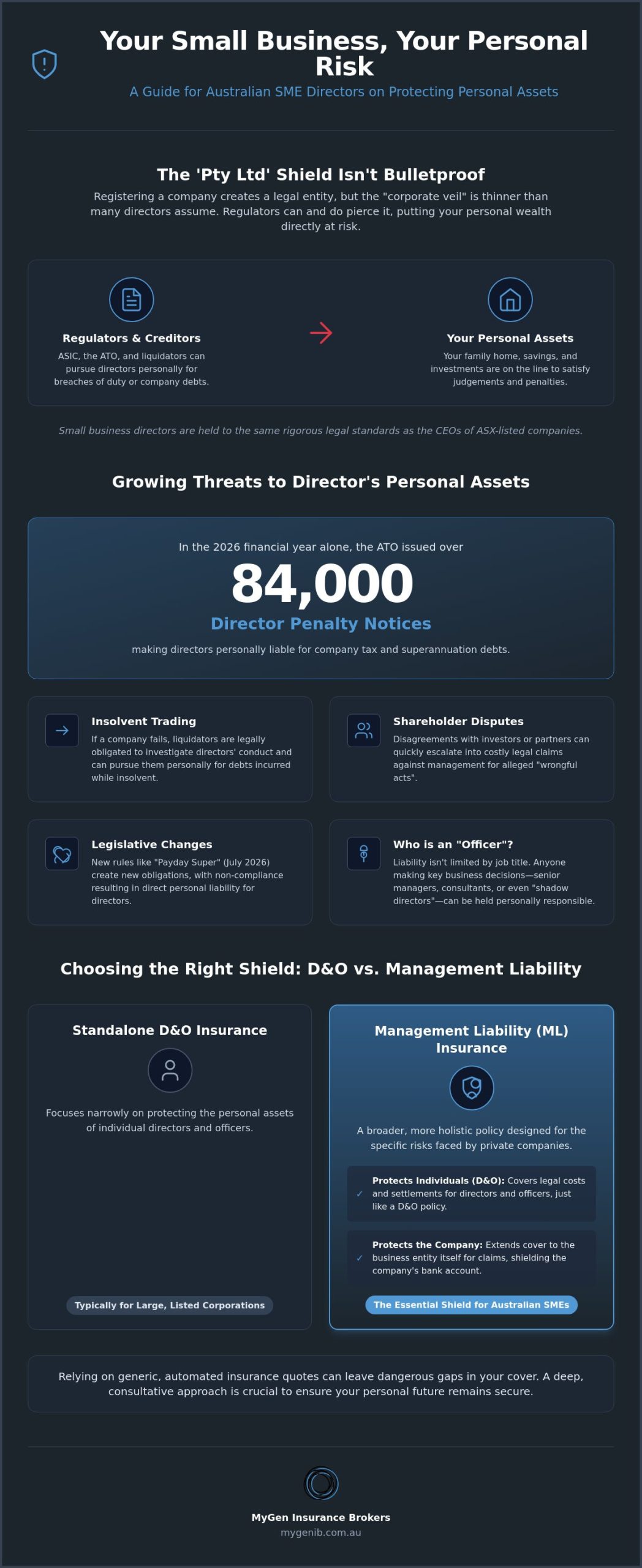
Many Australian business owners believe that registering a “Pty Ltd” company creates an impenetrable wall between their business debts and their personal bank account. This is a dangerous misconception often referred to as the myth of the corporate veil. While a company is a separate legal entity, the Corporations Act 2001 contains specific provisions that allow regulators and creditors to look past that entity if they believe a director has failed in their duties. If you’ve been asking yourself, “do I need directors and officers insurance for a small company,” it’s likely because you’ve sensed that the shield of incorporation isn’t as sturdy as it once seemed.
This is where Directors and Officers (D&O) liability insurance serves as a vital second line of defence. It acts as a protective shield designed to cover the legal costs and potential settlements arising from alleged “wrongful acts” committed while managing the firm. ASIC doesn’t offer a lighter touch for local family businesses; the legal standard of care and diligence required of you is identical to that of a blue-chip executive. When you’re in the driver’s seat, your decisions are subject to intense scrutiny, regardless of your company’s turnover.
To better understand this concept, watch this helpful video:
Claims against small firms often stem from high-friction events like shareholder disputes or insolvency proceedings. When a business faces financial distress, liquidators are legally obligated to investigate the conduct of the directors. If they find evidence of insolvent trading or a breach of duty, they can pursue you personally for the shortfall. Regulatory breaches are another common trigger. For instance, the ATO has significantly increased its enforcement, issuing over 84,000 Director Penalty Notices in the 2026 financial year. These notices make you personally liable for company tax debts, including the new “Payday Super” obligations that commenced in July 2026.
The Personal Cost of Management Decisions
A lawsuit isn’t just a business expense; it’s a direct threat to your family home and personal savings. When you’re named personally in a legal action, your private assets are on the line to satisfy a judgment. We’ve seen the emotional toll this takes on directors who must defend themselves without professional support. The stress of an ASIC investigation or a disgruntled shareholder’s claim can be overwhelming, especially when your personal future feels tied to the outcome of a complex legal battle.
Beyond insurance, maintaining a robust financial foundation for your property is another key part of asset protection; if you are based in South-East Queensland, you can visit Brisbane City Home Loans to discuss your mortgage needs with a specialist.
Who is Considered an “Officer”?
Don’t be misled by job titles. You don’t need “Director” on your business card to be legally exposed under the law. Under Australian law, an officer is any person who makes, or participates in making, decisions that affect the whole, or a substantial part, of the business. This means senior managers, consultants, or even shadow directors can find themselves in the firing line for management decisions just as easily as those listed on the official ASIC register. It’s about the influence you wield, not the title you hold.
D&O vs. Management Liability: Choosing the Right Shield
When you’re researching whether you need directors and officers insurance for a small company, you’ll often find two terms used interchangeably: D&O and Management Liability. We find this creates a fair bit of confusion for business owners who just want to know they’re safe. In the Australian market, standalone D&O is typically reserved for large, listed corporations. For a private SME, D&O is usually just one component of a broader Management Liability (ML) policy. While D&O focuses on protecting the individual (often referred to as Side A and Side B cover), a Management Liability policy extends that protection to the company entity itself, known as Side C cover. It’s a more holistic way of mitigating personal liability while also shielding the business’s own bank account.
It’s also vital to distinguish these management risks from the advice based risks covered by Professional Indemnity Insurance. While Professional Indemnity covers you for errors in the expert services you provide to your clients, Management Liability focuses on how you run the company behind the scenes. One looks outward at your professional output; the other looks inward at your governance, leadership, and regulatory compliance. If you’re feeling unsure about where your specific risks lie, we can help you review your business insurance to ensure your coverage is as deep as it needs to be.
What Management Liability Adds for Small Businesses
For a small Australian firm, the biggest management risks often involve the people you employ. Employment Practices Liability (EPL) is a standard feature of ML policies that protects you against claims of unfair dismissal, bullying, or harassment. With the Fair Work Commission’s unfair dismissal compensation cap set at $91,550 for the 2025-2026 period, a single claim can be devastating for a small firm’s cash flow. ML also includes Statutory Liability. This is designed to cover the costs of defending your business against fines or penalties from government regulators, such as WorkSafe or environmental agencies, where such fines are legally insurable.
The “Claims-Made” Nature of the Policy
These policies operate on a “claims-made” basis, which is a concept we always take the time to explain thoroughly. It means the policy that is active at the time a claim is actually made is the one that must respond, regardless of when the alleged mistake occurred. You must notify your broker the moment you become aware of a potential issue, not just when a formal legal writ arrives. If you decide to sell your business or retire, we always recommend “run-off” cover. This ensures you’re still protected for several years after you’ve finished up, preventing a past management decision from threatening your future financial peace of mind.
Securing Your Leadership: The MyGen Consultative Approach
Many small business owners gravitate towards instant, automated quotes because they seem efficient. However, these “tick and flick” systems often fail to ask the deeper questions about your specific business structure or industry risks. They might offer a low premium but hide restrictive sub-limits or broad exclusions that only come to light when you try to lodge a claim. We believe that when you’re deciding do I need directors and officers insurance for a small company, you deserve more than a generic algorithm. You need a solution that actually fits the unique shape of your leadership and provides genuine relief from the stress of personal liability.
Our approach is built on looking beneath the surface. We take the time to understand your governance processes, which often makes your risk more attractive to underwriters and can lead to better coverage terms. As noted in the Australian government guide to business insurance, Management Liability is a complex area where cover needs to match the specific exposures of your firm. By organising your internal records and compliance history, we position you as a high-quality risk, ensuring you aren’t paying for coverage gaps or unnecessary extras that don’t serve your goals.
Securing your management risks is just one piece of the puzzle. To see how D&O fits into your broader safety net, we suggest exploring our comprehensive guide to business insurance. This holistic view helps you transition from a state of uncertainty to one of complete clarity, knowing that every angle of your professional life is being watched over by experts who care about your long-term security.
Beyond the Policy: Risk Management as a Partnership
We don’t see ourselves as just another service provider. We act as a protective mentor, standing by your side when things get difficult. Having a seasoned hand to guide you through a complex claim or an ASIC inquiry provides a level of peace of mind that a faceless, distant entity simply can’t offer. We value long-term security over quick, generic transactions, focusing on the depth of our relationship with you rather than just the volume of policies we write.
Getting Started Without the Stress
Taking the first step shouldn’t feel like an administrative chore. We skip the exhausting, repetitive paperwork in favour of a professional, supportive conversation that gets to the heart of what you need to protect. It’s about turning a high-friction experience into something that feels managed and effortless. Speak with Anthony and the team at MyGen today for a personal risk assessment and let us do the heavy lifting to keep your personal assets safe.
Protecting Your Professional Legacy and Personal Peace of Mind
If you’ve been wondering, do I need directors and officers insurance for a small company, the answer lies in the reality that your personal assets don’t scale down with your business size. We’ve explored how the corporate veil is far from impenetrable, especially with the recent surge in regulatory scrutiny and personal liability for tax obligations. Transitioning from a standalone D&O perspective to a broader Management Liability framework allows you to protect your family home while securing the business you’ve worked so hard to build. To ensure your personal property financing is as robust as your insurance, you may wish to learn more about Quantum Brokers and their expert finance solutions. It’s about ensuring your leadership is backed by a shield that actually holds up under pressure.
We pride ourselves on being a proudly Australian owned and operated firm with over 20 years of experience helping directors navigate these complexities. Our team avoids the superficiality of automated bots, opting instead for a personalised, consultative approach that respects the unique structure of your firm. We’re here to do the heavy lifting, ensuring your transition from confusion to clarity is effortless. Request a Personalised Business Insurance Consultation with us today. You deserve the peace of mind that comes from having a seasoned, local expert in your corner.
Frequently Asked Questions
Is D&O insurance compulsory for small companies in Australia?
No, holding D&O insurance isn’t a compulsory legal requirement for small companies under Australian law. Unlike Workers Compensation, you aren’t mandated to have it, but the absence of this cover leaves your personal wealth directly exposed. We often find that directors only recognise the value of this protection when a regulatory inquiry or a shareholder dispute lands on their desk, making the strategic decision to hold cover early a vital step for your long term security.
What is the difference between Professional Indemnity and D&O insurance?
Professional Indemnity covers you for errors in the expert services or advice you provide to your clients, whereas D&O focuses on your conduct as a manager. If a client sues you for a faulty project, that’s a PI matter. However, if you’re asking “do I need directors and officers insurance for a small company,” you’re likely concerned about internal governance, regulatory breaches, or employment disputes that PI simply won’t cover.
Can a small business director be sued personally if the company is insolvent?
Yes, you can be held personally liable for debts incurred if your company continues to trade while it’s insolvent. Under the Corporations Act, liquidators have a legal duty to recover funds for creditors, and they can pursue your private assets, including the family home, to settle those debts. This is one of the most common scenarios where a robust insurance policy acts as a final line of defence for your personal financial future.
Does D&O insurance cover criminal acts or fraud?
No, D&O insurance does not cover proven criminal acts, deliberate fraud, or dishonest conduct. While your policy may provide an initial allowance for legal defence costs during an investigation, these funds must generally be repaid if a court eventually finds you guilty of a criminal offence. The cover is specifically designed to protect you against “wrongful acts” such as negligence, errors in judgement, or accidental breaches of duty while managing the firm.