
Is a tax deduction really a win if your insurance policy leaves you exposed to the risks that could derail your financial future? We know that as property costs rise and the ATO sharpens its focus on 2026 compliance, the desire to trim your taxable income is both natural and necessary. It’s frustrating to overpay for cover, yet the fear of an unexpected audit or a rejected claim creates constant stress. You shouldn’t have to choose between a smaller tax bill and a safe investment, so we’ve designed this guide to help you master the landlord insurance tax deduction australia requirements with absolute certainty.
We’ll explain exactly how to claim your premiums while ensuring your investment property is genuinely protected. You’ll learn to manage new data-matching rules and move from tax-time confusion to a state of total clarity by looking beneath the surface of your policy to ensure it’s truly fit for purpose.
Key Takeaways
- Confirm the specific ATO criteria to secure a valid landlord insurance tax deduction australia while ensuring your property is genuinely available for rent.
- Learn how to organise your records to satisfy the ATO’s expanded data-matching programs and protect yourself from the stress of an audit.
- Discover why a cheap, automated policy might be tax-deductible but could still leave you with a massive out-of-pocket loss when you need to claim.
- Understand why looking beneath the surface of your policy is essential to ensure critical risks like rent default and malicious damage are truly covered.
Is Landlord Insurance Tax Deductible? Understanding ATO Rules
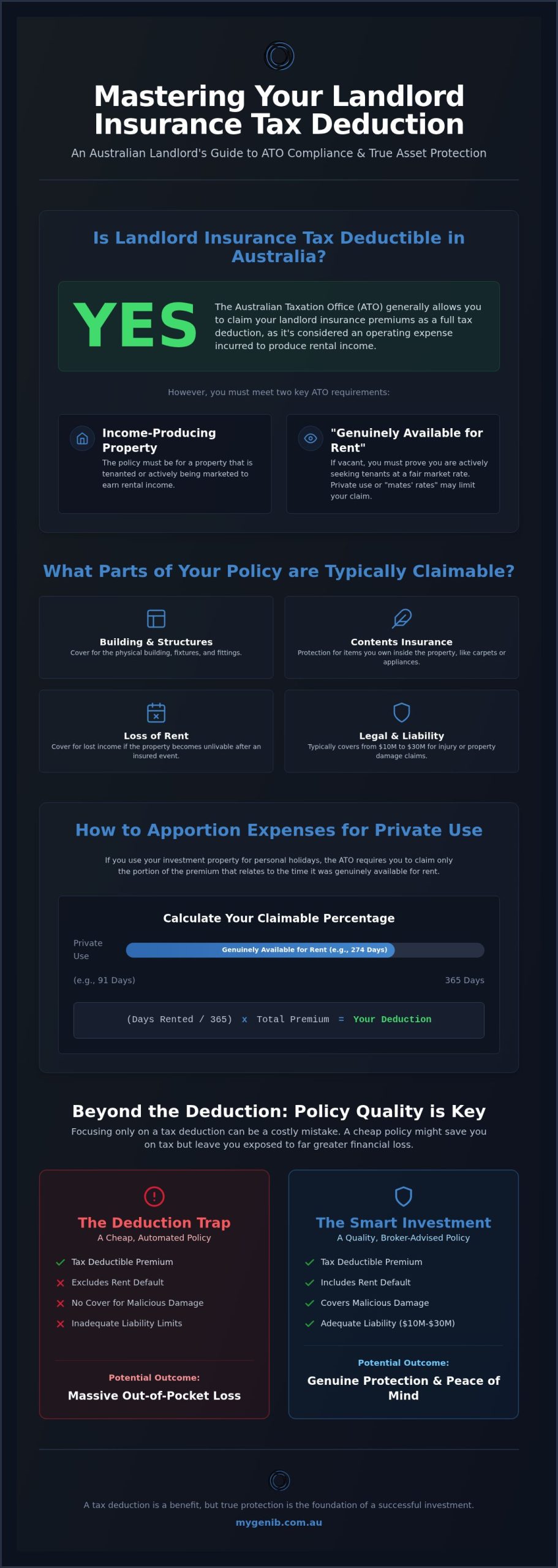
Dealing with property expenses can feel like a never-ending cycle, but the Australian Taxation Office (ATO) provides a clear path for relief. Generally, you can claim your landlord insurance premiums as a fully deductible operating expense. This is because the ATO views these costs as a revenue expense, meaning they’re incurred in the daily process of earning rental income rather than being a one-off capital cost used to improve the property’s value. Treating insurance as an immediate deduction acknowledges that it’s a recurring cost necessary for protecting your current income stream, not a permanent addition to the asset’s structure.
To secure a landlord insurance tax deduction australia, the core requirement is that your policy must directly relate to a property used to produce assessable income. This deduction isn’t limited to just one part of your cover; it typically spans the full breadth of your policy, including building and contents protection, loss of rent, and landlord liability. By including these costs in your annual return, you’re essentially Understanding Negative Gearing principles to offset your ownership costs against your total income. We’ve helped many clients realise that while insurance is a non-negotiable safeguard, its tax-effective nature helps soften the blow to your cash flow.
The “Genuinely Available for Rent” Requirement
You can’t claim these deductions if the property is purely for private use. To satisfy the ATO, your investment must be tenanted or “genuinely available for rent” at market rates. This means if your property is vacant, you must show you’re actively marketing it through a property manager or online listings. We’ve seen owners get caught out during short vacancy periods, so keeping copies of your advertisements and correspondence with agents is vital to proving your intent to the tax office. If you’re only renting the home to family at a “mates’ rate” below market value, your deduction may be limited or denied entirely.
Maximising Your Claims: How to Organise Your Deductions
Staying organised is the best way to ensure you don’t miss out on legitimate savings at tax time. We recommend keeping a dedicated digital folder for all premium payments, including the policy schedule and the specific tax invoices your broker sends. Generally, you claim these costs in the financial year you pay them. If you decide to pay for several years of cover in one hit, you’ll need to spread that deduction across those years to stay within the rules. This methodical approach ensures your landlord insurance tax deduction australia remains accurate and defensible. For those managing commercial rental portfolios alongside residential ones, our complete guide to business insurance in Australia offers deeper insights into protecting larger assets.
Apportioning Expenses for Holiday Homes and Private Use
If you use your investment property for personal holidays, you can’t claim the full premium amount. The ATO requires you to reduce your deduction proportionally based on private usage. You can calculate your claimable percentage in three simple steps. First, count the total days the property was tenanted or genuinely available for rent. Second, divide that number by the total days in the year. Finally, multiply your total premium by that figure to find your claimable amount. It’s a logical process that prevents errors during an audit. We believe that getting these details right is about more than just tax; it’s about the peace of mind that comes from total compliance. If you’re feeling overwhelmed by the fine print, connecting with a seasoned broker can help simplify the process.
Beyond the Deduction: Why Policy Quality Protects Your Long-Term ROI
Focusing solely on a landlord insurance tax deduction australia can lead to a dangerous trap. While the ATO allows you to claim your premium, a cheap, automated policy might leave you with a massive out-of-pocket loss when you actually need to claim. We’ve seen many investors choose the lowest price only to find that rent default or malicious damage is excluded in the fine print. An expert broker acts as a protective mentor, investigating the nuances of landlord insurance to ensure your ‘deductible’ expense is actually a sound investment. We check that your legal liability coverage, which typically ranges from $10 million to $30 million, is adequate for your specific risk profile.
Consultative risk management is about looking beneath the surface. It’s not just about the tax return; it’s about selecting a policy that balances the cost of the premium with the specific level of protection your asset requires. This deep-dive approach ensures you aren’t just checking a box for your accountant but truly securing your financial future. We believe a policy that doesn’t perform during a crisis is no bargain, regardless of its tax status.
The Value of a Personalised Insurance Review
“Tick and flick” online quotes often miss critical risks that a human expert identifies. Whether it’s the specific complexities of a strata title or regional environmental factors, automated systems simply don’t have the depth to provide total security. At MyGen Insurance Brokers, we simplify this by doing the heavy lifting for you. We provide the exact documentation your accountant needs at tax time, turning a complex, high-friction experience into one that feels effortless and managed. Our goal is to provide that calming, stabilising force that allows you to focus on growing your portfolio while we handle the fine print.
Secure Your Investment Legacy
Mastering the landlord insurance tax deduction australia requires more than just submitting a receipt at tax time. It’s about ensuring your property remains genuinely available for rent and that your policy actually performs when a tenant defaults or malicious damage occurs. While the tax savings are a welcome boost to your cash flow, they shouldn’t come at the expense of your long-term financial security. We bring over 20 years of industry expertise to every policy review, offering a personalised consultative approach that automated sites simply can’t match. With national coverage for property investors across Australia, we’re here to do the heavy lifting so you don’t have to. Secure your investment with a personalised landlord insurance review from MyGen. You’ve worked hard to build your portfolio; let’s ensure it stays protected for the years ahead.
Frequently Asked Questions
Is landlord insurance tax deductible if the property is vacant?
Yes, you can claim the premium even during vacancy if the property is genuinely available for rent. This means the home must be actively marketed at market rates and not used for private purposes. We often advise clients to keep copies of their property manager’s advertisements to satisfy the ATO that they were actively seeking a tenant during that period.
Can I claim the GST component of my landlord insurance premium?
For most residential property investors, the GST component of the premium is fully deductible. Since residential rent is usually input taxed, you aren’t claiming GST credits like a business would, so the entire premium amount including GST becomes part of your claim. It’s a small detail that ensures your landlord insurance tax deduction australia is calculated correctly to reflect your actual out-of-pocket costs.
What is the difference between landlord insurance and home insurance for tax purposes?
The fundamental difference lies in how the property is used to generate income. Standard home insurance is a private expense and isn’t deductible, while landlord insurance is a revenue expense incurred to protect an income-producing asset. If you move out of your home and turn it into a rental, you must switch your policy to ensure both your cover and your tax claims remain valid.
Do I need to provide a tax invoice to the ATO to claim my insurance deduction?
You don’t need to send the invoice when you lodge your return, but you must have it ready if the ATO asks for proof. With the ATO cross-referencing 2.3 million property records in 2026, having your policy schedule and tax invoice from your broker is essential. We provide our clients with clear, detailed documentation to make this verification process simple and stress-free at tax time.