
Your standard commercial property policy will not pay a single cent when a vital motor suddenly burns out from within. It’s easy to assume that standard business packs protect against every operational halt, but fire and perils policies routinely exclude internal mechanical or electrical faults. That’s why securing genuine machinery breakdown insurance cover is vital to keep unforeseen equipment failure from derailing your operations.
We understand the acute stress of watching revenue evaporate while machinery sits idle, particularly when automated quote forms overlook the distinct nuances of your plant. In this guide, you’ll discover how specialised breakdown cover steps in when internal components fail, how to link sums insured directly to business interruption protection, and how to secure tailored safeguards without relying on generic algorithms.
Key Takeaways
- Understand why standard commercial property policies exclude internal motor burnout and mechanical faults, leaving critical plant unprotected.
- Discover how specialised machinery breakdown insurance cover protects your balance sheet against sudden electrical, mechanical, and pressure vessel failures.
- Learn how connecting business interruption and deterioration of stock extensions safeguards revenue and perishable assets during prolonged equipment downtime.
- See how consultative broker risk assessments expose single points of failure that automated, generic quote forms regularly overlook.
Demystifying Machinery Breakdown Insurance Cover: Internal Failure vs Property Perils
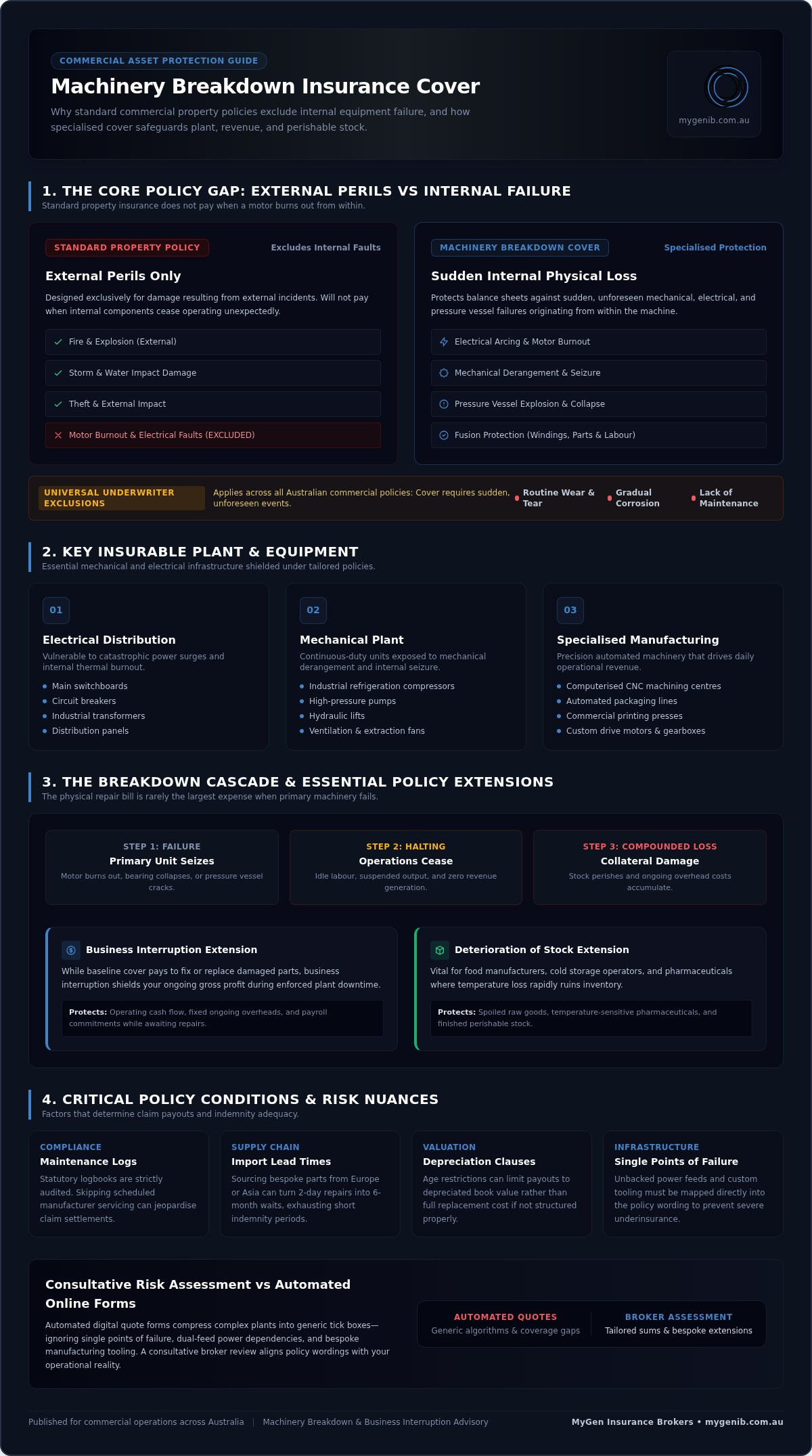
Many business owners discover the hard boundary of their commercial property policy only after a critical machine grinds to a halt. Standard property insurance is built exclusively for external perils; it responds to fire, storm damage, impact, or theft. In contrast, specialised machinery breakdown insurance cover exists to protect against sudden, internal physical loss. This includes mechanical derangement, electrical arcing, motor burnout, or pressure vessel explosion originating from within the unit.
Understanding this distinction has guided industrial underwriting since the early history of machinery insurance, when boiler failures exposed massive gaps in conventional property forms. However, protection is not boundless. Every Australian commercial underwriter strictly excludes routine wear and tear, gradual corrosion, and lack of maintenance. Cover applies to sudden, unforeseen events rather than predictable mechanical aging.
To see how underwriters evaluate these internal mechanical risks, watch this concise industry breakdown:
Key Protected Assets: From Cold Storage Compressors to CNC Machinery
Tailored machinery breakdown insurance cover shields the essential mechanical heart of your enterprise. Common insurable assets include:
- Electrical distribution: Main switchboards, circuit breakers, transformers, and distribution panels vulnerable to power surges.
- Mechanical plant: Industrial refrigeration compressors, high-pressure pumps, hydraulic lifts, and ventilation fans.
- Specialised manufacturing: Computerised CNC machining centres, automated packaging equipment, and commercial printing presses.
Motor burnout and fusion protection ensure that when an electrical current burns out windings, replacement parts and labour are fully covered. To structure these safeguards effectively across your entire operation, explore our comprehensive guide to business insurance.
Evaluating Essential Policy Extensions: Business Interruption and Deterioration of Stock
When a primary compressor or drive motor seizes, the physical repair bill is rarely the largest expense. The deeper commercial wound stems from halted operations, idle labour, and lost revenue. While baseline machinery breakdown insurance cover pays to fix or replace damaged parts, business interruption extensions protect your ongoing gross profit during an enforced plant shutdown. For food manufacturers, cold storage operators, and pharmaceuticals, pairing this with deterioration of stock cover is vital. Perishable inventory quickly spoils if temperature-controlled units sit powerless, turning a mechanical hiccup into a balance sheet crisis. The Australian Government highlights these interrelated protections in its guide to types of business insurance.
Navigating Policy Conditions: Maintenance Obligations and Replacement Timelines
Insurers don’t settle claims in a vacuum; policy conditions require rigorous compliance. Underwriters regularly inspect statutory maintenance logbooks to confirm equipment was serviced according to manufacturer standards. Skipping scheduled logbook entries can jeopardise a payout when you need it most.
Supply chain dependencies also demand careful planning. Sourcing bespoke parts from Europe or Asia can turn a two-day repair into a six-month wait, meaning inadequate indemnity periods leave your cash flow dangerously exposed. Watch out for age restrictions and depreciation clauses as well, which can limit payouts to depreciated book value rather than full replacement. Working with MyGen Insurance Brokers helps you balance these operational nuances against insurer wordings to keep your business resilient.
Securing Tailored Machinery Cover: Why Consultative Brokerage Outperforms Automated Quotes
Automated online quote generators promise instant convenience, but algorithms cannot inspect a production line. Generic digital forms compress intricate mechanical setups into rigid tick boxes, creating dangerous coverage gaps and severe underinsurance. When securing robust machinery breakdown insurance cover, an off-the-shelf wording often ignores single points of failure, dual-feed power dependencies, and bespoke manufacturing tooling. We explore these critical operational pitfalls in our detailed guide on why insurance brokers beat automated quotes.
Consultative broking digs beneath the surface of your asset register. As the International Risk Management Institute outlines in its standard definition of equipment breakdown insurance, true protection must align equipment repair with overall operational continuity. A dedicated professional audits critical plant interdependencies, pinpointing bottlenecks where a single burnt stator could shut down an entire facility.
The Consultative Risk Assessment Process for Australian Enterprises
Protecting complex operations demands a structured, methodical review. Our advisory process delivers clarity across every link of your production chain:
- Supply chain auditing: We evaluate lead times for overseas components and critical spares to ensure your indemnity periods survive prolonged import delays.
- Custom policy endorsements: We negotiate bespoke wording with Australian commercial underwriters, removing restrictive exclusions around electrical arcing or temporary hire costs.
- Financial alignment: We calibrate physical damage limits alongside revenue protections to eliminate underinsurance traps.
Safeguarding your enterprise requires an experienced, steady hand rather than an algorithm. Contact the team at MyGen Insurance Brokers to schedule a comprehensive, consultative review of your operational machinery today.
Securing True Resilience for Your Essential Plant
Sudden electrical and mechanical failures demand specialised policy structures that standard commercial property policies routinely exclude. Protecting your enterprise requires far more than just replacing damaged components; it means aligning realistic business interruption limits and deterioration of stock extensions so unexpected downtime won’t drain your cash flow.
Securing genuine protection demands thorough diligence rather than the guesswork of generic online forms. With over 20 years of commercial broking experience across Australia, MyGen Insurance Brokers champions hands-on risk discovery over rigid algorithms. As a Corporate Authorised Representative of Community Broker Network, we examine your exact operational dependencies to negotiate robust machinery breakdown insurance cover tailored to your plant. Partner with MyGen Insurance Brokers for tailored business cover and give your enterprise the lasting security it deserves.
Frequently Asked Questions
Does standard commercial property insurance cover sudden machinery breakdown?
No, standard commercial property insurance does not cover sudden internal machinery breakdown. Standard property policies are designed strictly to respond to defined external events such as fire, storm, or vehicle impact. For commercial landlords and property managers—as highlighted in guides by Commercial Property Insurance UK—core property policies focus on structural protection rather than operational equipment failure. When an electric motor or mechanical gear fails from within, you need dedicated machinery breakdown insurance cover to step in and absorb the unexpected repair or replacement expenses.
What is the difference between motor burnout and machinery breakdown insurance?
Motor burnout focuses strictly on the electrical fusion of windings within an electric motor. Machinery breakdown insurance cover provides far more comprehensive protection across your entire operational plant. It safeguards against catastrophic mechanical fractures, seized bearings, gearbox failures, and internal pressure explosions, protecting the whole mechanical assembly rather than just the motor’s electrical wiring.
Can deterioration of refrigerated stock be included under machinery breakdown cover?
Yes, deterioration of stock can be included as an essential extension to your machinery breakdown policy. If a cold room compressor or industrial refrigeration unit fails mechanically, the resulting temperature fluctuation can ruin perishable goods within hours. This extension ensures you’re compensated for the spoiled raw materials or finished inventory, preventing severe secondary financial hits.
Are hire costs for temporary replacement equipment covered after a breakdown?
Yes, temporary hire costs can be covered when you include an increased cost of working extension within your business interruption structure. If an overseas replacement part takes months to arrive, renting a temporary mobile compressor or generator keeps your business trading. A tailored policy ensures the insurer covers these temporary hire fees, preserving operational momentum while repairs are completed.