
What if an employee used their authorised access to take money or property, and your policy didn’t respond? Fidelity insurance for employee theft may help protect a business against certain losses caused by employee dishonesty, but cover depends on the policy wording and the circumstances of the loss. Some policies treat third-party fraud and other criminal acts separately.
Before relying on insurance as a financial backstop, it helps to understand what may be covered and what conditions apply. This guide explains how fidelity cover can differ from other business insurance and what exclusions, evidence requirements and claim conditions to check. It also sets out practical steps for comparing policy wording with your business’s risks.
Key Takeaways
- Fidelity insurance for employee theft may respond to specified losses, but the policy wording determines the scope of cover.
- Map staff access to money, stock and approvals to identify where your business could face employee-dishonesty risks.
- Check who counts as an insured person, as well as limits, excesses, exclusions and notification requirements.
- If theft is suspected, preserve records, document what is known and follow the policy’s notification instructions while seeking appropriate advice.
What is fidelity insurance for employee theft, and what might it cover?
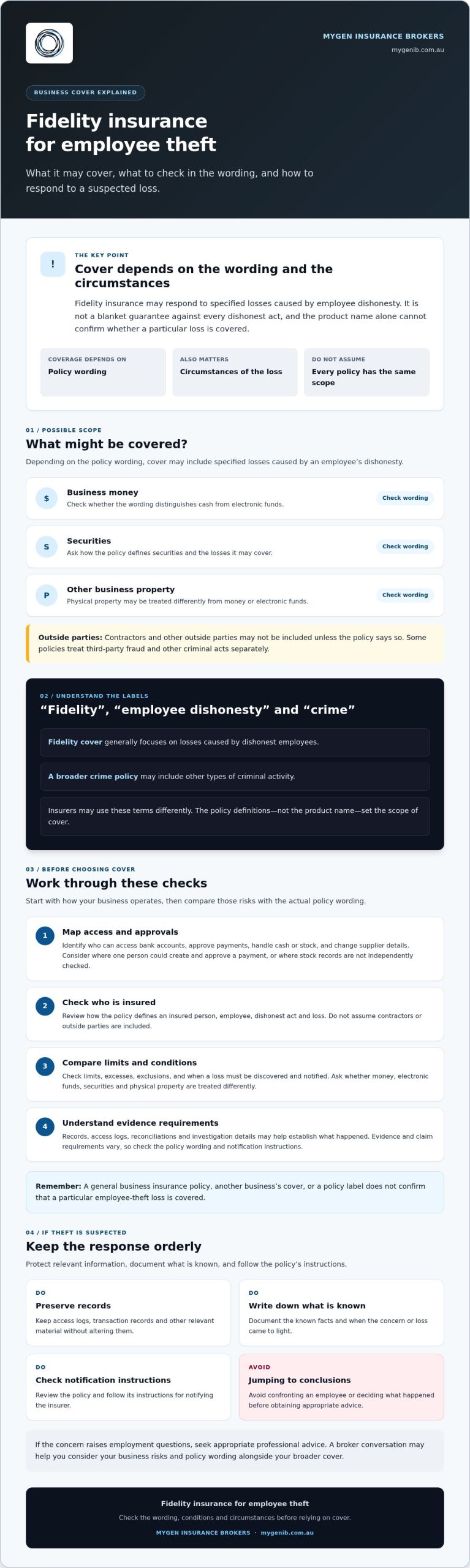
Suspected employee theft can create financial uncertainty as well as a difficult workplace situation. Understanding what your policy may respond to is a useful first step. Fidelity insurance for employee theft may cover specified losses caused by employee dishonesty, but the policy wording and circumstances determine whether a particular loss is covered.
Depending on the wording, cover may include theft of business money, securities or other property by an employee. It is not a blanket guarantee against every dishonest act, and it may not extend to contractors or outside parties unless the policy says so. For a general overview of the concept, see Fidelity bond.
This video provides another overview of fidelity guarantee insurance:
Is fidelity insurance the same as employee dishonesty or crime insurance?
Insurers may use terms such as “fidelity”, “employee dishonesty” or “crime” differently. Fidelity cover generally focuses on losses caused by dishonest employees, while a broader crime policy may include other types of criminal activity. The product name alone does not confirm what is insured.
Fidelity insurance covers specified losses from employee dishonesty, with protection determined by the policy wording and the circumstances of the loss. Check how the policy defines insured people, theft and fraud, and whether it treats cash, electronic funds and physical property differently.
Do not assume a general business insurance policy includes fidelity protection, or that every crime policy has the same scope. Review the actual wording and clarify any uncertainty with an insurance adviser before relying on cover.
How to assess fidelity insurance for employee theft before choosing cover
Start with how your business operates, not just the headline limit. Map who can access bank accounts, approve payments, handle cash or stock, and change supplier details. Then consider plausible loss scenarios. For example, one person might be able to create and approve a payment, or stock records might not be independently checked. This can help you assess whether proposed cover reflects your exposures and where internal controls may reduce risk.
Next, check how the policy defines dishonest acts, loss and insured persons. Review limits and excesses, exclusions, and the requirements for when a loss must be discovered and notified. Ask whether the wording treats money, electronic funds, securities and physical property differently. Do not assume another business’s cover, or a general business insurance policy, provides the same protection. For wider context, see this Australian business insurance guide.
What policy wording and evidence should a business check?
Ask how the policy describes an alleged dishonest act and what kinds of loss it may cover. Records, access logs, reconciliations and investigation details may help establish what happened. Evidence and claim requirements vary, so check the wording and notification instructions rather than assuming what will be required. A product label alone cannot confirm whether a particular loss is covered.
If a concern also raises employment questions, avoid jumping to conclusions and seek appropriate professional advice. Legal Steps for Employers in Australia offers further context on handling workplace theft concerns.
A broker conversation can help you consider your business risks and policy wording alongside your broader cover. MyGen can discuss your insurance needs, but confirm whether a suitable fidelity option can be arranged before relying on it. Explore business insurance advice with MyGen.
Handling Employee Theft: When to Call Your Broker
Discovering a possible loss can be unsettling. Protect relevant records, note what is known and when it came to light, and check your policy’s instructions for notifying the insurer. Preserve access logs, transaction records and other material without altering them. Avoid confronting an employee or deciding what has happened before you have appropriate advice.
Keep the response orderly. The Australian Government’s guide to fraud and corruption is written for Commonwealth entities, but offers a useful reference for thinking about prevention, detection and response. For workplace-specific considerations, seek advice from an appropriately qualified professional.
How can a broker help review employee-dishonesty risks?
A broker can discuss your business operations and existing policies, then help you understand relevant wording and questions to raise. A broker cannot guarantee that a loss will be covered. Ask whether suitable fidelity insurance for employee theft can be arranged, how it might fit alongside your existing business insurance, and what information an insurer may need to assess your circumstances.
MyGen’s business insurance broker guide explains the value of a considered broking conversation. MyGen provides insurance advice, not direct underwriting, and the availability of fidelity cover should be confirmed. To review your broader business insurance needs, discuss your business insurance needs with MyGen.
Make your next cover decision with clarity
Fidelity insurance for employee theft is only useful if its definitions, covered people and claim requirements align with the risks your business actually faces. Review the wording rather than relying on a product label. Keep clear records of roles, access and controls to help you understand your exposure.
If you are responding to suspected theft, preserve relevant information and follow the policy’s notification instructions. For a proactive review, a broker can help you consider your operations, existing insurance and questions to raise, while confirming whether suitable fidelity cover can be arranged.
MyGen Insurance Brokers takes a personalised, consultative approach to risk and insurance discussions. Anthony Simpson brings over 20 years of industry experience to those conversations. Discuss your business insurance needs with MyGen to review your risks and consider appropriate cover.
Frequently Asked Questions
Does fidelity insurance cover all employee theft?
No. Fidelity insurance for employee theft responds only to losses that meet the policy’s definitions and conditions. The wording may distinguish between types of dishonest conduct, insured employees, and money or property. Exclusions, limits and notification requirements can also affect a claim. For a specific incident, check the policy and contact the insurer or broker rather than assuming cover applies.
Is fidelity insurance the same as employee dishonesty insurance?
Not necessarily. Insurers may use “fidelity” and “employee dishonesty” to describe similar protection, but labels are not a reliable guide to scope. One policy may focus on employee-caused losses, while a broader crime policy may address additional criminal acts. Compare the definitions and insured events in the actual wording before treating the terms as interchangeable.
What should a business do if it suspects employee theft?
Preserve relevant documents and electronic records, write down what is known and when it was discovered, then follow the policy’s notification instructions. Avoid altering records, confronting the employee or making conclusions before the facts are established. Seek appropriate employment or legal advice about workplace decisions, and ask the insurer or broker what information may be needed next.
Can a business insurance broker help arrange fidelity cover?
Yes. A broker can discuss how your business operates, review existing policies and help identify wording questions or possible gaps. Ask whether suitable fidelity or employee-dishonesty cover can be arranged and what information an insurer may request to assess the risk. MyGen Insurance Brokers takes a personalised, consultative approach, but availability and suitability must be confirmed, and cover cannot be guaranteed.