
A lower premium can look appealing, but it may come with a higher excess and more to pay if you claim. If your documents use “deductible” instead, it’s understandable to wonder whether the term changes what you owe. The question of excess vs deductible in insurance Australia is less about the label and more about the policy wording.
In Australian general insurance, “excess” is the standard term, while “deductible” is often used for a similar contribution. The amount and the circumstances in which it applies depend on the policy, so an overseas definition or headline premium won’t tell you the full story.
This guide explains how the terms relate, where to find the amount and relevant conditions in your policy, and what to compare before choosing cover. You’ll be better placed to weigh the premium against a possible out-of-pocket cost for the risks you need insured.
Key Takeaways
- With excess vs deductible in insurance Australia, focus on the policy wording. The labels can vary, but the terms often describe a contribution you may need to make when claiming.
- Check your policy schedule and wording for each excess, when it applies, and any claim conditions that could affect what you pay.
- Compare the premium alongside excess amounts, covered events, exclusions and limits to understand the cover as a whole.
- If you’re reviewing professional indemnity cover, explore our professional indemnity insurance guide for further considerations.
Excess vs deductible in Australian insurance: explained
In the excess vs deductible in insurance Australia discussion, “excess” is the term you’re most likely to see in an Australian policy. It generally refers to an amount you may have to contribute towards a claim when specified conditions apply. The amount, how it’s collected and whether it applies depend on the policy and the circumstances of the claim.
“Deductible” is common in some overseas insurance terminology. The terms can describe a similar concept, but a familiar label alone doesn’t confirm how a local policy works. The Deductible (or excess) reference outlines the terminology. For your cover, check the insurer’s documents.
For a broader explanation of insurance terminology, watch this video. Its discussion may use terms differently from an Australian policy, so check your own wording.
Are excess and deductible interchangeable in Australia?
They can describe a similar contribution, but don’t assume they operate identically. Policy documents may define the contribution differently, explain when it applies, or set out more than one amount. Read the policy schedule alongside the full wording and claim conditions to understand what may be payable in your circumstances. The policy wording, not a general definition, governs the policyholder’s contribution.
This distinction matters across different types of cover, including home, motor and professional indemnity insurance. For readers interested in how online platforms handle vehicle and property coverage, you can discover insure.az to explore digital policy solutions. If a term is unclear, ask how it applies to the specific policy and claim scenario you’re considering. A broker can help explain the wording and compare cover against your risks, but a general definition cannot determine a claim outcome.
How an insurance excess affects a claim and your policy comparison
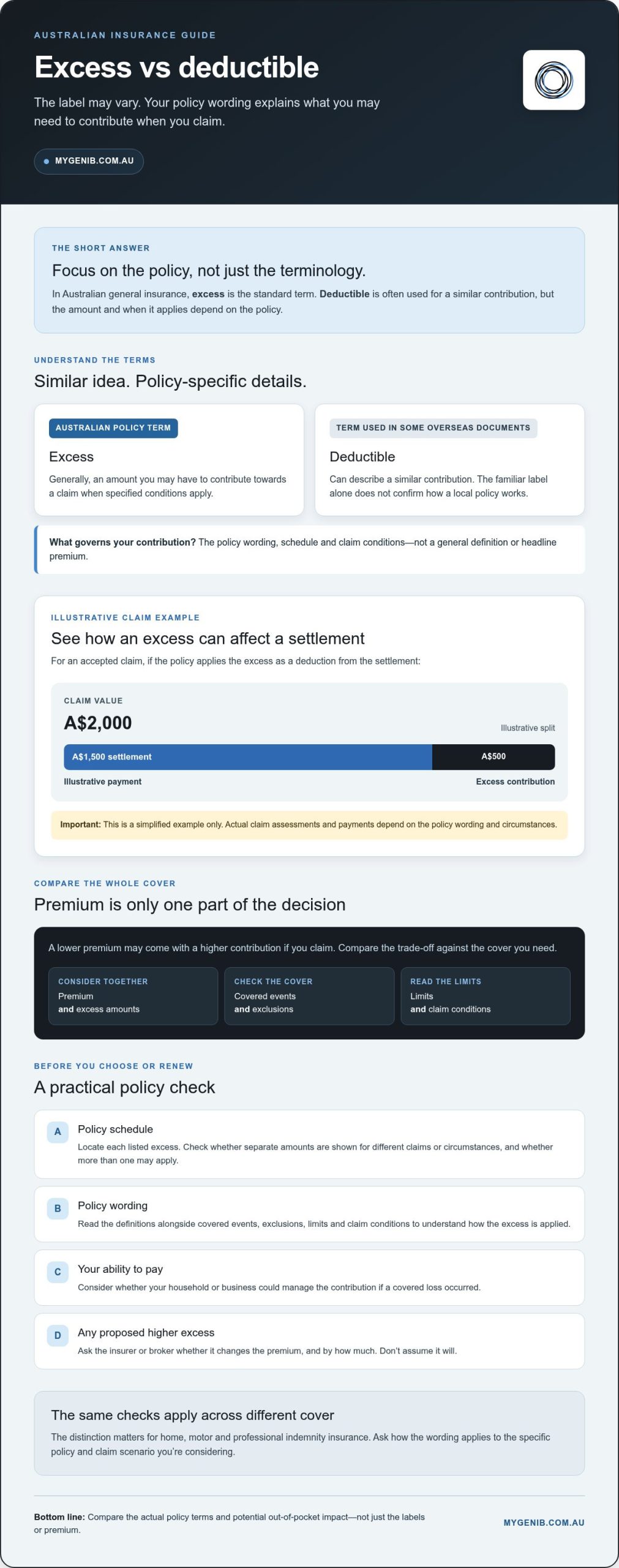
An excess can affect the amount you contribute if a claim is covered and the policy’s conditions are met. For example, imagine an accepted claim for damage valued at A$2,000 and an excess of A$500. If the policy applies that excess as a deduction from the settlement, the illustrative payment would be A$1,500. This is a simplified example only. Actual claim assessments and payments depend on the policy wording and circumstances.
Don’t compare cover by premium alone. Review the excess alongside covered events, exclusions, limits and any conditions that affect claims. A lower premium may come with a higher contribution, but that trade-off is only useful if the cover still suits your circumstances. For a business-focused overview, read our business insurance guide.
What to check before accepting an excess
Read the policy schedule and wording together. Confirm the excess amount, when it applies, whether separate excesses could apply to the same claim, and which definitions or claim conditions affect it. Then consider whether your household or business could manage that contribution if a covered loss occurred. If you’re considering a higher excess, ask the insurer or broker whether it changes the premium and by how much. Don’t assume it will.
- Schedule: Find the listed excess amounts and check whether more than one may apply.
- Wording: Check relevant definitions, covered events, exclusions, limits and claim conditions.
- Affordability: Consider whether you could meet the contribution when making a claim.
These checks make the excess vs deductible in insurance Australia question practical: you’re comparing the policy’s actual terms and potential out-of-pocket impact, not just the labels. To clarify terms and compare cover for your risks, learn more about MyGen Insurance Brokers’ insurance advice.
A practical Australian policy checklist: clarify the excess before you choose
Before choosing or renewing cover, use this checklist to turn unfamiliar terms into questions you can resolve. For the excess vs deductible in insurance Australia question, your policy documents provide details that general explanations can’t.
- Policy schedule: Locate the excess amount and check whether separate amounts are listed for different claims or circumstances.
- Policy wording: Find the definitions that explain how the excess is applied and whether more than one may apply to a claim.
- Claim conditions: Check what must be true for cover to respond, along with relevant exclusions and limits.
- Questions to resolve: Ask when you may need to contribute, how the amount is collected, and whether a proposed change to the excess affects the premium.
- Affordability: Consider whether your business could manage the contribution if a covered loss occurred.
For claims-related considerations specific to professional indemnity, see our professional indemnity insurance guide.
When a broker can help explain policy wording
A broker can help clarify policy terms and assess how cover may align with the risks and priorities you disclose. MyGen takes a consultative approach to insurance advice and placement for clients across Australia. This can support a more informed comparison, but it doesn’t guarantee how an insurer will assess a claim.
If your business risks or policy terms raise questions, discuss your insurance needs with MyGen.
Choose cover with the details in view
With excess vs deductible in insurance Australia, the label is only a starting point. Check the policy schedule, wording and claim conditions to understand when an excess applies and what you may contribute. Then weigh that amount against the premium, covered events, exclusions and limits, rather than judging cover by price alone.
A careful review can make comparisons more relevant to your risks. MyGen takes a tailored, consultative approach to insurance and risk management, with broker Anthony Simpson bringing over 20 years of industry experience. Guidance can help clarify policy terms and suitability, though claim decisions depend on the policy and the insurer’s assessment.
To discuss your business insurance needs, talk with MyGen. A clearer understanding of your cover can help you decide on your next step.
Frequently Asked Questions
Are excess and deductible the same thing in Australia?
They can refer to a similar contribution, but don’t assume they work identically. “Excess” is the common term in Australian general insurance, while “deductible” is widely used in overseas terminology—for instance, providers such as Verdant Insurance structure auto, home, and business policies around deductibles. For excess vs deductible in insurance Australia, check the policy schedule and wording. These explain whether a contribution applies, how it’s calculated and which claim conditions affect it.
How does an excess work when you make an insurance claim?
If a claim is covered and the policy’s conditions are met, you may need to contribute the stated excess. Depending on the policy, it may be taken from a settlement or paid another way. Check the schedule and wording for when it applies, whether separate excesses can apply, and how the insurer handles the contribution. The exact claim outcome depends on the circumstances and policy terms.
Can I choose the excess on my insurance policy?
Sometimes. An insurer may offer a choice of excess amounts, or a policy may include an excess you can’t change. If you’re offered options, ask whether selecting a different excess would change the premium and by how much. Don’t assume a higher excess will always reduce the premium. Consider whether you could manage the contribution if you needed to claim.
What happens if the claim is less than the excess?
Generally, if the amount of a covered loss assessed under the policy is less than the applicable excess, the insurer may not pay a benefit for that claim. However, the result depends on how the policy defines the loss, applies the excess and assesses the claim. Check the wording or ask the insurer or your broker how it would apply to your circumstances.