
If a trusted employee is tricked into transferring money to a scammer, will your business insurance respond? The answer can depend on how the payment was authorised, how the fraud occurred and the exact policy wording. Social engineering fraud insurance should not be assumed to be automatically included.
A fake supplier invoice, an impersonated executive or a convincing request to change bank details can prompt an employee to make a genuine payment. Cyber and crime policies may treat the resulting loss differently, so definitions, exclusions, limits and security conditions all matter.
This guide explains common social engineering scams affecting Australian businesses, where cover may sit and what to review before a loss occurs. It also covers practical safeguards, from payment verification to staff training, and how a broker-led review can consider fraud exposures alongside wider business and cyber insurance needs.
Key Takeaways
- Social engineering fraud uses deception to prompt someone to share information or take an action, such as approving a payment.
- Business email compromise and payment redirection can exploit routine processes, making independent verification an important safeguard.
- Social engineering fraud insurance may sit within cyber or crime cover, but the wording and circumstances of the loss determine whether a policy responds.
- Review policy definitions, exclusions, limits and required controls against your payment processes to identify potential gaps before a loss occurs.
What is social engineering fraud, and how can it affect an Australian business?
Social engineering fraud occurs when deception persuades someone to disclose information or authorise an action that benefits a criminal. The target might be an accounts clerk, business owner or employee with access to payment systems. Unlike a purely technical intrusion, which exploits a weakness in a system or network, social engineering relies on influencing a person. It can occur with or without hacking. The broader security concept and its techniques are outlined in What is Social Engineering?
In business email compromise, a criminal may impersonate a supplier or colleague through a convincing email account or message. Invoice redirection is one example: the criminal poses as a regular supplier and asks the business to pay future invoices into a different bank account. Executive impersonation follows a similar pattern, with a message that appears to come from a senior leader and requests a time-sensitive transfer or confidential information. In each case, a routine request is made to look legitimate.
How do social engineering scams trick a business into authorising a payment?
Imagine receiving an email that appears to come from a regular supplier. It says the supplier has changed banks and includes an invoice with new account details. A looming due date or urgent project can make the request seem plausible, while familiarity with the supplier may lower suspicion. An employee might process the payment if the request arrives through a trusted-looking channel and fits an expected transaction.
Social engineering manipulates people to obtain information or prompt an action. A technical intrusion directly exploits a device, account or network. The methods can overlap, but they are not interchangeable. When assessing social engineering fraud insurance, the sequence of events, the employee’s action and the policy wording may all affect how a loss is considered.
Does cyber insurance automatically cover social engineering fraud?
No. A cyber policy does not automatically cover every loss following a fraudulent payment. Some policies may address certain social engineering losses through specific wording or an extension. Others may exclude them or respond only when particular conditions are met. Crime insurance may also be relevant, but a payment made after a deceptive instruction is not automatically covered under that type of policy either.
The same scam can be treated differently under two policies because each defines the covered event, the loss and the required response in its own way. Trace what happened, from the instruction received to the payment authorised, then compare that sequence with the policy terms. Do not rely on a policy label or a general summary.
Which policy wording, limits and conditions should a business review?
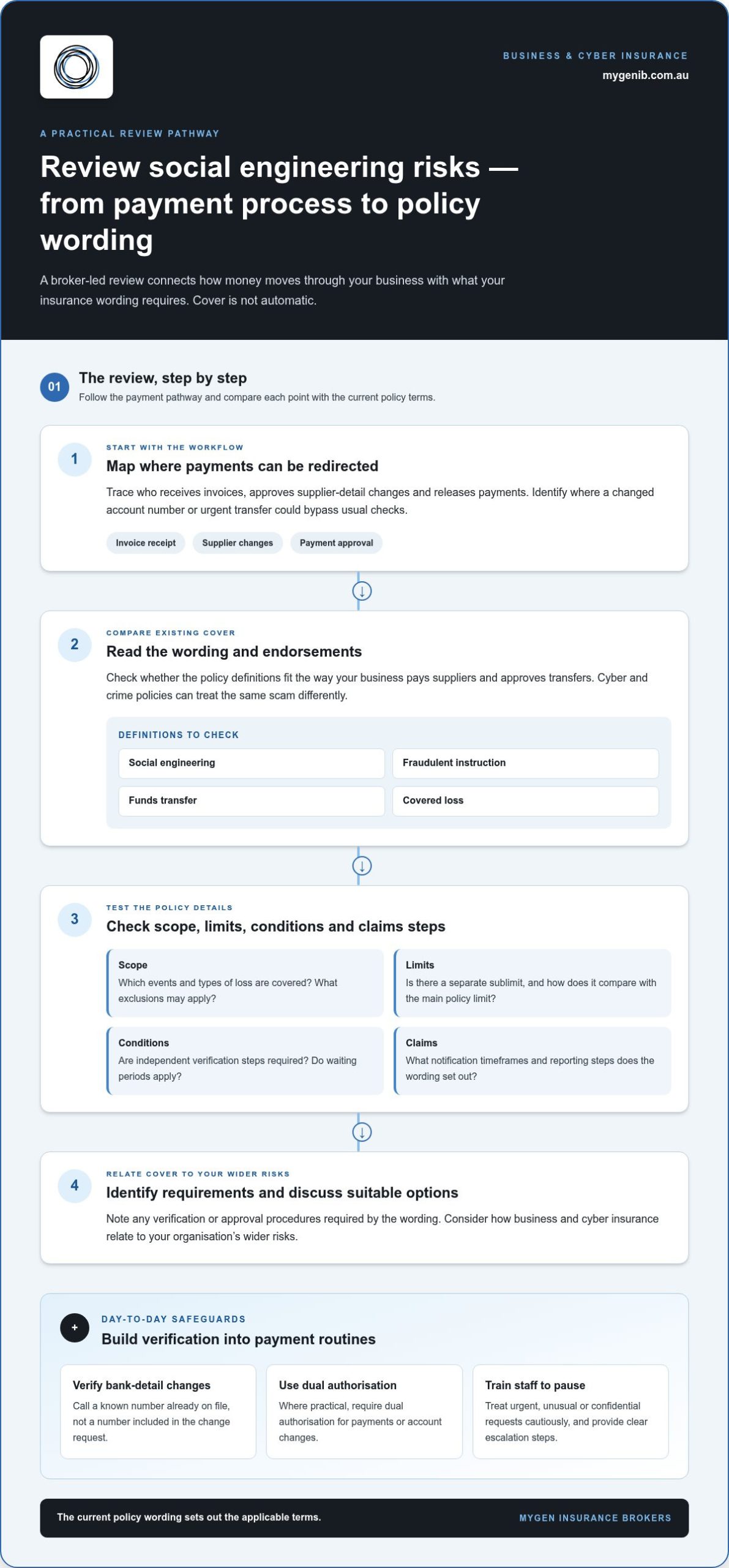
Read the current policy wording alongside any endorsements. Check how it defines social engineering, fraudulent instruction, funds transfer and covered loss. Consider whether those definitions fit the way your business pays suppliers and approves transfers. A broker-led review can relate the wording to your business’s exposures and consider cyber and business insurance as part of the wider risk picture.
Use this checklist to guide the review:
- Scope: Which events and types of loss are covered, and what exclusions may apply?
- Limits: Is there a separate sublimit, and how does it compare with the main policy limit?
- Conditions: Are independent verification steps required? Do waiting periods apply?
- Claims: What notification timeframes and reporting steps does the wording set out?
These are points to examine, not assumptions about standard cover. The current policy wording sets out the applicable terms. A review of business and cyber insurance advice can help clarify how the wording relates to your payment processes and identify areas that need attention.
How can an insurance broker help your business prepare for social engineering fraud?
A useful review starts with how money moves through your business, not just the name of an insurance policy. A broker can map who receives invoices, approves supplier-detail changes and releases payments, then compare those steps with your policy wording and any control requirements. This brings practical prevention and social engineering fraud insurance into the same conversation.
Consider these steps:
- Map payment risks: Identify points where a changed account number or urgent transfer could bypass usual checks.
- Review existing cover: Compare policy definitions, exclusions, limits and conditions with your payment processes.
- Identify control requirements: Note any verification or approval procedures required by the wording.
- Discuss suitable options: Consider how business and cyber insurance relate to your organisation’s wider risks.
Practical controls can strengthen day-to-day payment processes. Verify bank-detail changes by calling a known number already on file, rather than a number included in the change request. Where practical, use dual authorisation for payments or account changes. Train staff to pause when a request is urgent, unusual or confidential, and give them clear steps for escalating concerns without feeling pressured to act immediately.
What does a tailored social engineering insurance review involve?
A broker can examine payment workflows, supplier-change procedures and existing insurance arrangements, then relate those details to the policy wording and conditions. MyGen Insurance Brokers takes a personalised, consultative approach to risk assessment, considering business and cyber insurance in context rather than assuming one policy or extension will suit every business. Anthony Simpson brings more than 20 years of industry experience to this work.
Information about business insurance with MyGen Insurance Brokers is available online.
Make your next step a clearer view of risk
Use your next policy review to test how your safeguards work in practice. Can a staff member independently verify a supplier’s new bank details? Is there a clear second approval for unusual transfers? Can your team quickly locate the relevant policy wording if a suspicious payment request arrives? These questions turn uncertainty about social engineering fraud insurance into a focused review of your business’s processes and cover.
MyGen provides business insurance advice to organisations nationally across Australia, with a personalised approach to understanding each business’s risks. Reviewing payment procedures alongside insurance arrangements can bring potential gaps into focus without assuming a particular policy will respond to every scenario.
Discuss your business insurance needs with MyGen to take a practical step towards clearer risk planning.
Frequently Asked Questions
Can a business recover money after a social engineering scam?
Possibly, but recovery is not assured. Contact your bank as soon as you discover the transfer and ask it to try to stop or recall the funds. Record when you reported the incident and any reference number provided. Notify your insurer in line with your policy’s claims conditions. Whether social engineering fraud insurance responds depends on the wording and the circumstances.
Is invoice redirection fraud the same as business email compromise?
Not exactly. Invoice redirection fraud is a particular scam in which payment details are changed so money goes to a criminal’s account. Business email compromise is a broader form of impersonation or email account abuse that can be used to redirect invoices, request payments or seek sensitive information. A redirection scam can happen without an attacker taking control of a supplier’s email account.
What evidence should a business keep after a suspected social engineering scam?
Preserve the original emails or messages, including sender details and timestamps, rather than keeping only screenshots. Save the relevant invoice, previous supplier payment details, the altered account information, transaction receipt and approval records. Write a brief timeline of events, including who was contacted and when. Keep bank, insurer and police reference details together, and avoid deleting or editing potentially relevant files.
How can a small business reduce the risk of fraudulent payment instructions?
Keep an approved supplier register with verified payment details and a documented process for changing them. Where staffing allows, separate the person who updates supplier records from the person who releases payments. Before processing a change, compare it with the supplier’s usual communication pattern and pause if anything is unusual. Practise the steps with staff so they know how to raise concerns promptly.