
A townhouse’s walls don’t determine which insurance applies; its title and strata arrangements do. For a strata-titled townhouse, the body corporate is generally required by Australian law to hold residential strata insurance. Individual building insurance usually applies to a home outside a strata or body corporate scheme. So, when comparing strata insurance vs building insurance for a townhouse, start by checking how the property is titled.
It’s easy to assume you need to insure the entire building yourself, or that strata cover takes care of everything. The distinction matters: strata insurance usually covers the building and shared areas, while your belongings and some owner-funded fixtures may need separate cover.
This guide explains what each type of cover is designed to protect, how to identify which arrangement applies to your townhouse, and what to look for in the policy details. You’ll have a clearer basis for deciding what cover may be relevant to your property.
Key Takeaways
- Compare the strata policy’s terms with your townhouse’s fixtures, fittings and any renovations to spot areas that may need separate cover.
- In the ACT, an eligible person can request free inspection of and a copy of the owners corporation’s current insurance policies, which must be provided within 14 days, according to ACT Parliamentary Counsel.
- For an individual building policy, consider whether changes such as an extension or loft conversion have altered the home’s rebuild needs.
- Use the decision guide to identify whether your townhouse is part of a strata scheme and what policy details matter for your situation.
What’s the difference between strata insurance and building insurance?
The distinction depends on your townhouse’s title and whether it belongs to a shared scheme. The strata insurance vs building insurance for townhouse decision starts with who insures the building and common property.
Strata cover for common areas
Residential strata insurance is arranged for a scheme and can cover its insured buildings, common property and shared areas, such as gardens, lifts, pools, walls, windows, ceilings and floors. It usually includes liability cover for injuries or property damage on common property. Strata-title owners share this building cover through the scheme rather than insuring the entire structure individually.
Strata, company and Torrens titles have different ownership arrangements. A strata scheme insures shared property, while a standalone Torrens-title owner typically insures the building individually. For a company-title townhouse, the company documents explain how property and insurance are managed.
Building cover for individual property
Individual building insurance generally applies to a home outside a strata or body corporate scheme. It covers the insured structure; contents insurance covers belongings such as furniture and clothing. Home insurance can cover natural disasters and unforeseen damage, but the policy wording sets out insured events and exclusions.
NSW Government says a strata damage policy must include owners’ improvements and fixtures that form part of the building. When comparing strata insurance vs building insurance for townhouse cover, the key distinction is whether the policy insures the scheme’s building or an individual home.
Cover for damage and renovations
After a leak, the cause and policy terms help determine whether a claim involves the building, common property or contents. Burglary may involve stolen belongings or damage to the structure, which can fall under different cover. State laws and policy terms differ, so schemes may treat the same event differently.
Renovations can affect how fixtures are treated. A replacement bathroom may be subject to scheme rules and renovation approval conditions. Extensions to a non-strata home can increase rebuilding needs, so tell your insurer about significant changes.
Checking the policy and sum insured
Ask the strata manager for the current policy, certificate of currency and sum insured. Compare the insured property description, common areas, liability cover and exclusions with your townhouse and its fixtures. In the ACT, an eligible person can request free inspection of and a copy of the owners corporation’s current insurance policies, which must be provided within 14 days, according to ACT Parliamentary Counsel.
Because state rules and policy terms vary, compare your scheme documents with the policy before deciding what additional cover may suit you. For a practical strata insurance vs building insurance for townhouse check, confirm the title, then match the insured property to your home.
| Option | What it covers | Typical responsibility |
|---|---|---|
| Strata insurance | Insured building and common property | Scheme or owners corporation |
| Individual building insurance | Insured standalone home structure | Property owner |
| Contents insurance | Personal belongings | Owner or occupier |
First confirm the title, then compare the policy’s insured property and exclusions with your townhouse.
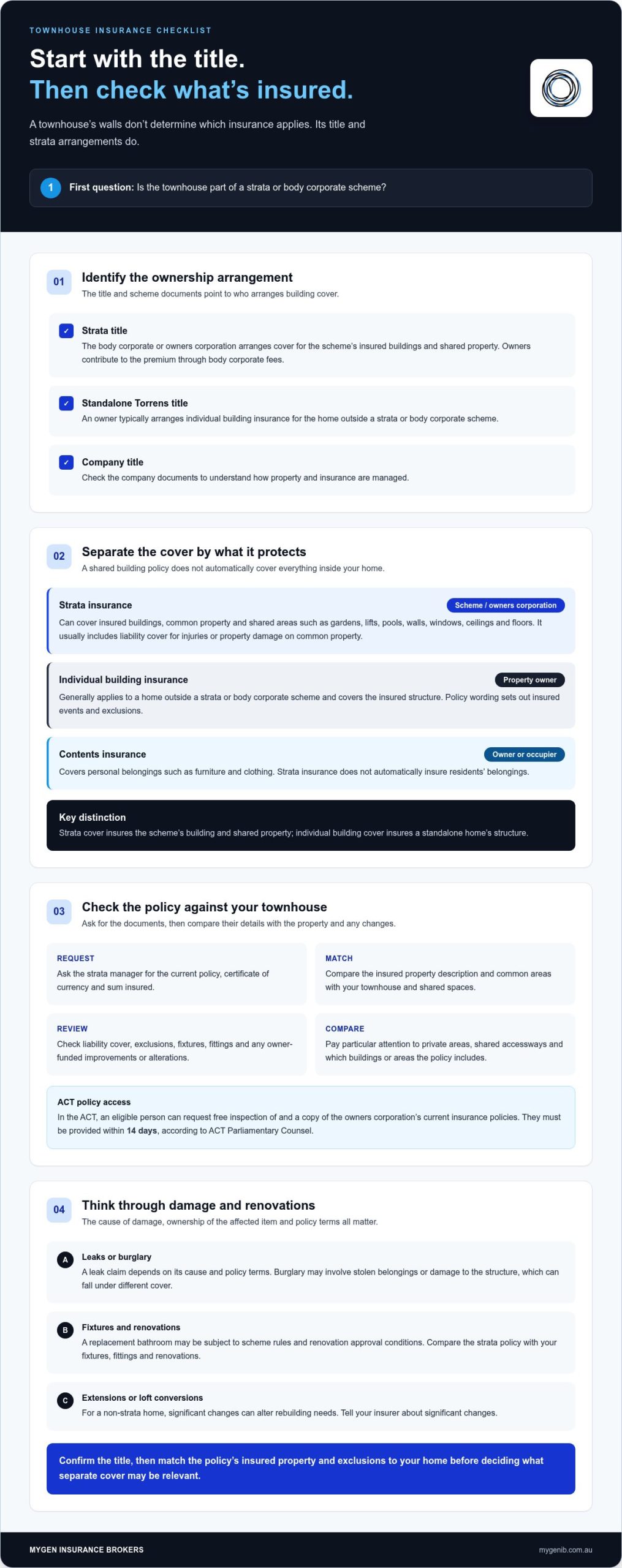
Strata insurance compared with individual building insurance
For townhouse owners, the strata insurance vs building insurance comparison starts with the title and scheme arrangements. These determine who insures the building and whether a separate policy for the structure is relevant.
Owners corporation strata insurance
In Australia, the body corporate or owners corporation arranges insurance for the scheme’s insured buildings and shared property. Owners contribute to the premium through body corporate fees, rather than each insuring the whole structure separately. A policy may cover shared assets such as gardens, while its terms define which buildings and areas are included.
With strata insurance, the scheme’s cover is managed collectively. It doesn’t automatically insure residents’ furniture or other personal belongings, so owners or occupiers may consider contents insurance for those items.
Separate townhouse building insurance
A townhouse owner generally doesn’t need a second policy for the whole building if it’s strata-titled and the owners corporation’s policy covers that structure. Instead, review the policy wording for gaps involving personal contents, fixtures or alterations. A duplicate building policy may not address those separate needs.
For a home outside a strata scheme, the owner typically arranges individual building cover. A standalone Torrens-title townhouse is one example. The strata insurance vs building insurance for townhouse owners decision turns on the title, the scheme’s insured property and the cover the owner wants for belongings.
To compare strata insurance vs building insurance for townhouse owners, identify the title, read the scheme documents and match the policy description to the home. Pay particular attention to private areas, shared accessways and exclusions, as attached townhouses can have different insurance responsibilities.
If questions remain about cover for your home or belongings, review your cover options alongside the scheme documents. The takeaway is to establish what the shared policy insures before arranging separate building cover.
MyGen Insurance Brokers: Business Insurance
Once you understand your townhouse’s title and what the strata policy covers, MyGen Insurance Brokers can help assess your personal insurance needs. For an individual home, Home Insurance may suit building and contents needs; Business Insurance is relevant if you also need cover for business risks.
Bring the policy details and questions about your property, belongings or business activities to the discussion. MyGen takes a personalised approach to identifying risks and considering suitable cover, rather than relying on instant automated quotes.
Contact MyGen Insurance Brokers to discuss your insurance needs, or visit mygenib.com.au.
Make your next insurance review more useful
Make the strata insurance versus building insurance decision for your townhouse practical. Gather your title information, current policy documents, renovation records and a list of belongings you want to protect. Note any remaining questions about cover. This gives you a clear starting point for discussing your insurance needs and keeping your records organised as circumstances change.
If your insurance needs extend beyond your home, MyGen Insurance Brokers offers Business Insurance, Professional Indemnity Insurance and Commercial Motor Insurance. Discuss these separately from your townhouse cover so each policy can be considered against the risks it is intended to address.
For a considered conversation about your insurance needs, contact MyGen Insurance Brokers. Taking the next step with your documents in hand can help you move forward with greater clarity and confidence.
Frequently Asked Questions
What Cover Do You Need?
The cover you need depends on the townhouse title, who occupies it and what you own. First identify whether a strata scheme insures the building, then consider contents insurance for furniture, clothing and appliances. If you rent out the townhouse, landlord insurance addresses different risks from owner-occupier cover. Keep renovation details and a belongings list handy when reviewing policy terms and exclusions.
What does residential strata insurance cover?
Residential strata insurance generally covers insured buildings and shared property, with the exact scope set out in the policy. For example, a scheme policy can cover a shared driveway or garden, while an owner’s contents policy covers personal belongings inside the townhouse. Check whether the policy includes liability cover and how it treats fixtures, as these details affect what happens after damage to shared or private areas.
What factors can contribute to strata insurance premiums?
Strata insurance premiums reflect the risk and value of the property being insured. Relevant details include the building’s insured value, construction and condition, location-related hazards, shared facilities and the cover selected. For example, a scheme with a pool or lift has different common assets to insure than a smaller complex. Owners can see their contribution through body corporate fees and review the policy’s insured sum and cover at renewal.
What is a body corporate?
A body corporate is the group responsible for managing shared property and scheme matters in a strata or community title development. Owners contribute to shared expenses and decisions, including arranging the scheme’s insurance. For example, maintaining a common garden or managing a shared driveway can be the body corporate’s responsibility. Names and management arrangements differ across Australia, so the scheme documents clarify who handles these duties.
When might a strata owner need additional insurance?
A strata owner may need additional cover for belongings, landlord risks or fixtures outside the scheme policy. For example, an owner-occupier can arrange contents insurance for furniture and clothing, while a landlord can consider cover suited to renting out the townhouse. Renovations and valuable personal items also call for a close look at policy limits and exclusions, helping the owner identify gaps before relying on existing cover.