
Your “standard” business insurance policy is often just a starting point, not a finished safety net. We know how draining it feels to wade through pages of technical jargon, only to worry that your generic cover won’t actually hold up when a specific industry risk or a high-stakes client contract arrives. It’s a common frustration for local business owners who want to do the right thing but feel trapped by one-size-fits-all solutions. Understanding the most common business insurance endorsements Australia offers is the key to transforming a basic policy into a precise, protective shield.
We’ve seen how the right endorsement can be the difference between a rejected claim and total peace of mind. This guide will help you identify, decode, and use these customisations to bridge dangerous gaps in your current protection. We’ll show you how to read your policy schedule with confidence, highlight which endorsements are essential for your specific trade, and help you build a risk management strategy that feels managed rather than messy. By the end, you’ll have the clarity you need to ensure your cover is as unique as the business you’ve worked so hard to build.
Key Takeaways
- Learn how specific endorsements on your policy schedule override standard wording to ensure your cover actually matches your business reality.
- Identify the most common business insurance endorsements Australia requires, especially for contractors needing to meet strict contractual obligations from larger clients.
- Understand why the Professional Services Exclusion is a critical risk for tradespeople who provide advice, and how to bridge that gap effectively.
- Discover why a methodical, expert review of your policy is safer than automated quotes, helping you uncover “silent” exclusions before they lead to a rejected claim.
Decoding Your Policy Documents: The Schedule, the PDS, and the Endorsement
Most business owners view their insurance papers as a daunting pile of fine print. We understand that frustration. However, at the heart of your cover lies the endorsement to the policy, which is simply a formal amendment that changes the terms of your original contract. These are the tools we use to customise your protection. Using common business insurance endorsements Australia wide allows us to tailor a generic policy to the specific risks of your industry, ensuring your safety net is actually fit for purpose.
To better understand this concept, watch this helpful video:
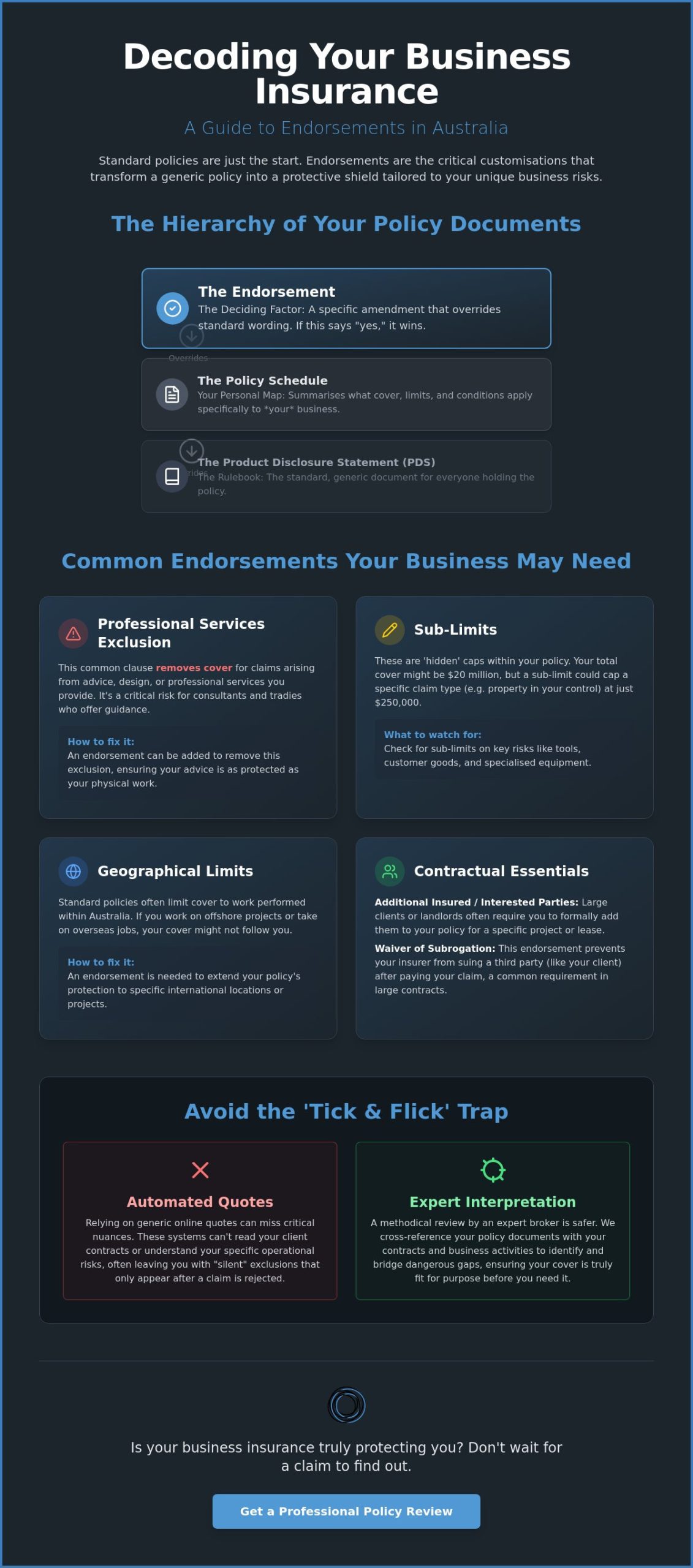
There’s a clear hierarchy of power when it comes to your documents. Think of the Product Disclosure Statement (PDS) as the rulebook for everyone; it’s the standard baseline. Your Policy Schedule, however, is your personal map. When an endorsement appears on your schedule, it usually overrides the standard PDS wording. If the PDS says “no” but your endorsement says “yes”, the endorsement wins. This hierarchy is why we spend so much time refining the details on your schedule.
Under the updated Duty of Disclosure rules for 2026, being precise with these amendments is vital for a successful claim. An endorsement doesn’t always add more cover. Sometimes it restricts it to keep premiums manageable, while other times it expands your protection to meet a specific client contract. We focus on getting this balance right so you aren’t paying for what you don’t need or, worse, left exposed when it counts. Getting common business insurance endorsements Australia specific is about accuracy, not just ticking boxes.
Where Endorsements Hide: Reading Your Policy Schedule
Your Schedule is a personalised summary, and it’s where the real detail lives. While the PDS provides the broad definitions, the Schedule tells you exactly what applies to you. You’ll often find these details under headings like “Endorsements,” “Attaching Clauses,” or “Special Conditions.” We recommend checking the effective date on these sections. It’s a small detail that ensures the amendment is active for your current policy period, giving you the certainty that your protection is up to date. To ensure your baseline policy is correctly set up before adding these details, you can explore Business Package Insurance with the help of an expert broker.
The Legal Relationship Between Documents
It’s a mistake to view your Schedule and PDS as separate entities. Legally, they must be read as a single, integrated contract. A “standard” policy is rarely enough for Australian businesses with unique risks or specialised equipment. To see how these documents fit into the bigger picture of your risk management, you can explore the complete guide to business insurance in Australia. This integrated approach ensures your safety net has no hidden holes.
Common Business Insurance Endorsements in the Australian Market
In Australia, the gap between a standard policy and the specific demands of a head-contract can be vast. We often see contractors caught out by the “Professional Services Exclusion.” This is a common clause that removes cover for claims arising from advice, design, or technical instruction. If you’re a tradie or a specialist providing layout advice, this exclusion could leave you exposed during a claim. Navigating common business insurance endorsements Australia requires a deep dive into these nuances, often found by cross-referencing your schedule with the Product Disclosure Statement provided by your insurer. This ensures your advice is as protected as your physical work.
It’s also vital to watch for sub-limits. These act as “hidden” restrictions that cap the amount an insurer will pay for a specific type of loss, even if your total sum insured is much higher. For example, you might have A$20 million in public liability, but a sub-limit might cap “property in your care, custody, or control” at just A$250,000. Similarly, if your team works on offshore rigs or takes on overseas projects, you must check your “Geographical Limits” endorsement. Without it, your safety net might stop at the Australian coastline, leaving you vulnerable in international waters or foreign jurisdictions.
Contractual Essentials: Additional Insureds and Waivers
Big firms and commercial landlords often demand an “Additional Insured” or “Interested Parties” endorsement. This formally adds them to your policy for the duration of a project or lease. They might also insist on a “Waiver of Subrogation.” This legal amendment prevents your insurer from trying to recover claim costs from the principal contractor, even if they were at fault. Before you sign off on these heavy contractual requirements, we suggest reviewing your professional indemnity insurance limits to ensure you aren’t inadvertently breaching your own policy conditions.
Specific Industry Add-ons
For mobile businesses, “Tools of Trade” or “Stock in Transit” endorsements are non-negotiable. You might also see “Cyber Liability” added to a general business policy. While this offers a basic level of protection, it usually has much lower limits than a standalone policy. As we move through 2026, we recommend a quick checklist of your replacement costs. Inflation has shifted the value of equipment, and those old sub-limits might no longer be adequate to replace your gear at current A$ prices. If you’re unsure about your current levels, a quick chat with a specialist insurance broker can provide the clarity you need.
Avoiding the ‘Tick and Flick’ Trap: Why Expert Interpretation Matters
Speed is often the enemy of accuracy. While automated online portals promise a policy in minutes, they usually rely on a “tick and flick” approach that ignores the unique heartbeat of your business. We believe you deserve more than a generic algorithm. A professional broker acts as a protective mentor, looking beneath the surface to identify “silent” exclusions that often lurk in standard wording. By adhering to the Insurance Brokers Code of Practice, we ensure our advice is grounded in your best interests, doing the heavy lifting of policy analysis so you don’t have to. Real peace of mind comes from knowing your common business insurance endorsements Australia wide are tailored to your actual daily operations, not just a best-guess estimate.
The Risk of Generic Wording
Standard endorsements can still leave significant gaps if they aren’t calibrated to your specific turnover or staff numbers. For instance, a generic theft endorsement might have a limit that hasn’t been adjusted for current A$ inflation or your specific inventory levels. This is why expert insurance brokers are essential for complex commercial risks. We focus on the “suitability” factor; an endorsement only has value if it triggers exactly when you need to make a claim. We don’t just add clauses; we ensure they are active and adequate for your specific trade.
Your Next Steps for a Secure Future
Securing your future requires a move away from price-only decisions toward value-based protection. We suggest this simple three-step review to ensure your safety net is ready:
- Check your Schedule: Look for the specific endorsements we discussed in the previous sections, such as additional insureds or sub-limits.
- Compare to your Contracts: Ensure your cover meets the exact wording required by your head-contractors, clients, or landlords.
- Consult a Broker: Let us perform a methodical risk assessment to find the “hidden” gaps that generic policies often miss.
It’s time to turn a complex, high-friction experience into one that feels managed and secure. We invite you to contact our team today to organise a personalised deep-dive into your current coverage, ensuring your business is protected for whatever lies ahead. Having the right common business insurance endorsements Australia specific to your industry isn’t just a luxury; it’s the foundation of a resilient business strategy.
Securing Your Business with Precision and Clarity
We’ve seen how a standard policy is often just the beginning of your protection journey. By understanding how to decode your schedule and identifying the specific gaps left by generic wording, you’ve taken the first step toward a more secure future. Ensuring your common business insurance endorsements Australia are correctly aligned with your daily operations is the only way to turn a complex contract into a reliable safety net. It’s about moving away from the anxiety of the unknown and toward the confidence of being truly covered.
At MyGen Insurance Brokers, we act as your protective mentor, doing the heavy lifting of policy analysis so you can focus on your growth. With over 20 years of industry experience and a specialised focus on complex Australian commercial risk, we offer a personalised consultative approach that goes far beneath the surface. Don’t leave your livelihood to the chance of an automated algorithm. We invite you to organise a personalised risk consultation with MyGen Insurance Brokers today. Let’s work together to build a strategy that provides the relief and peace of mind you deserve.
Frequently Asked Questions
What is a Product Disclosure Statement (PDS) in Australian insurance?
A Product Disclosure Statement (PDS) is a legally required document that outlines the features, benefits, and exclusions of an insurance policy. It serves as the standard baseline for all policyholders, providing the generic rules of the contract. We suggest reading it alongside your policy schedule to see how specific amendments have tailored those standard terms to fit your unique business needs.
How do I know if my business insurance policy limit is high enough?
Determining if your policy limit is sufficient requires a methodical look at your current assets and potential liability exposures. You should consider the current A$ replacement value of your equipment and any specific indemnity limits required by your major clients. We often perform deep-dives into common business insurance endorsements Australia wide to ensure that sub-limits aren’t leaving you underinsured for high-value risks.
What is the difference between an insurance endorsement and a condition?
An endorsement is a specific change or addition to your policy wording, while a condition is a requirement you must meet to ensure your cover remains valid. Think of an endorsement as an upgrade or a tailor-made adjustment to your safety net. A condition is more like the maintenance instructions; if you don’t follow the rules, such as keeping specific security locks in good working order, your insurer might not be able to support you during a claim.
Can I add an endorsement to my business insurance policy mid-year?
You can absolutely add an endorsement mid-year to reflect changes in your staff numbers, turnover, or business activities. There’s no need to wait for your renewal date to bridge a gap in your protection or to satisfy a new contractual obligation. We handle these updates promptly so your cover stays accurate and your peace of mind remains intact throughout the entire policy period.