
If a client trips over a stray laptop cable in your office, you likely know which policy to call, but what happens if they "trip" over the professional advice you provided instead? It is a common point of friction for local business owners who find themselves staring at a screen of "tick and flick" options without a clear explanation of what they actually cover. Understanding the nuances of public liability vs professional indemnity insurance australia is not just about ticking a box for a contract; it is about building a layered strategy that protects both your physical presence and your hard-earned expertise. We understand the frustration of feeling under-insured or, conversely, paying for coverage that doesn't fit your daily reality. You want to focus on growing your business, not decoding insurance jargon or worrying about a potential lawsuit that could derail your progress. This article will clear the confusion between physical risks and professional errors to ensure your Australian business is properly protected. We will walk through the specific legal obligations for different industries and provide a simple way to distinguish between your physical and intellectual liabilities so you can move forward with confidence. Key Takeaways Distinguish between physical mishaps on your premises and the financial fallout of professional advice to ensure your liability strategy is sound. Identify whether your industry, such as healthcare or finance, has mandatory insurance obligations under Australian regulatory bodies like AHPRA or the TPB. Gain a clear, jargon-free understanding of public liability vs professional indemnity insurance australia so you can stop guessing and start protecting your business with precision. Uncover the "contractual requirement" trap and learn why reviewing your client agreements is vital before you commit to a specific level of cover. Discover why integrating both policies through a consultative broker simplifies your claims process and uncovers hidden risks that automated sites often miss. Table of Contents Defining the Divide: Physical Risks vs Professional Advice Choosing the Right Cover for Your Australian Business The Risk Management Approach: Why Integration Matters Defining the Divide: Physical Risks vs Professional Advice Understanding the difference between public liability vs professional indemnity insurance australia starts with a simple distinction: one covers what you do physically, while the other covers what you say professionally. In Australia, Public Liability protects your 'actions,' while Professional Indemnity protects your 'advice'. We often find that business owners feel a sense of unease when selecting cover, fearing they might leave a gap in their protection. By looking at the specific triggers for a claim, we can turn that confusion into a structured plan for security. The easiest way to remember the divide is the 'Slip and Trip' rule. If a visitor trips over your laptop bag in a … [Read more...] about Public Liability vs Professional Indemnity Insurance Australia: What is the Difference?
Is Business Insurance Tax Deductible? 2026 Guide
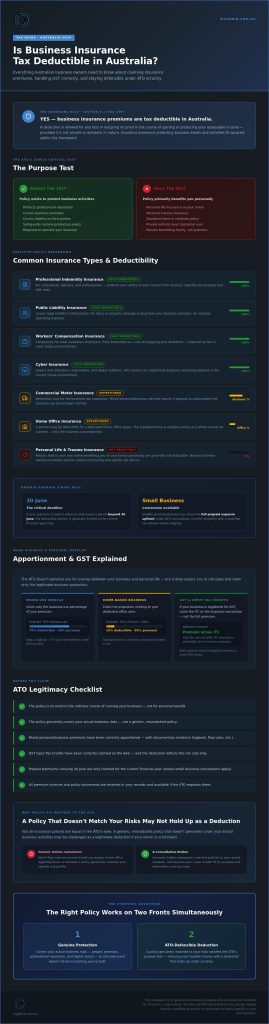
Your business insurance premium isn't just a cost of doing business. It's a legitimate tax deduction that could meaningfully reduce what you owe the ATO each financial year. So if you've been wondering whether business insurance is tax deductible in Australia, the short answer is yes, but the full picture is worth understanding properly before you lodge your return. If premiums feel heavier than they used to, you're not imagining it. Many Australian business owners are feeling the pressure of rising insurance costs in 2026, and the last thing you want is to overpay your tax bill on top of that. Add in the genuine confusion around GST, Input Tax Credits, and what the ATO actually expects to see if it comes knocking, and it's easy to see why so many people feel uncertain about what they can and can't claim. This guide cuts through that uncertainty. You'll discover exactly which business insurance premiums qualify as deductions, how to handle the GST correctly, and what makes a claim legitimate in the ATO's eyes. More than that, you'll see how the right policy, one that's genuinely matched to your specific risks, isn't just protection. It's a strategic asset working for your business on two fronts at once. Key Takeaways Understanding whether business insurance is tax deductible in Australia comes down to one core ATO principle: the premium must be incurred in the ordinary course of running your business, not for personal benefit. When your business and personal life overlap — such as with a home-based operation — you'll need to apportion your premiums correctly and understand how GST and Input Tax Credits affect what you can actually claim. Not all insurance policies are created equal in the ATO's eyes; a policy that doesn't genuinely cover your actual risks may not hold up as a legitimate business deduction if scrutinised. A consultative broker can uncover hidden exposures that generic online calculators routinely miss, ensuring your cover is both fit for purpose and defensible come tax time. Getting your insurance strategy right in 2026 means working smarter on two fronts at once — genuine protection for your business and a deduction that holds up under ATO scrutiny. Table of Contents The ATO Rules: Understanding Deductibility for Business Insurance Apportionment and GST: Navigating Complex Tax Scenarios Strategic Protection: Why Broker-Led Policies Maximise Value The ATO Rules: Understanding Deductibility for Business Insurance The foundation of any legitimate insurance deduction sits inside Section 8-1 of the Income Tax Assessment Act 1997. Under this provision, you can claim a deduction for any loss or outgoing incurred in the course of gaining or producing your assessable income, provided it isn't private or domestic in nature. Insurance premiums fit squarely within that framework because they protect the very assets and activities that generate your income. The ATO doesn't view them as optional extras; it treats them as a genuine … [Read more...] about Is Business Insurance Tax Deductible? 2026 Guide

Common Business Insurance Exclusions: What Your Policy Won’t Cover in 2026
Would your business survive a major claim if your insurer pointed to a single sentence on page forty-two to deny your payout? We understand the deep sense of unease that comes from relying on generic, automated policies that often fail to grasp the unique risks of your specific industry. It is frustrating to feel like you are just another number in a "tick and flick" system, especially when you realise that many common business insurance exclusions are tucked away in language designed to be overlooked. You deserve to have total clarity regarding the boundaries of your protection. Our goal is to help you discover these hidden gaps and learn how to avoid the pitfalls that lead to denied claims during critical times. We will provide a clear list of what your policy likely won't cover in 2026, from evolving cyber threats to shifting professional liabilities, and offer a methodical framework to evaluate your current insurance with the confidence of a seasoned expert. By looking beneath the surface of your current cover, we can ensure your business remains a stable and secure force in your local community. Key Takeaways Understand why exclusions exist as necessary boundaries to keep your cover sustainable while protecting against uninsurable risks like general wear and tear. Recognise the hidden danger of contractual liability and how signing certain agreements can leave you personally responsible for claims your insurer won't touch. Identify the most common business insurance exclusions for 2026, including the universal refusal to cover dishonest acts or intentional damage by staff. Learn why generic "tick and flick" automated quotes often lead to restrictive cover and how a personalised, deep-dive assessment provides true security. Gain a practical framework to evaluate your current policy, allowing you to move from a state of anxiety to one of professional confidence. Table of Contents Understanding Business Insurance Exclusions: The Boundaries of Your Protection The Big Three: Common Exclusions Australian Small Businesses Face How to Bridge the Gap: Why Personalised Brokerage Beats Automated Quotes Understanding Business Insurance Exclusions: The Boundaries of Your Protection When you open your policy document, the list of inclusions usually feels like a safety net; however, it's the exclusions that define the true shape of your protection. In simple terms, exclusions are the specific circumstances or events where your insurer will not pay out. We see these boundaries as essential for keeping premiums affordable for everyone. By removing high-certainty risks like general wear and tear or intentional damage, insurers can maintain a sustainable pool of funds for the genuine accidents that threaten your livelihood. Understanding these Commercial general liability insurance fundamentals is the first step toward moving from uncertainty to total clarity. You'll typically find two types of hurdles within your paperwork. General exclusions … [Read more...] about Common Business Insurance Exclusions: What Your Policy Won’t Cover in 2026

How to Get a Certificate of Currency: 2026 Guide
You have finally landed that major contract, but the project is stalled because the site manager is demanding a document you thought you already sent. It is a stressful moment that many Australian business owners face when they realise their Policy Schedule does not satisfy the specific "proof of cover" requirement. Learning how to get a certificate of currency for business insurance is about more than just checking a box; it is about ensuring your professional reputation remains intact. We recognise the urgency you feel when a deadline is fast approaching and the concern that your current limits might not be enough to get you through the gate. We believe that your insurance should act as a stabilising force, not a source of last-minute friction. This guide will show you exactly how to secure and verify a valid Certificate of Currency so you can satisfy contract requirements with absolute confidence. We will explore the methodical steps to ensure interested parties are listed correctly and explain how to navigate the 2026 landscape of digital issuance. Our goal is to move you from a state of confusion to one of certainty, ensuring that a professional PDF is in your inbox and your new contract starts on time. Key Takeaways Distinguish between your private Policy Schedule and the Certificate of Currency to ensure you share only the necessary proof of cover with external parties. Master the process of how to get a certificate of currency for business insurance quickly, whether you need to log into a portal or coordinate with a specialist broker. Verify that your "interested parties" and "scope of works" are accurately listed to satisfy rigorous contract requirements and avoid site access delays. Understand why a standard certificate might not be enough for complex contracts and how a seasoned expert can help you tailor the document for high-stakes projects. Gain the confidence to secure a valid, professional PDF that protects your business reputation and keeps your project timeline on track. Table of Contents What is a Certificate of Currency and Why Does Your Business Need One? The Step-by-Step Process to Organise Your Certificate of Currency Verifying Your Certificate: Ensuring it Meets Contractual Requirements What is a Certificate of Currency and Why Does Your Business Need One? In the fast-paced world of Australian commerce, a simple handshake is rarely enough to satisfy a new partner. Whether you are tendering for a high-value government project or signing a commercial lease, you will inevitably be asked for a Certificate of Currency. This formal document, issued by your insurer or broker, confirms that your policy is active and the premium is fully paid. It acts as an official Proof of Insurance that you can share with confidence. Essentially, a Certificate of Currency is a snapshot of your protection at a specific point in time. Many business owners wonder why their Policy Schedule isn't sufficient for these requests. While a … [Read more...] about How to Get a Certificate of Currency: 2026 Guide

How to Make a Business Insurance Claim: A Step-by-Step Guide for Australian Owners
Did you know that delays in claim handling were the most common issue reported to the Australian Financial Complaints Authority last year? When your livelihood is on the line, the dense wording of a Product Disclosure Statement is often the last thing you want to decipher. We know the pressure you're under when trying to figure out how to make a business insurance claim while simultaneously keeping your doors open and your staff paid. It's a high-stakes situation where the fear of a rejected claim can feel just as heavy as the physical loss itself. We're here to replace that uncertainty with a methodical, protective approach to your recovery. You deserve a settlement that covers the full extent of your loss without the friction of endless negotiations. This guide provides a clear framework to navigate the Australian claims process, from gathering evidence to understanding your rights under the 2026 General Insurance Code of Practice. We'll show you how to manage the documentation and communication required so you can focus on getting your business back to its best. Key Takeaways Master the immediate 24-hour response required to secure your premises and mitigate further loss before the formal assessment begins. Learn how to make a business insurance claim that stands up to scrutiny by capturing the specific visual evidence and financial records insurers require. Demystify the role of the loss adjuster and prepare for the assessment phase with a clear understanding of your rights under the 2026 General Insurance Code of Practice. Discover how professional advocacy can manage the heavy lifting of negotiations, ensuring your settlement reflects the true cost of business interruption. Gain clarity on the mandatory timeframes for claim decisions to help you manage cash flow and maintain operational stability during recovery. Table of Contents Immediate Actions: What to Do in the First 24 Hours Building a Bulletproof Case: Documentation and Evidence The Settlement Process: Navigating Assessments and Approvals Immediate Actions: What to Do in the First 24 Hours The moments following a fire, storm, or break-in are often a blur of adrenaline and anxiety. Your priority must always be the safety of your team and the public. If there is an immediate threat, call Triple Zero (000) without hesitation. Once the area is safe, your focus shifts to understanding the insurance claims process and how it applies to your specific situation. Knowing how to make a business insurance claim effectively starts with these first few hours of response. To better understand the fundamentals of this process, watch this helpful video: While it's natural to want to apologise or fix everything immediately, caution is your best ally. Never admit liability or accept fault, even if you feel responsible. Doing so can prejudice your insurer's position and complicate your cover under a public liability or professional indemnity event. Instead, focus on "reasonable care" by … [Read more...] about How to Make a Business Insurance Claim: A Step-by-Step Guide for Australian Owners

Common Mistakes at Business Insurance Renewal: How to Protect Your Firm in 2026
What if the simple act of clicking "renew" on your policy is actually the biggest risk your business faces this year? With average insurance quotes rising by nearly 15 per cent in the lead up to June 2026, the pressure to find savings is immense. However, overlooking the common mistakes at business insurance renewal can leave your firm exposed to devastating gaps in coverage. We know how frustrating it is to watch costs climb while you're already stretched for time; it feels like another administrative hurdle when you'd rather be focusing on your team and your customers. We understand that the 2026 market feels volatile, especially with ASIC now making insurance claims and complaint handling a top enforcement priority. You deserve to know that if the worst happens, your claim will actually be paid without a fight. In this guide, we'll help you identify the critical errors that lead to underinsurance and show you how to satisfy your Duty of Disclosure with absolute confidence. We'll explore why a "tick and flick" approach fails complex Australian businesses and how a methodical review ensures your policy reflects exactly how you operate today. Key Takeaways Moving beyond the "set and forget" mindset to ensure your policy isn't a stale document that fails to reflect your firm's current growth. Identifying the common mistakes at business insurance renewal, such as using "close enough" turnover figures that can lead to significant gaps in your business interruption cover. Recognising how shifts in your workforce mix, including the use of subcontractors, can fundamentally alter your liability profile and risk exposure. Understanding why a manual, deep-dive review by a seasoned broker provides a level of security that automated "tick and flick" algorithms simply cannot match. Securing peace of mind for 2026 by meeting your Duty of Disclosure, ensuring that if you ever need to claim, the support you've paid for is actually there. Table of Contents Beyond the Premium: Why the 'Set and Forget' Approach Fails Australian Businesses The Critical Renewal Audit: Identifying Changes That Could Void Your Cover Navigating the 2026 Market: Why a Personalised Broker Review Beats an Algorithm Beyond the Premium: Why the 'Set and Forget' Approach Fails Australian Businesses It's understandable why many Australian business owners view their insurance premium as just another fixed overhead, much like electricity or rent. However, treating your policy as a "set and forget" item is one of the most common mistakes at business insurance renewal. In a market where premiums have risen significantly, the urge to simply find the cheapest price is strong. But focusing solely on the bottom line ignores the fact that your risk is variable, not fixed. A policy that saved you $500 today could easily leave you $50,000 out of pocket if a claim is declined due to outdated information. Your business isn't a static entity. Over the last 12 months, you've likely … [Read more...] about Common Mistakes at Business Insurance Renewal: How to Protect Your Firm in 2026

Understanding Business Insurance Requirements in Australia: 2026 Guide
What if the automated "tick and flick" quote you just purchased is actually a roadmap for a future denied claim? It is a valid fear, especially when you are staring at sixty pages of legalistic jargon that feels designed to confuse rather than clarify. We understand the frustration of feeling like a number in a database, where the unique risks of your specific trade are glossed over for the sake of a quick transaction. Navigating the specific business insurance requirements Australia demands in 2026 can feel like an uphill battle against information overload and fine print. We believe that your insurance should be a bespoke shield, not a generic commodity. You deserve to know exactly where you stand before an incident occurs, rather than discovering a gap in coverage when it is far too late. This guide will show you how to decode your insurance documents and identify the critical clauses that determine whether your Australian business is truly protected. We will provide a simple framework to review your existing coverage and clarify why your Policy Schedule is often more important than the general PDS, giving you the confidence that your hard work is secure. Key Takeaways Understand the vital distinction between the Product Disclosure Statement (PDS) and your Policy Schedule to ensure your specific business activities are actually covered. Navigate the complexities of business insurance requirements Australia by identifying which mandatory and voluntary policies are essential for your industry in 2026. Decode the fine print of "claims-made" versus "occurrence" policies to prevent unexpected claim rejections based on timing and lodgement dates. Learn to spot dangerous exclusions and restrictive sub-limits, such as "Silent Cyber" gaps, that often hide within generic, automated insurance quotes. Shift from a "tick and flick" mindset to a methodical review process that ensures your insurance is a bespoke shield rather than a generic commodity. Table of Contents The Anatomy of an Australian Business Insurance Policy Claims-Made vs Occurrence: Navigating the Fine Print Ensuring Your Policy Actually Works When You Need It The Anatomy of an Australian Business Insurance Policy Most business owners receive their insurance documents and immediately file them away, overwhelmed by the sheer volume of text. This reaction is understandable, but it creates a dangerous gap in your protection. Within the complex Australian insurance market, your policy isn't just one document; it's a hierarchy of information where the specific often overrides the general. We believe that clarity is the foundation of security, and that begins with knowing exactly which document holds the answers you need. The Product Disclosure Statement (PDS) acts as the insurer's general rulebook, outlining the standard terms and conditions that apply to every policyholder in that category. Conversely, your Policy Schedule is the bespoke heart of the contract, detailing your unique … [Read more...] about Understanding Business Insurance Requirements in Australia: 2026 Guide

2026 Strategic Guide: Small Business Financial Risks
Could your business survive a $50,000 hit to its cash flow tomorrow? With the average cost of a cyber incident for Australian small businesses now exceeding that figure, the margin for error has never been thinner. We recognise that identifying the various financial risks for small business Australia in 2026 feels like a constant balancing act between maintaining daily operations and keeping up with relentless regulatory shifts. It's often exhausting to worry if a single oversight or a sudden ATO penalty might undo years of your dedicated hard work. You have built something significant, and we believe your legacy deserves more than a superficial approach to security. This strategic guide will help you pinpoint the most critical financial threats facing your enterprise today and show you how to protect your assets through methodical risk management. We will explore the impact of non-deductible interest charges, the transition to Payday Super, and how a tailored insurance strategy can provide the genuine peace of mind you need to lead with confidence. Key Takeaways Understand how the 2026 economic environment, from inflation to interest rate shifts, directly impacts your business solvency and daily cash flow. Learn to conduct a thorough internal audit to identify hidden vulnerabilities in your processes and external dependencies before they escalate. Discover how to quantify the "cost of silence" by calculating the precise financial impact of a single day of business interruption. Identify the most critical financial risks for small business Australia and learn why a personalised approach to insurance is superior to "tick and flick" automated systems. Move beyond simple compliance to a methodical risk management framework that provides genuine peace of mind and protection for your life's work. Table of Contents The Evolving Landscape of Financial Risks for Small Businesses in Australia A Methodical Framework to Organise Your Risk Management Strategy Why Personalised Brokerage is the Ultimate Financial Safeguard The Evolving Landscape of Financial Risks for Small Businesses in Australia The landscape of financial risks for small business Australia has shifted dramatically as we move through 2026. Business owners now face a complex intersection of high operating costs and shifting consumer behaviour. With the official cash rate holding at 4.35% and annual inflation recorded at 4.0% in May 2026, the cost of doing business has rarely been more demanding. Developing a deeper understanding financial risk is no longer an academic exercise; it's a survival requirement for SMEs in sectors like construction and hospitality where insolvencies have begun to stabilise at higher historical averages. To better understand how these economic pressures are impacting the local market, watch this helpful report on the current state of Australian business solvency: Cash flow remains the most frequent point of failure. When payments from clients slow … [Read more...] about 2026 Strategic Guide: Small Business Financial Risks