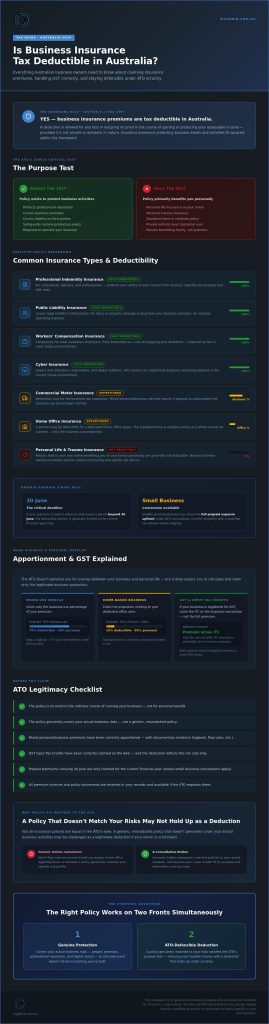
Your business insurance premium isn't just a cost of doing business. It's a legitimate tax deduction that could meaningfully reduce what you owe the ATO each financial year. So if you've been wondering whether business insurance is tax deductible in Australia, the short answer is yes, but the full picture is worth understanding properly before you lodge your return. If premiums feel heavier than they used to, you're not imagining it. Many Australian business owners are feeling the pressure of rising insurance costs in 2026, and the last thing you want is to overpay your tax bill on top of that. Add in the genuine confusion around GST, Input Tax Credits, and what the ATO actually expects to see if it comes knocking, and it's easy to see why so many people feel uncertain about what they can and can't claim. This guide cuts through that uncertainty. You'll discover exactly which business insurance premiums qualify as deductions, how to handle the GST correctly, and what makes a claim legitimate in the ATO's eyes. More than that, you'll see how the right policy, one that's genuinely matched to your specific risks, isn't just protection. It's a strategic asset working for your business on two fronts at once. Key Takeaways Understanding whether business insurance is tax deductible in Australia comes down to one core ATO principle: the premium must be incurred in the ordinary course of running your business, not for personal benefit. When your business and personal life overlap — such as with a home-based operation — you'll need to apportion your premiums correctly and understand how GST and Input Tax Credits affect what you can actually claim. Not all insurance policies are created equal in the ATO's eyes; a policy that doesn't genuinely cover your actual risks may not hold up as a legitimate business deduction if scrutinised. A consultative broker can uncover hidden exposures that generic online calculators routinely miss, ensuring your cover is both fit for purpose and defensible come tax time. Getting your insurance strategy right in 2026 means working smarter on two fronts at once — genuine protection for your business and a deduction that holds up under ATO scrutiny. Table of Contents The ATO Rules: Understanding Deductibility for Business Insurance Apportionment and GST: Navigating Complex Tax Scenarios Strategic Protection: Why Broker-Led Policies Maximise Value The ATO Rules: Understanding Deductibility for Business Insurance The foundation of any legitimate insurance deduction sits inside Section 8-1 of the Income Tax Assessment Act 1997. Under this provision, you can claim a deduction for any loss or outgoing incurred in the course of gaining or producing your assessable income, provided it isn't private or domestic in nature. Insurance premiums fit squarely within that framework because they protect the very assets and activities that generate your income. The ATO doesn't view them as optional extras; it treats them as a genuine … [Read more...] about Is Business Insurance Tax Deductible? 2026 Guide

Small Business Risk Assessment: 2026 Australian Guide
Most small business risk assessment checklists you'll find online were built for everyone, which means they were really built for no one. If you've ever downloaded a generic template and found yourself staring at categories that have nothing to do with your trade, your clients, or the way you actually operate day-to-day, you already know the feeling: a vague sense that something important has been missed, but no clear idea what. That anxiety is entirely reasonable. The gap between ticking a compliance box and being genuinely protected is wider than most business owners realise, and the consequences of confusing the two can be serious. A cyber incident, a client dispute, or an unexpected liability claim doesn't care how neatly your paperwork was filed. This guide was written specifically for Australian small business owners who want more than a superficial exercise. Working through a proper small business risk assessment checklist should feel less like bureaucratic housekeeping and more like a thorough investigation into everything that keeps your livelihood running. By the end, you'll have a clear, prioritised picture of your actual vulnerabilities, a framework for acting on them, and a solid understanding of how to translate that picture into the right insurance coverage for your specific situation. Key Takeaways Australian small businesses face a distinct set of pressures in 2026 — from shifting regulatory requirements to escalating digital threats — that generic, one-size-fits-all templates simply aren't equipped to address. Working through a proper small business risk assessment checklist is a methodical, five-step process that moves well beyond surface-level compliance, helping you uncover the vulnerabilities most likely to threaten your specific livelihood. Physical assets, digital data, and the professional advice you give to clients all carry exposure — and knowing which of these is most at risk in your business changes everything about how you protect it. A completed risk assessment isn't just paperwork; it becomes the foundation for a consultative insurance broker to build coverage that actually fits, rather than a policy assembled from automated guesswork. The difference between a "tick and flick" quote and a deep-dive approach can be the difference between being covered and being caught out — this guide shows you how to tell the two apart. Table of Contents Understanding Business Risk in the Australian Market Your 5-Step Small Business Risk Assessment Checklist Implementing Your Strategy: From Checklist to Comprehensive Coverage Understanding Business Risk in the Australian Market At its core, a risk assessment is a methodical process of identifying what could go wrong in your business, evaluating how likely that is to happen, and deciding what you're going to do about it before it does. The risk assessment methodology that underpins this process has been refined across industries for decades, but applying it meaningfully … [Read more...] about Small Business Risk Assessment: 2026 Australian Guide

Small Business Risk Assessment Checklist: A 2026 Guide for Australian Business Owners
What if the greatest threat to your livelihood isn't a competitor, but a hidden vulnerability tucked away in your daily operations? With a cyber incident reported every six minutes in Australia, the stakes for local owners have never been higher; yet, most generic templates fail to address the unique complexities of our modern environment. We recognise the frustration of wading through non-applicable advice while worrying about professional liability or data breaches. That's why we've put together this small business risk assessment checklist, designed to help you identify and manage the specific pressures facing Australian enterprises in 2026. We understand that keeping up with shifting regulations, such as the 12% superannuation guarantee or the new Payday Super requirements, can feel like a constant weight on your shoulders. It's natural to feel a sense of anxiety when trying to distinguish between different types of liability or wondering if your data is truly secure. Our goal is to replace that uncertainty with a sense of professional confidence and relief. We'll walk you through a consultative framework that moves beyond simple tick-boxes, providing you with a clear roadmap to bridge the gap between identifying a threat and achieving genuine peace of mind. Key Takeaways Move beyond generic "tick and flick" templates by adopting a methodical, consultative approach that uncovers the hidden vulnerabilities unique to your trade. Utilise our tailored small business risk assessment checklist to identify operational and legal gaps before they escalate into costly disruptions. Learn how to manage 2026-specific pressures, from new payday super requirements to the rising frequency of local cyber incidents. Discover the essential steps to bridge the gap between spotting a risk and transferring it through the right insurance cover. Recognise why a seasoned broker is your best ally in navigating complex liability issues and avoiding the pitfalls of automated quotes. Table of Contents Beyond the 'Tick and Flick': A Consultative Framework for Business Risk The 2026 Small Business Risk Assessment Checklist Bridging the Gap: From Risk Identification to Protection Beyond the 'Tick and Flick': A Consultative Framework for Business Risk A true risk assessment isn't just a compliance hurdle to clear. It's a methodical deep-dive into the operational, financial, and legal vulnerabilities that could otherwise stay hidden beneath the surface of your daily grind. We often see owners fall into the "tick and flick" trap, using generic templates that barely scratch the surface of their specific trade. This superficial approach often leads to catastrophic underinsurance or missed exposures that only come to light when it's already too late. By looking beneath the surface, we can reveal risks that automated systems ignore. To better understand how a structured review protects your livelihood, watch this helpful video: In the … [Read more...] about Small Business Risk Assessment Checklist: A 2026 Guide for Australian Business Owners

Insurance Broker vs Direct Insurer: Which is Better for Australian Small Businesses?
Did you know that while only 10% of Australian small businesses admit to being underinsured, industry data from June 2026 suggests the actual rate of exposure for property and asset values could be as high as 70%? It's a sobering thought for any business owner who has ever felt frustrated by impersonal, automated quote systems or confused by the dense jargon found in standard policy documents. When you are weighing up the choice of an insurance broker vs direct insurer for small business, you aren't just comparing prices; you're deciding who will stand in your corner when things go wrong. We understand that you want the peace of mind that comes with knowing your hard-earned assets are genuinely protected by a policy tailored to your specific operations, not a generic package. This article will show you why the right choice determines whether your claim is settled swiftly or leaves you facing a significant financial shortfall. We will look at the vital role of expert advocacy and how a methodical risk analysis can turn a complex, high-friction experience into a secure and certain outcome for your business. Key Takeaways Identify who is truly standing in your corner by understanding the fundamental difference in loyalty between a broker and a direct insurer. Discover why the specific choice of an insurance broker vs direct insurer for small business can be the deciding factor in whether a complex claim is successfully resolved. Understand why the "tick and flick" model of direct quoting often leaves Australian business owners unknowingly exposed when a crisis occurs. Learn how to spot the difference between a "deep-diver" who investigates your unique risks and a "skimmer" who offers generic, automated packages. Gain the clarity you need to ensure your policy is a precise fit for your operations rather than a high-risk, generic compromise. Table of Contents Insurance Broker vs Direct Insurer: Understanding the Fundamental Difference Why Brokered Claims are Twice as Likely to Be Paid in Full Choosing Your Partner: How to Spot a High-Value Insurance Broker Insurance Broker vs Direct Insurer: Understanding the Fundamental Difference We often see business owners choose direct insurance because it feels efficient and cost-effective in the moment. However, the fundamental difference between an insurance broker vs direct insurer for small business is who the representative actually works for. A direct insurer is an employee of the insurance company; their primary loyalty is to their employer's bottom line. Conversely, an Insurance broker acts as your professional advocate, legally bound to act in your best interests to find the most suitable protection across the entire market. To better understand how these roles differ in practice, watch this helpful comparison: Most direct platforms rely on a "tick and flick" approach. You answer a few generic questions, and a computer generates a quote based on a standard template. This speed often … [Read more...] about Insurance Broker vs Direct Insurer: Which is Better for Australian Small Businesses?