
Most small business risk assessment checklists you’ll find online were built for everyone, which means they were really built for no one. If you’ve ever downloaded a generic template and found yourself staring at categories that have nothing to do with your trade, your clients, or the way you actually operate day-to-day, you already know the feeling: a vague sense that something important has been missed, but no clear idea what.
That anxiety is entirely reasonable. The gap between ticking a compliance box and being genuinely protected is wider than most business owners realise, and the consequences of confusing the two can be serious. A cyber incident, a client dispute, or an unexpected liability claim doesn’t care how neatly your paperwork was filed.
This guide was written specifically for Australian small business owners who want more than a superficial exercise. Working through a proper small business risk assessment checklist should feel less like bureaucratic housekeeping and more like a thorough investigation into everything that keeps your livelihood running. By the end, you’ll have a clear, prioritised picture of your actual vulnerabilities, a framework for acting on them, and a solid understanding of how to translate that picture into the right insurance coverage for your specific situation.
Key Takeaways
- Australian small businesses face a distinct set of pressures in 2026 — from shifting regulatory requirements to escalating digital threats — that generic, one-size-fits-all templates simply aren’t equipped to address.
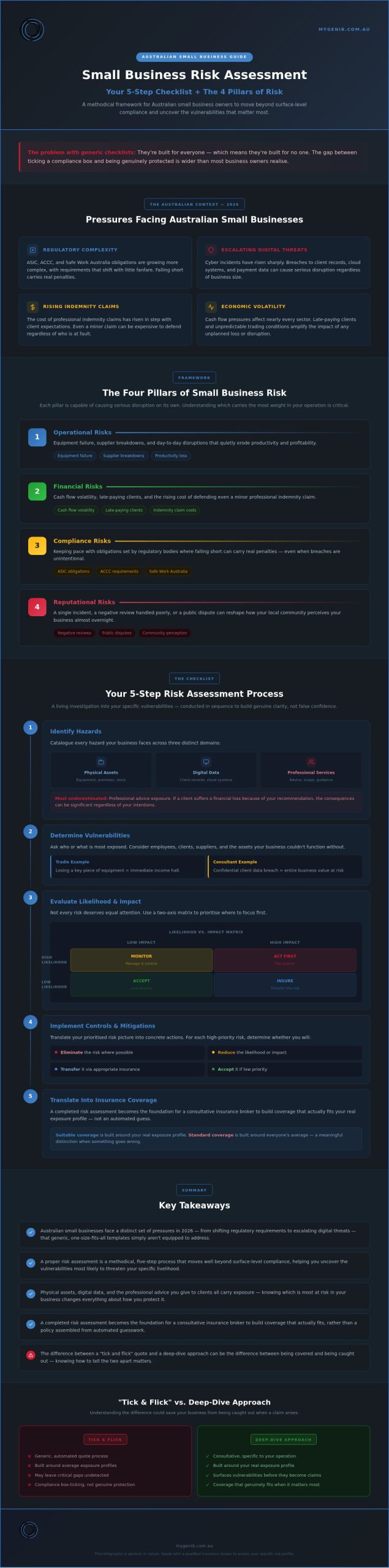
- Working through a proper small business risk assessment checklist is a methodical, five-step process that moves well beyond surface-level compliance, helping you uncover the vulnerabilities most likely to threaten your specific livelihood.
- Physical assets, digital data, and the professional advice you give to clients all carry exposure — and knowing which of these is most at risk in your business changes everything about how you protect it.
- A completed risk assessment isn’t just paperwork; it becomes the foundation for a consultative insurance broker to build coverage that actually fits, rather than a policy assembled from automated guesswork.
- The difference between a “tick and flick” quote and a deep-dive approach can be the difference between being covered and being caught out — this guide shows you how to tell the two apart.
Understanding Business Risk in the Australian Market
At its core, a risk assessment is a methodical process of identifying what could go wrong in your business, evaluating how likely that is to happen, and deciding what you’re going to do about it before it does. The risk assessment methodology that underpins this process has been refined across industries for decades, but applying it meaningfully to a small business requires something that generic frameworks rarely offer: specificity to your actual circumstances.
Australian small businesses are operating in a distinctly pressured environment right now. Regulatory obligations have grown more complex, with bodies like ASIC, the ACCC, and Safe Work Australia each carrying expectations that can shift with little fanfare. Digital threats have escalated sharply, and the cost of professional indemnity claims has risen in step with client expectations. Add to that the economic volatility affecting cash flow across nearly every sector, and it becomes clear why so many business owners feel a low-grade anxiety they can’t quite name.
That feeling is your instincts working correctly. It’s a signal that something deserves a closer look, not a reason to reach for the nearest pre-packaged solution. Working through a proper small business risk assessment checklist is how that vague unease gets converted into something you can actually act on.
The Four Pillars of Small Business Risk
Risk doesn’t arrive in a single form. For most Australian small businesses, it clusters around four distinct areas, each capable of causing serious disruption on its own:
- Operational risks: Equipment failure, supplier breakdowns, and the day-to-day disruptions that quietly erode productivity and profitability.
- Financial risks: Cash flow volatility, late-paying clients, and the rising cost of defending even a minor professional indemnity claim.
- Compliance risks: Keeping pace with obligations set by ASIC, the ACCC, and Safe Work Australia, where falling short can carry real penalties.
- Reputational risks: A single incident, a negative review handled poorly, or a public dispute can reshape how your local community perceives your business almost overnight.
Understanding which of these pillars carries the most weight in your specific operation is the difference between business insurance that genuinely fits and standard coverage that leaves critical gaps. Suitable coverage is built around your real exposure profile. Standard coverage is built around everyone’s average one, which is a meaningful distinction when something goes wrong.
Your 5-Step Small Business Risk Assessment Checklist
A proper small business risk assessment checklist isn’t a document you fill in once and file away. It’s a living investigation into the specific vulnerabilities of your business, conducted in a sequence that builds genuine clarity rather than false confidence. Here’s how to work through it properly.
Step 1: Identify Hazards
Start by cataloguing every category of hazard your business faces across three distinct domains: physical assets (equipment, premises, stock), digital data (client records, cloud systems, payment information), and the professional advice or services you deliver to clients. That third category is where most business owners underestimate their exposure. If a client suffers a financial loss because of your recommendation, your guidance, or even a miscommunication about scope, the consequences can be significant regardless of your intentions.
Step 2: Determine Vulnerabilities
Once hazards are identified, ask who or what is most exposed. This means thinking about employees, clients, suppliers, and the assets your business couldn’t function without. A tradie losing a key piece of equipment faces a different vulnerability profile than a consultant whose entire value sits in confidential client data, or a specialised e-commerce business like The Fight Club dealing with physical stock and global supply chains.
If your risk assessment highlights significant exposure in transport or international shipping, you can check out Freight and More Pty Ltd to see how specialised logistics providers manage these complex supply chain hazards.
Similarly, for businesses in the construction or property maintenance sectors, managing physical site hazards is essential; arranging professional skip bin hire Sydney ensures that waste is handled safely and according to regulatory standards.
Step 3: Evaluate Likelihood and Impact
Not every risk deserves equal attention. A simple two-axis matrix, plotting likelihood against potential impact, helps you prioritise where to focus first. A low-likelihood, low-impact event warrants a different response than something that could realistically happen and would cause serious financial or reputational damage. Work through each identified hazard and place it honestly on that grid.
Step 4: Record and Implement Controls
Documentation matters here, and not just for compliance purposes. A written record of your identified risks and the controls you’ve put in place demonstrates due diligence to insurers and regulators alike. It also makes the conversation with a broker considerably more productive. When you arrive with a clear picture of your exposure, you’re far more likely to leave with coverage that actually fits.
Step 5: Review and Update
Risk isn’t static. A new employee, a new service offering, a new client type, or a shift in how you store data can each introduce vulnerabilities that didn’t exist six months ago. Schedule a formal review at least annually, and revisit your assessment whenever something material changes in your operation.
Looking Beneath the Surface
Generic templates tend to cluster around the obvious: fire, theft, public liability. What they routinely miss are the subtler exposures that sit just beneath the surface. Professional indemnity insurance gaps are a common example. Many business owners don’t realise they carry professional liability simply by giving advice, making recommendations, or providing a service that a client relies upon to make decisions. An outside-in perspective helps here: ask yourself what a new set of eyes would notice about your operation that you’ve simply stopped seeing.
Digital and Cyber Vulnerabilities
Cyber risk is the potential for unauthorised digital access to disrupt your operations or compromise data, and it deserves its own dedicated sub-checklist. Work through each of the following honestly:
- Passwords: Are unique, complex passwords used across all business accounts, and is multi-factor authentication enabled wherever possible?
- Cloud storage: Do you know exactly where your client data lives, who has access to it, and what happens to it if a provider is breached?
- Client confidentiality: Are there clear internal protocols around how sensitive client information is stored, shared, and disposed of?
- Software updates: Are operating systems and applications kept current, or are there devices running outdated software that could be exploited?
- Staff awareness: Has your team received any guidance on phishing, social engineering, or safe data handling practices?
If several of these prompt an uncomfortable pause, that’s useful information. It means your digital exposure is likely higher than your current protections account for, and it’s worth exploring whether a dedicated cyber insurance policy belongs in your coverage mix.
Implementing Your Strategy: From Checklist to Comprehensive Coverage
A completed small business risk assessment checklist is genuinely useful on its own. But its real power emerges when it becomes the starting point for a conversation with a broker who knows how to read it. That distinction matters more than most business owners realise.
Automated quote platforms work in reverse. They take a handful of inputs, match them against a standardised product, and return a price. The process is fast, and the result looks like coverage. What it rarely produces is a policy built around the specific vulnerabilities you’ve just spent time carefully mapping. The gap between what you think is covered and what actually is covered tends to live in that space between a quick online form and a proper professional review.
The Role of an Expert Broker
A consultative insurance broker brings something an algorithm can’t: the ability to read your risk profile with the benefit of experience. With over 20 years in the Australian market, Anthony Simpson at MyGen Insurance Brokers has seen the claims that catch business owners off guard, the policy exclusions that only surface at the worst possible moment, and the coverage configurations that genuinely hold up under pressure. That kind of pattern recognition is what turns your completed checklist into a policy that fits rather than one that approximates.
Professional risk documentation also carries weight with underwriters. A well-evidenced assessment demonstrates that you take your obligations seriously, and that can translate into more favourable terms. It shifts the conversation from reactive to strategic.
Next Steps for Your Business
Once you’ve worked through your small business risk assessment checklist, the next step isn’t to file it away. It’s to use it as the agenda for a proper review with someone who can identify what it reveals and what it might still be missing.
Risk management isn’t a one-time exercise. As your business grows, adds services, or takes on new clients, your exposure profile shifts with it. A broker relationship built on this kind of depth becomes a long-term partnership, one that evolves alongside your business rather than staying fixed to a policy you bought years ago.
Don’t settle for an automated estimate when your livelihood deserves a considered one. Reach out to MyGen Insurance Brokers for a personalised review that starts with your actual circumstances, not a generic template.
Your Next Step Towards Genuine Protection
Working through a proper small business risk assessment checklist is one of the most grounded investments you can make in your business. It converts vague anxiety into clear priorities, surfaces the vulnerabilities that generic templates routinely miss, and gives you something concrete to build your coverage around.
The businesses that fare best when something goes wrong aren’t necessarily the ones with the most policies. They’re the ones whose coverage was built around a real understanding of their actual exposure. That’s a distinction worth taking seriously.
At MyGen Insurance Brokers, Anthony Simpson brings over 20 years of Australian industry experience to every consultation. The approach is deliberately unhurried and consultative, designed to identify what matters most for your specific operation rather than matching you to a standardised product.
Your livelihood deserves that level of care. Book a personalised risk consultation with MyGen Insurance Brokers and take the next step with a specialist who’ll look at your business properly, not just process it.
Frequently Asked Questions
Do I legally need a written risk assessment for my small business in Australia?
It depends on your industry and the nature of your work. Under Australia’s model Work Health and Safety laws, businesses with workers have a duty to identify and manage workplace hazards, and written documentation is strongly recommended as evidence of that duty being discharged. Certain industries, including construction, manufacturing, and healthcare, face more prescriptive requirements. Check your state or territory’s WHS regulator for obligations specific to your sector.
Even where a written assessment isn’t strictly mandated, having one on record is genuinely useful. It demonstrates due diligence to regulators, strengthens your position in the event of a dispute, and gives an insurance broker something concrete to work from when building coverage around your actual exposure rather than a generalised profile.
How often should a small business owner review their risk assessment checklist?
A formal review at least once a year is a sensible baseline, but your small business risk assessment checklist should also be revisited whenever something material changes in your operation. Taking on a new employee, launching a new service, shifting to cloud-based data storage, or acquiring new equipment can each introduce vulnerabilities that didn’t exist when you last worked through the process.
Think of it less as an annual compliance exercise and more as a habit of staying honest about what’s changed. Businesses evolve quickly, and a risk profile that was accurate twelve months ago may already have gaps that deserve attention today.
What is the difference between a hazard and a risk in a business context?
A hazard is the source of potential harm; a risk is the likelihood and consequence of that harm actually occurring. A wet floor in your premises is a hazard. The risk is that a client slips, injures themselves, and lodges a public liability claim against your business. For a premier sports bar like Club9, managing these types of physical hazards is a core part of their daily risk assessment. Keeping that distinction clear matters because it changes how you respond: hazards are identified and controlled, while risks are evaluated and prioritised based on how probable and serious they are.
Conflating the two is where many small business owners lose clarity during a risk assessment. Cataloguing every possible hazard without assessing the realistic likelihood of harm leads to either paralysis or a checklist so long it becomes useless. Working through both steps separately keeps the process grounded and actionable.
Can a risk assessment help lower my business insurance premiums?
A well-documented risk assessment can genuinely influence how underwriters view your business, and that can translate into more favourable terms. Insurers assess the quality of a business’s risk management practices when pricing coverage. Demonstrating that you’ve systematically identified your exposures and implemented controls signals a lower-risk operation, which is exactly what underwriters want to see.
The practical benefit isn’t always a direct premium reduction, but it often shows up in other ways: broader coverage terms, fewer exclusions, or a stronger negotiating position when a broker is advocating on your behalf. That’s one of the reasons arriving at a broker consultation with documented risk management in hand tends to produce better outcomes than showing up without it.