
Your business insurance premium isn’t just a cost of doing business. It’s a legitimate tax deduction that could meaningfully reduce what you owe the ATO each financial year. So if you’ve been wondering whether business insurance is tax deductible in Australia, the short answer is yes, but the full picture is worth understanding properly before you lodge your return.
If premiums feel heavier than they used to, you’re not imagining it. Many Australian business owners are feeling the pressure of rising insurance costs in 2026, and the last thing you want is to overpay your tax bill on top of that. Add in the genuine confusion around GST, Input Tax Credits, and what the ATO actually expects to see if it comes knocking, and it’s easy to see why so many people feel uncertain about what they can and can’t claim.
This guide cuts through that uncertainty. You’ll discover exactly which business insurance premiums qualify as deductions, how to handle the GST correctly, and what makes a claim legitimate in the ATO’s eyes. More than that, you’ll see how the right policy, one that’s genuinely matched to your specific risks, isn’t just protection. It’s a strategic asset working for your business on two fronts at once.
Key Takeaways
- Understanding whether business insurance is tax deductible in Australia comes down to one core ATO principle: the premium must be incurred in the ordinary course of running your business, not for personal benefit.
- When your business and personal life overlap — such as with a home-based operation — you’ll need to apportion your premiums correctly and understand how GST and Input Tax Credits affect what you can actually claim.
- Not all insurance policies are created equal in the ATO’s eyes; a policy that doesn’t genuinely cover your actual risks may not hold up as a legitimate business deduction if scrutinised.
- A consultative broker can uncover hidden exposures that generic online calculators routinely miss, ensuring your cover is both fit for purpose and defensible come tax time.
- Getting your insurance strategy right in 2026 means working smarter on two fronts at once — genuine protection for your business and a deduction that holds up under ATO scrutiny.
The ATO Rules: Understanding Deductibility for Business Insurance
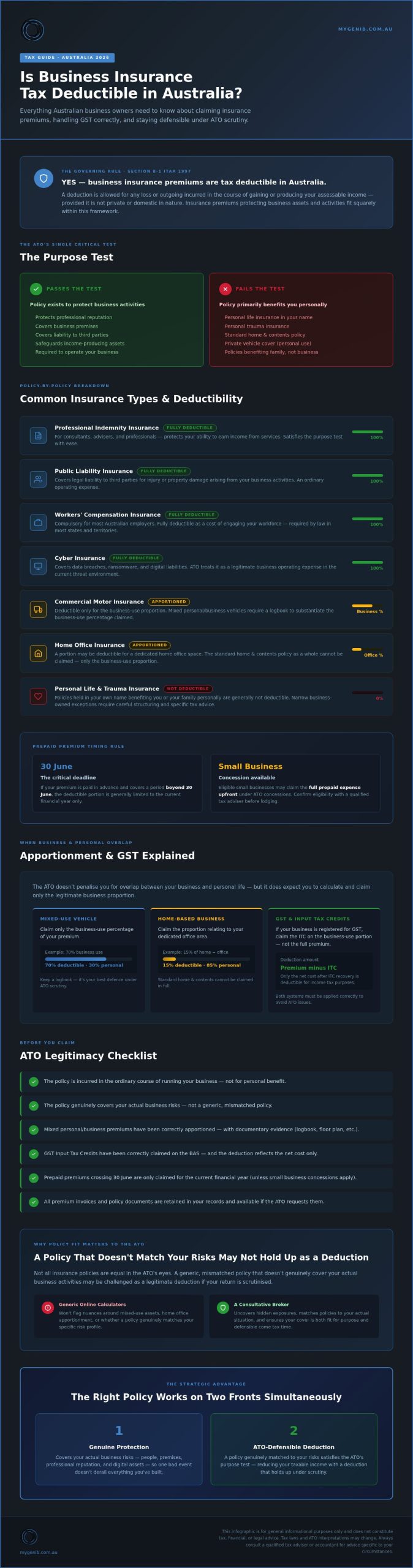
The foundation of any legitimate insurance deduction sits inside Section 8-1 of the Income Tax Assessment Act 1997. Under this provision, you can claim a deduction for any loss or outgoing incurred in the course of gaining or producing your assessable income, provided it isn’t private or domestic in nature. Insurance premiums fit squarely within that framework because they protect the very assets and activities that generate your income. The ATO doesn’t view them as optional extras; it treats them as a genuine cost of keeping a business operational.
The critical test is purpose. Ask yourself honestly: does this policy exist to protect your business activities, or does it serve a personal need? That single question is what the ATO calls the purpose test, and it’s the lens through which every premium you claim will be assessed if your return is ever scrutinised. A policy taken out to protect your professional reputation, your business premises, or your liability to third parties will pass that test. A policy that primarily benefits you as a private individual won’t.
Timing adds another layer of complexity. If you pay a premium in advance that covers a period extending beyond 30 June, the deductible portion is generally limited to the current financial year. Small businesses may be eligible to claim the full prepaid expense upfront under certain ATO concessions, but it’s worth confirming your eligibility with a qualified tax adviser before lodging.
Common Deductible Insurance Types for Australian Firms
Knowing whether business insurance is tax deductible in Australia is one thing; knowing precisely which policies qualify is another. Here’s how the most common covers are treated:
- Professional Indemnity Insurance: A core deduction for consultants, advisers, and any professional whose advice could expose them to a claim. Because the policy directly protects your ability to earn income from your professional services, it satisfies the purpose test with ease.
- Public Liability Insurance: Covers your legal liability to third parties injured or suffering property damage as a result of your business activities. Fully deductible as an ordinary operating expense.
- Workers’ Compensation Insurance: Compulsory for most employers across Australia and fully deductible as a cost of engaging your workforce.
- Cyber Insurance: As digital threats grow more sophisticated, this cover protects your business from data breaches, ransomware, and related liabilities. The ATO treats it as a legitimate business operating expense, and it’s deductible accordingly.
- Commercial Motor Insurance: Deductible for vehicles used in your business, but here’s the catch: if a vehicle serves both business and personal purposes, you can only claim the proportion of the premium that relates to business use. Keep a logbook; it’s your best defence if the ATO asks questions.
Non-Deductible Traps to Avoid
Not every premium qualifies, and confusing personal cover with business cover is one of the most common mistakes Australian business owners make. Life insurance and trauma insurance taken out in your own name are generally not deductible because they benefit you or your family personally, not your business operations. There are narrow exceptions involving business-owned policies, but those require careful structuring and specific tax advice.
Home insurance is another grey area. If you operate from a dedicated home office, you may be able to apportion a portion of your home insurance premium as a business deduction. However, the standard home and contents policy you hold as a homeowner sits firmly in the personal category and can’t be claimed in full. The distinction matters, and getting it wrong is the kind of error that draws ATO attention.
Understanding these boundaries is where a consultative approach pays dividends. Generic online calculators won’t flag these nuances. A broker who takes the time to understand your specific situation will.
Apportionment and GST: Navigating Complex Tax Scenarios
Claiming business insurance as a tax deduction becomes more nuanced the moment your business and personal lives share the same space, the same vehicle, or the same policy. The ATO doesn’t penalise you for that overlap, but it does expect you to separate the two with precision. Getting that calculation right is where many business owners quietly lose money, either by overclaiming and attracting scrutiny, or by underclaiming and leaving legitimate deductions on the table.
The core principle is straightforward: you can only deduct the portion of a premium that relates directly to your business activities. If a policy covers both purposes, you need to apportion it. That means identifying a defensible, reasonable method for calculating the business use percentage and applying it consistently year after year.
For home-based businesses, the most common approach is to calculate the proportion of your home that functions as a dedicated workspace. If your home office occupies 12% of your property’s total floor area, then 12% of the relevant home insurance premium may be claimable as a business expense. The key word is “dedicated.” A dining table that doubles as an occasional desk won’t satisfy the ATO’s requirements; a clearly defined room used exclusively for business purposes will.
Commercial vehicle insurance follows a similar logic. If a vehicle serves both business and private purposes, the deductible portion of the premium is limited to the percentage of kilometres driven for business. Keeping a contemporaneous logbook, one you update as you go rather than reconstruct at tax time, is the most reliable way to substantiate that figure. The ATO is well aware that logbooks created retrospectively tend to produce suspiciously round numbers.
Your accountant plays a critical role in finalising these apportionment figures at year-end. They can review your records, confirm you’ve applied a consistent and defensible methodology, and ensure the figures align with any other claims you’re making, such as home office running costs or vehicle depreciation. It’s a conversation worth having early, not on the eve of lodgement.
GST and Input Tax Credits
If your business is registered for GST, the way you claim insurance premiums changes in one important respect. Insurance premiums include GST, and if you’re entitled to claim an Input Tax Credit (ITC) for that GST through your Business Activity Statement, then the deductible amount you report in your income tax return is the net premium, excluding the GST component you’ve already recovered. Claiming both the full premium and the ITC would amount to a double benefit the ATO won’t allow.
There’s a specific rule worth knowing: for certain insurance types, the GST is calculated as one-eleventh of the premium. This is the standard formula, but the practical implication is that your income tax deduction and your GST credit must be calculated separately and consistently. In short, your ITC reduces the cost base of the premium, which in turn reduces the income tax deduction you can legitimately claim.
Home Office and Landlord Insurance Nuances
Landlord insurance occupies its own category. If you own a residential investment property, the premium for a dedicated landlord insurance policy is generally fully deductible as a rental property expense, because the policy exists solely to protect an income-producing asset. This is a cleaner deduction than the apportioned home office scenario, provided the property is genuinely tenanted or actively available for rent.
Where things get complicated is when a property serves multiple purposes across the year. A holiday rental that’s also used personally for several weeks requires the same apportionment discipline described above. Keep clear records of rental periods versus personal use, and let those figures drive the deductible portion of your premium.
If you’re uncertain whether your current policies are structured to support the cleanest possible deductions, speaking with a consultative broker can bring real clarity. A broker who takes the time to understand how you actually use your assets, rather than relying on a generic questionnaire, can ensure your cover is both fit for purpose and aligned with how you’ll need to account for it at tax time. That kind of detail-focused advice is what working with an experienced insurance broker is genuinely worth.
Strategic Protection: Why Broker-Led Policies Maximise Value
There’s a quiet risk hiding inside every “tick and flick” online insurance quote, and it has nothing to do with the premium. If a policy doesn’t accurately reflect your actual business activities, it may not respond the way you expect when a claim arises. And if it doesn’t genuinely protect your business operations, the ATO has grounds to question whether it qualifies as a legitimate business expense at all. The deductibility question and the coverage question are, in that sense, the same question.
Generic online calculators are built for speed, not precision. They can’t ask about the specific nature of your client contracts, the subcontractors you engage, or the professional advice your business provides. A consultative broker digs into exactly those details, identifying exposures that a standardised questionnaire would never surface. That depth of investigation is what makes the difference between a policy that genuinely protects your business and one that looks adequate on paper but leaves you exposed in practice.
The structure of your business also matters here. A sole trader and a company face different liability profiles, different contractual obligations, and different risk exposures. The policies that make sense for one structure may be poorly suited to the other. Getting that alignment right isn’t just good risk management; it’s what ensures your premiums are defensible as business deductions when the question of whether business insurance is tax deductible in Australia is put to the test.
Insurance brokers who take a consultative approach earn their place in your business by doing the work that automated platforms simply can’t replicate.
The MyGen Approach to Risk and Reward
At MyGen Insurance Brokers, the process begins with a genuine investigation into how your business actually operates, not how a dropdown menu assumes it does. With over 20 years of experience, broker Anthony Simpson brings the kind of pattern recognition that only comes from working across a wide range of industries and business structures. That experience means hidden risks get identified early, unnecessary cover gets removed, and the policies that remain are genuinely fit for purpose. As your business grows or changes direction, that relationship evolves with it, ensuring your cover stays aligned with your current risk profile and your tax position.
Preparing for the End of Financial Year (EOFY)
The weeks leading up to 30 June are the right time to review your business insurance portfolio, not just renew it automatically. A structured review in May or June can reveal policies that no longer match your business activities, premiums that need apportioning correctly, or cover gaps that have emerged as your operations have grown. Before you meet with your tax agent, gather the following:
- Policy schedules and renewal certificates for all business-related covers
- Premium invoices showing GST amounts separately
- Records of any apportionment calculations, such as home office floor area percentages or vehicle logbooks
- Documentation confirming the business purpose of each policy
Arriving at that conversation well-prepared means your tax agent can confirm whether business insurance is tax deductible in Australia for each of your specific policies, calculate the correct deductible amounts, and ensure your Input Tax Credits are reconciled properly. That’s the kind of clarity that turns a routine renewal into a genuine strategic advantage.
Your Next Step Toward Smarter, More Defensible Cover
The question of whether business insurance is tax deductible in Australia has a clear answer, but getting it right in practice takes more than a quick online search. You need policies that genuinely reflect your business activities, apportionment calculations that hold up under scrutiny, and a clear understanding of how GST interacts with your income tax deductions. Those three things working together are what turn your insurance spend into a legitimate, defensible asset at tax time.
Generic quotes won’t get you there. What does is a broker who takes the time to understand how your business actually operates, identifies the risks that automated platforms routinely miss, and builds cover that works on both fronts: real protection and a clean deduction.
With over 20 years of experience and a genuinely consultative approach, MyGen Insurance Brokers delivers exactly that kind of depth, for businesses across Australia. Don’t leave your coverage, or your tax position, to chance. Speak with a MyGen broker today to organise a comprehensive risk review for your business. You’ll finish the conversation with far more clarity than you started with.
Frequently Asked Questions
Is public liability insurance tax deductible for sole traders in Australia?
Yes, public liability insurance is fully tax deductible for sole traders in Australia. Because the policy protects your business activities and your legal liability to third parties, it satisfies the ATO’s purpose test under Section 8-1 of the Income Tax Assessment Act 1997. The deduction is claimed in the financial year the premium is incurred, and you’ll report the net amount if your business is registered for GST and you’ve claimed an Input Tax Credit.
One practical note for sole traders: if you operate from home and your public liability policy covers both your business premises and your personal property, you may need to apportion the premium. Keep clear records of how your workspace is used so that figure is defensible if the ATO ever asks.
Can I claim the GST component of my business insurance premium?
If your business is registered for GST, you can’t claim both the GST component as a tax deduction and as an Input Tax Credit simultaneously. The ATO treats these as separate mechanisms. You recover the GST portion through your Business Activity Statement as an Input Tax Credit, and then your income tax deduction is based on the net premium only, the amount excluding GST. Claiming the full premium inclusive of GST in your tax return when you’ve already recovered that GST would constitute a double benefit.
If your business isn’t registered for GST, the full premium including GST is deductible, because there’s no Input Tax Credit available to offset it. Your accountant can confirm which situation applies to your business and ensure the figures reconcile correctly across both your BAS and your income tax return.
What happens if I pay my annual insurance premium in June?
Paying your annual premium in June is a legitimate strategy, but the deductibility rules depend on your business size and the period the premium covers. If the policy runs from June through to the following May, general tax rules limit your deduction to the portion that falls within the current financial year. However, small businesses may qualify for an ATO concession that allows the full prepaid expense to be claimed upfront, provided the prepayment period doesn’t exceed 12 months.
Whether business insurance is tax deductible in Australia for the full amount in that June payment comes down to whether you meet the small business concession threshold, which the ATO reviews periodically. Confirm your eligibility with a qualified tax adviser before lodging, rather than assuming the full premium is claimable in the year of payment.
Is workers’ compensation insurance tax deductible for my employees?
Workers’ compensation insurance is fully tax deductible as a business operating expense. It’s a compulsory obligation for most employers across Australian states and territories, and the ATO treats the premium as a straightforward cost of engaging your workforce. The deduction applies to the employer’s premium, not to any benefit paid out to an employee following a workplace injury, which is a separate matter governed by your state’s workers’ compensation scheme.
Because workers’ compensation is state-regulated, premium structures and obligations vary depending on where your employees are based. If your business operates across multiple states, your premiums may be calculated and managed separately for each jurisdiction. A broker familiar with your specific workforce arrangement can help ensure your cover is correctly structured, so both your obligations and your deductions are in order.