

The cheapest public liability policy you find today might actually be the most expensive mistake your business ever makes. We know how unsettling it feels to stare at different quotes for the same amount of cover and have no idea why the prices vary so significantly. It’s natural to worry about paying for protection you don't need, or worse, finding out a cut-price policy leaves you vulnerable when a claim lands on your desk. Understanding the public liability insurance cost Australia businesses are navigating in 2026 requires looking beneath the surface of generic algorithms.We’ll demystify the specific drivers behind your premiums, from industry risks to the impact of turnover and location. You’ll gain the clarity needed to choose a policy that matches your unique risk profile, ensuring you're buying genuine peace of mind. We’ll also explain why a tailored assessment offers better value than a one-size-fits-all quote. Key Takeaways Identify the specific drivers, such as industry risk and annual turnover, that move your premium from a generic estimate to a precise reflection of your actual exposure. Navigate the complexities of the public liability insurance cost australia market by understanding why $5 million is the baseline and when contracts require a higher $20 million limit. Learn how implementing and documenting robust safety protocols acts as a stabilising force that can make your business more attractive to underwriters. Recognise the value of looking beneath the surface to bundle policies, turning a fragmented insurance portfolio into a cohesive and more cost-efficient protection strategy. Table of Contents Factors Influencing Public Liability Insurance Costs in Australia Evaluating Cover Levels: Why Precision Matters Over Price Strategic Risk Management: Reducing Your Long-Term Costs Factors Influencing Public Liability Insurance Costs in Australia We understand that a quote for your public liability insurance cost australia can feel like a moving target. It’s rarely about a single number; rather, it’s a reflection of your "Total Cost of Risk." Underwriters look at the broader landscape of Insurance in Australia to determine how likely your specific operations are to result in a claim. By looking beneath the surface of a generic quote, we can identify the precise variables that insurers use to calculate your premium, ensuring you aren't penalised for risks you don't actually carry.To better understand this concept, watch this helpful video: How Industry Risk Profiles Dictate Your Premium Australian underwriters use "hazard grades" to categorise your business activities based on historical data. A high-risk tradie working on a construction site faces a higher probability of property damage compared to a desk-based consultant. While a retailer might worry about a slip-and-fall incident, a hospitality venue manages complex personal injury risks related to food service or crowded spaces. This is why your business insurance must be … [Read more...] about Public Liability Insurance Cost Australia: 2026 Pricing Guide
Is Business Insurance Tax Deductible? 2026 Guide
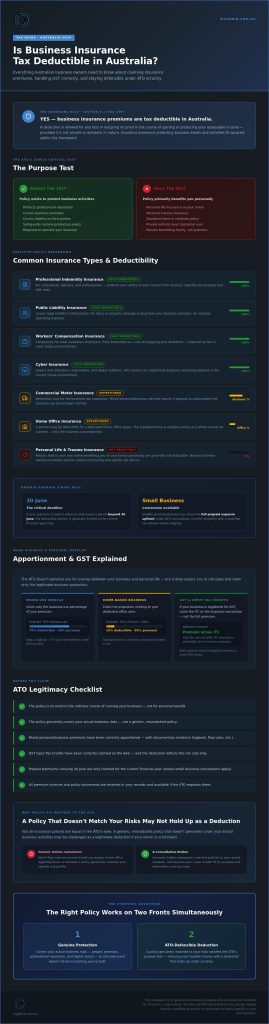
Your business insurance premium isn't just a cost of doing business. It's a legitimate tax deduction that could meaningfully reduce what you owe the ATO each financial year. So if you've been wondering whether business insurance is tax deductible in Australia, the short answer is yes, but the full picture is worth understanding properly before you lodge your return. If premiums feel heavier than they used to, you're not imagining it. Many Australian business owners are feeling the pressure of rising insurance costs in 2026, and the last thing you want is to overpay your tax bill on top of that. Add in the genuine confusion around GST, Input Tax Credits, and what the ATO actually expects to see if it comes knocking, and it's easy to see why so many people feel uncertain about what they can and can't claim. This guide cuts through that uncertainty. You'll discover exactly which business insurance premiums qualify as deductions, how to handle the GST correctly, and what makes a claim legitimate in the ATO's eyes. More than that, you'll see how the right policy, one that's genuinely matched to your specific risks, isn't just protection. It's a strategic asset working for your business on two fronts at once. Key Takeaways Understanding whether business insurance is tax deductible in Australia comes down to one core ATO principle: the premium must be incurred in the ordinary course of running your business, not for personal benefit. When your business and personal life overlap — such as with a home-based operation — you'll need to apportion your premiums correctly and understand how GST and Input Tax Credits affect what you can actually claim. Not all insurance policies are created equal in the ATO's eyes; a policy that doesn't genuinely cover your actual risks may not hold up as a legitimate business deduction if scrutinised. A consultative broker can uncover hidden exposures that generic online calculators routinely miss, ensuring your cover is both fit for purpose and defensible come tax time. Getting your insurance strategy right in 2026 means working smarter on two fronts at once — genuine protection for your business and a deduction that holds up under ATO scrutiny. Table of Contents The ATO Rules: Understanding Deductibility for Business Insurance Apportionment and GST: Navigating Complex Tax Scenarios Strategic Protection: Why Broker-Led Policies Maximise Value The ATO Rules: Understanding Deductibility for Business Insurance The foundation of any legitimate insurance deduction sits inside Section 8-1 of the Income Tax Assessment Act 1997. Under this provision, you can claim a deduction for any loss or outgoing incurred in the course of gaining or producing your assessable income, provided it isn't private or domestic in nature. Insurance premiums fit squarely within that framework because they protect the very assets and activities that generate your income. The ATO doesn't view them as optional extras; it treats them as a genuine … [Read more...] about Is Business Insurance Tax Deductible? 2026 Guide

When to Switch Insurance Brokers: A Strategic Guide for Australian Businesses
Is your insurance broker acting as a genuine advocate for your business, or have they become a silent partner who only appears when it's time to collect a commission? Many Australian business owners stay with the same firm for years out of habit, even as they notice a lack of proactive communication or see their premiums climb without a word of explanation. It's a common frustration to feel like just another entry in a spreadsheet rather than a valued client whose risks are being actively managed. Understanding when to switch insurance brokers is a strategic necessity, especially as recent regulatory shifts like the 2026 Insurance Brokers Code of Practice place a higher priority on transparency and your right to informed consent. We believe you deserve the peace of mind that comes from a partner who dives deep into your specific industry risks rather than simply skimming the surface. This guide will help you identify the critical signs of an underperforming broker and provide a clear roadmap for a transition that doesn't leave your coverage exposed. You'll learn how to move toward a more protective, consultative relationship where your assets are genuinely secured. We have outlined a methodical approach to ensure the process is seamless, shifting the burden of complexity away from your desk so you can focus on running your business with confidence. Key Takeaways Spot the warning signs of a "tick and flick" broker who only reaches out at renewal time, leaving your business vulnerable throughout the rest of the year. Discover the strategic 90-day "golden window" for when to switch insurance brokers to ensure a thorough market review without risking any gaps in your protection. Learn how the simple Broker of Record (BOR) letter works to authorise a more diligent partner to handle the heavy lifting of your transition. Understand why industry-specific expertise is vital for complex risks like professional indemnity insurance, ensuring your cover is tailored to your actual exposures. Shift from a transactional relationship to a consultative partnership that focuses on genuine advocacy, precision, and long-term asset security. Table of Contents Recognising the Signs: When Your Current Insurance Broker Is No Longer the Right Fit The Logistics of Transitioning: Timing, the Broker of Record Letter, and Avoiding Gaps Choosing Your Next Partner: Moving Beyond Automated Quotes to Personalised Protection Recognising the Signs: When Your Current Insurance Broker Is No Longer the Right Fit Business insurance isn't a "set and forget" arrangement; it's a dynamic shield that needs to evolve alongside your company. Many owners find themselves questioning what is an insurance broker? when their current provider feels more like a billing department than a strategic partner. If you only hear from your broker 14 days before your policy expires, you've likely fallen into the "tick and flick" trap. This transactional approach leaves your assets exposed because a … [Read more...] about When to Switch Insurance Brokers: A Strategic Guide for Australian Businesses

Commercial Vehicle Insurance: A Comprehensive Guide for Australian Businesses
Between 2019 and 2024, the average cost of motor insurance premiums in Australia climbed by a staggering 42 per cent, mirroring a sharp rise in claims expenses. If you're feeling the pressure of these rising overheads, you're certainly not alone. Many local business owners are currently struggling to distinguish between simple business use and the robust protection of commercial vehicle insurance, often fearing that a small oversight in disclosure could lead to a devastating denied claim. We understand that with repair costs up 26 per cent since 2022 and diesel prices recently surging, your focus is on survival and stability. We believe you deserve more than just a generic policy; you deserve the peace of mind that comes from knowing your assets are truly secure. This guide will show you how to protect your business assets and maintain continuity with a tailored approach to motor cover. We'll examine the latest 2026 regulatory shifts, including the APRA premium freeze and the new 21 day claims processing mandate, to ensure you have the clarity needed to choose the right level of protection for your fleet. By the end of this article, you'll understand how to identify the specific risks facing your vehicles and how to find a reliable partner to manage them. Key Takeaways Recognise the "Risk Gap" that exists when using a personal policy for business and learn how to secure your income-generating assets against denied claims. Evaluate the differences between Comprehensive, Third Party, and Fire and Theft cover to determine the most cost-effective protection for your specific vehicle type. Understand the long-term financial implications of choosing Agreed Value over Market Value to ensure your business continuity isn't compromised by a total loss. Discover how a precise, consultative approach to commercial vehicle insurance uncovers hidden risks that automated "tick and flick" systems often overlook. Learn why partnering with an expert to investigate your specific work nature is the most reliable way to find an underwriter that actually understands your trade. Table of Contents Understanding Commercial Vehicle Insurance: Why Your Personal Policy Isn't Enough Navigating Cover Options: Finding the Right Protection for Your Business Assets The Consultative Advantage: Organising Your Commercial Motor Cover with Precision Understanding Commercial Vehicle Insurance: Why Your Personal Policy Isn't Enough Many Australian business owners assume their daily drive is covered under a standard policy because they've ticked a "business use" box. However, Vehicle insurance is structured around specific risk profiles, and commercial operations introduce variables that domestic insurers simply aren't equipped to handle. Commercial vehicle insurance is a specialised policy designed for vehicles used primarily for income-generating activities. It closes the "Risk Gap" that occurs when your vehicle's mileage, cargo, and usage patterns exceed what a standard … [Read more...] about Commercial Vehicle Insurance: A Comprehensive Guide for Australian Businesses