
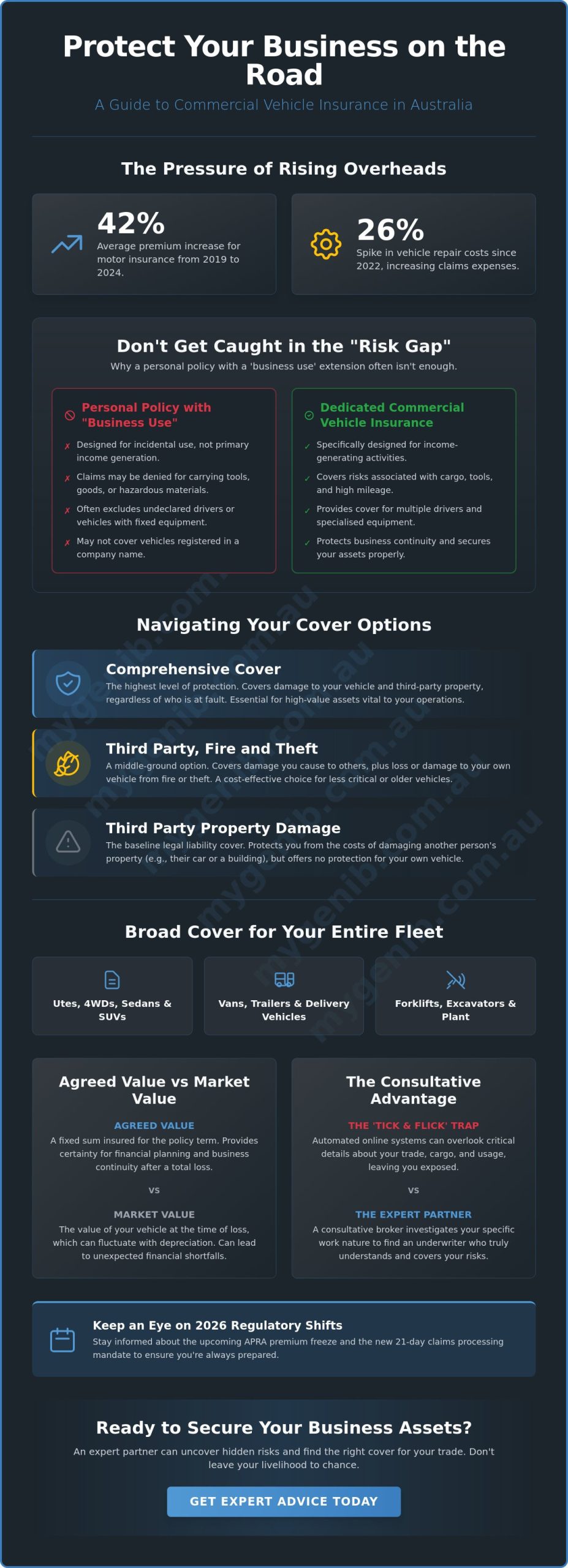
Between 2019 and 2024, the average cost of motor insurance premiums in Australia climbed by a staggering 42 per cent, mirroring a sharp rise in claims expenses. If you’re feeling the pressure of these rising overheads, you’re certainly not alone. Many local business owners are currently struggling to distinguish between simple business use and the robust protection of commercial vehicle insurance, often fearing that a small oversight in disclosure could lead to a devastating denied claim. We understand that with repair costs up 26 per cent since 2022 and diesel prices recently surging, your focus is on survival and stability.
We believe you deserve more than just a generic policy; you deserve the peace of mind that comes from knowing your assets are truly secure. This guide will show you how to protect your business assets and maintain continuity with a tailored approach to motor cover. We’ll examine the latest 2026 regulatory shifts, including the APRA premium freeze and the new 21 day claims processing mandate, to ensure you have the clarity needed to choose the right level of protection for your fleet. By the end of this article, you’ll understand how to identify the specific risks facing your vehicles and how to find a reliable partner to manage them.
Key Takeaways
- Recognise the “Risk Gap” that exists when using a personal policy for business and learn how to secure your income-generating assets against denied claims.
- Evaluate the differences between Comprehensive, Third Party, and Fire and Theft cover to determine the most cost-effective protection for your specific vehicle type.
- Understand the long-term financial implications of choosing Agreed Value over Market Value to ensure your business continuity isn’t compromised by a total loss.
- Discover how a precise, consultative approach to commercial vehicle insurance uncovers hidden risks that automated “tick and flick” systems often overlook.
- Learn why partnering with an expert to investigate your specific work nature is the most reliable way to find an underwriter that actually understands your trade.
Understanding Commercial Vehicle Insurance: Why Your Personal Policy Isn’t Enough
Many Australian business owners assume their daily drive is covered under a standard policy because they’ve ticked a “business use” box. However, Vehicle insurance is structured around specific risk profiles, and commercial operations introduce variables that domestic insurers simply aren’t equipped to handle. Commercial vehicle insurance is a specialised policy designed for vehicles used primarily for income-generating activities. It closes the “Risk Gap” that occurs when your vehicle’s mileage, cargo, and usage patterns exceed what a standard domestic underwriter considers “incidental” business use.
Standard domestic insurers often view business-related mileage through a narrow lens. They expect occasional trips to a local meeting, not the constant wear and tear of a mobile workshop or a delivery route. If you’re carrying tools, delivering goods, or visiting clients regularly, you’re operating outside the safety net of a personal policy. This specialized cover is essential for maintaining your business continuity when the unexpected happens on the road.
To better understand the different levels of protection available, watch this helpful video:
The Danger of the “Business Use” Extension on Personal Policies
Relying on a “business use” extension on a personal policy is often a gamble you don’t want to take. These extensions are generally intended for office workers who occasionally drive to a seminar, not for full-time commercial operations. Claims are frequently denied if the insurer discovers you were carrying hazardous materials or had multiple undeclared drivers using the vehicle. If your vehicle is registered in a company name or carries fixed plant and equipment, it’s time to transition from business car insurance to a dedicated commercial motor policy that actually understands your daily grind.
Broad Coverage: From Utes to Heavy Machinery
A comprehensive commercial vehicle insurance policy protects a diverse range of assets essential to your workflow. We see everything from the standard tradie’s ute to complex site machinery. Protection typically includes:
- 4WDs, sedans, and SUVs used for client visits.
- Vans, trailers, and light delivery vehicles.
- Forklifts, excavators, and specialised plant equipment.
For those operating larger fleets or heavy haulage, staying compliant with Australian heavy vehicle regulations is a non-negotiable part of your risk management. You can find more detail on these specific requirements in our guide to truck insurance.
Navigating Cover Options: Finding the Right Protection for Your Business Assets
Choosing the right level of protection is a strategic decision that affects your bottom line and your ability to recover after an incident. Most Australian insurers offer three distinct tiers of cover. Comprehensive is the gold standard, protecting your vehicle and third-party damage regardless of fault. Third Party, Fire and Theft provides a middle ground, while Third Party Property Damage is the baseline, covering only the damage you cause to others. Each tier serves a purpose, but the choice should reflect your vehicle’s value and its role in your daily operations.
Legal liability is perhaps the most critical component of commercial vehicle insurance. It shields your business from the astronomical costs associated with damaging high-end luxury cars or public infrastructure. While CTP is a compulsory insurance for business vehicles, it only addresses personal injury claims. A proper commercial policy ensures that a single mistake on the road doesn’t bankrupt your operation. Managing your premium often comes down to how you structure your excess. A higher voluntary excess can lower your annual costs, but you must balance this against your immediate cash flow. There’s no relief in a lower premium if you can’t afford the excess when a claim arises.
Essential Add-ons for Business Continuity
Standard policies often leave gaps that can halt your operations. We recommend looking at these specific extensions to keep your business moving:
- Hire Car After Accident: If your van is off the road, your income stops. This add-on provides a replacement vehicle while yours is being repaired.
- Windscreen and Glass Cover: For frequent highway users, a chipped windscreen is almost inevitable. Waiving the excess for glass claims is a small price for significant convenience.
- Tool and Stock Cover: Your vehicle policy usually doesn’t cover what’s inside. You’ll likely need a separate General Property or “Inland Marine” extension to protect your tools and trade stock.
Agreed Value vs. Market Value: A Strategic Business Choice
Deciding how your vehicle is valued determines your payout in a total loss scenario. Market Value is the cost to replace the vehicle at its current age and condition. Agreed Value is a fixed sum you and the insurer settle on at the start of the policy. For many professionals, Agreed Value is the safer bet. A consultant driving a prestige vehicle might choose this to ensure their payout covers an existing finance agreement. Since insurance for consultants australia often focuses on maintaining a professional image, having the certainty of a specific replacement value is vital. If you’re unsure which valuation suits your fleet, speaking with a specialist can help clarify your options.
The Consultative Advantage: Organising Your Commercial Motor Cover with Precision
The lure of an “instant quote” is strong when you’re busy running a business, but these automated systems often lead to the very confusion and claim denials you’re trying to avoid. A standard algorithm can’t ask the nuanced questions required to truly understand your risk. It doesn’t care if you’re a plumber with a single ute or a logistics firm with a dozen vans. We believe commercial vehicle insurance requires a human touch to ensure that the policy you pay for is the policy that performs when you need it most. As highlighted in Canstar’s guide to business car insurance, the distinction between personal and business use remains one of the most significant hurdles for Australian operators.
Before we sit down to review your cover, it helps to have your details ready. Having this information on hand allows us to deep-dive into your specific needs rather than skimming the surface:
- Vehicle Identification Numbers (VINs) and registration details.
- Comprehensive claims history for the last five years.
- A list of regular drivers and their driving records.
- Detailed descriptions of any vehicle modifications or fixed equipment.
Managing Fleet Risk and Multiple Drivers
Managing a growing fleet brings administrative headaches that a single-vehicle policy can’t solve. Consolidating your assets under one commercial vehicle insurance fleet policy simplifies your paperwork and often provides better leverage during renewals. We help you weigh the costs of “Any Driver” versus “Named Driver” cover, ensuring you aren’t overpaying for flexibility you don’t actually need. If you operate multiple vehicles and want to understand how to consolidate them cost-effectively, our fleet insurance for small business buying guide outlines the key steps Australian SMEs should take in 2026. Maintaining a safe driver record is the most sustainable way to keep your premiums manageable, and we can help you implement strategies to protect your claims-free rating.
Why Professional Advice Beats a Standard Algorithm
Professional advice is vital given the current regulatory climate. With the Australian Financial Complaints Authority (AFCA) now offering fast-track dispute resolution for commercial transport, having a partner who understands these mechanisms provides a layer of protection no software can replicate. Algorithms often ignore the latest shifts, such as the March 2026 APRA freeze on unjustified premium hikes. Understanding why expert insurance brokers provide more value than automated quotes is essential for any business owner who wants genuine protection rather than a false sense of security. At MyGen Insurance Brokers, we look beneath the surface of a standard policy to ensure your protection is robust and compliant. We investigate the fine print so you don’t have to, turning a high-friction process into a managed, secure outcome. Contact MyGen Insurance Brokers for a tailored consultation to see how we can protect your business assets.
Securing Your Business Future on the Road
Your business vehicles represent more than just transport; they’re the lifeblood of your daily operations. We’ve explored why a standard domestic policy creates a dangerous “Risk Gap” and how selecting the right valuation method can safeguard your cash flow during a total loss. Understanding these nuances ensures you aren’t just buying a policy, but investing in genuine business continuity. Getting your commercial vehicle insurance right requires looking beneath the surface of generic, automated quotes to find the specific protection your trade demands.
With over 20 years of industry experience as a Corporate Authorised Representative of Community Broker Network, our team provides a personalised, consultative risk assessment that looks beyond the algorithm. We’re here to do the heavy lifting for you, turning a complex requirement into a source of long-term security. Contact MyGen Insurance Brokers for a personalised commercial motor consultation today. Let’s work together to ensure your fleet is protected by a steady, experienced hand, giving you the clarity to focus on what you do best.
Frequently Asked Questions
Is my personal car insurance enough for my small business?
No, a personal policy is rarely sufficient if your vehicle is a primary tool for your trade or business. While some domestic insurers offer a “business use” extension, this is typically intended for incidental travel, such as driving to an occasional meeting, rather than the heavy usage seen in daily commercial operations. Relying on a personal policy for deliveries, carrying heavy tools, or frequent client visits creates a risk gap that could lead to a denied claim when you need support the most.
What is the difference between agreed value and market value in commercial motor insurance?
Market value is the current replacement cost of your vehicle based on its age and condition at the time of a loss, whereas agreed value is a fixed sum settled upon when the policy begins. Choosing an agreed value provides greater financial certainty, especially if you have specific finance obligations or a vehicle that is essential to your professional image. This choice ensures you aren’t left with a shortfall if your vehicle is written off, allowing you to replace your asset without unexpected out-of-pocket expenses.
Does commercial vehicle insurance cover the tools and equipment inside my van?
Standard commercial vehicle insurance typically protects the vehicle itself, but it doesn’t automatically cover the contents like tools, stock, or specialised equipment. To protect these vital assets, you’ll need to add a General Property or “Inland Marine” extension to your policy. We often see business owners discover this gap only after a theft or accident, so we make it a priority to investigate your specific cargo needs during our consultation process.
Can I insure a fleet of vehicles under one policy with different drivers?
Yes, you can consolidate multiple vehicles into a single fleet policy which allows for “Any Driver” or “Named Driver” configurations. This approach simplifies your administration and can offer more sustainable premiums by assessing the collective risk of your business rather than individual vehicles. It’s a practical way to manage staff turnover while ensuring every driver behind the wheel is protected under a consistent level of commercial vehicle insurance, regardless of which vehicle they are operating on the day.