
On July 1, 2026, the Heavy Vehicle National Law reform will fundamentally change how Australian operators manage risk; however, many businesses are still treating their truck insurance like a generic administrative chore. We understand the frustration of watching premiums rise while you’re left wondering if your policy actually covers the specific realities of your fleet. It’s exhausting to feel like you’re paying for protection that might fail you during a major loss or a complex claim process. You deserve a partner who looks beneath the surface to ensure your security is never left to chance.
We’ve developed this methodical checklist to help you navigate the complexities of heavy vehicle protection and the new APRA regulations, such as the mandatory 21-day claim settlements. You’ll gain a clear understanding of the difference between mandatory and optional covers, ensuring your policy is a precise match for your operational risks and new requirements like mandatory Safety Management Systems. We’ll show you how to move from a state of confusion to one of total clarity, giving you the peace of mind that your transport business is truly secure.
Key Takeaways
- Learn why specialised truck insurance is a fundamental necessity for heavy vehicles, providing the depth of cover that standard motor policies often lack.
- Identify the six essential elements of a robust checklist; this ensures your accidental damage and public liability covers are tailored to your specific fleet.
- Understand how the 2026 regulatory shifts impact your insurance obligations, helping you avoid the fear of being under-insured during a major loss.
- Discover why a methodical, deep-dive risk assessment by a professional broker is superior to the high-friction, “tick and flick” instant quote model.
- Gain a clear path to a secure outcome by learning to match your policy to your actual operational risks rather than settling for generic protection.
What is Truck Insurance and Why Does Your Business Need It?
At its core, truck insurance is a highly specialised subset of commercial motor insurance, essentially a more complex form of vehicle insurance tailored specifically for the logistics sector. While a standard car policy might cover a simple commute, it’s ill-equipped to handle the massive weights, articulated configurations, and high-value cargo that define your daily operations. We see it as a protective shield for your livelihood. It’s about ensuring that a single incident doesn’t undo years of hard work or leave you personally liable for significant damages.
To see how these costs and risks play out for an owner-operator on the ground, watch this practical perspective:
Staying compliant with the National Heavy Vehicle Regulator (NHVR) isn’t just about paperwork; it’s about survival. Australian transport regulations are becoming increasingly rigorous, especially with the 2026 reforms requiring documented Safety Management Systems for all accredited operators. Our approach at MyGen moves beyond a simple transaction. We don’t just look at the premium. We conduct a deep-dive into your actual risk exposure, identifying the gaps that generic “tick and flick” truck insurance policies often ignore. We want you to feel the relief that comes from knowing your business is built on a stable foundation.
Common Vehicle Types Covered in Australia
The Australian landscape requires a diverse fleet, and your cover needs to be just as flexible. We help operators secure protection for various configurations, including:
- Rigid trucks, prime movers, and B-doubles.
- Specialised trailers and earthmoving equipment.
- Light commercial vehicles and utes used for business purposes.
The Reality of Under-insurance on Australian Roads
Relying on a basic market value assessment can be a dangerous gamble. If your rig is custom-fitted with specialised gear, a standard payout won’t cover the cost of a like-for-like replacement. You also need to consider the impact of downtime. When your truck is off the road, your cash flow stops instantly, but your overheads and finance payments continue. A methodical insurance strategy accounts for these hidden pressures, providing a stabilising force when you need it most.
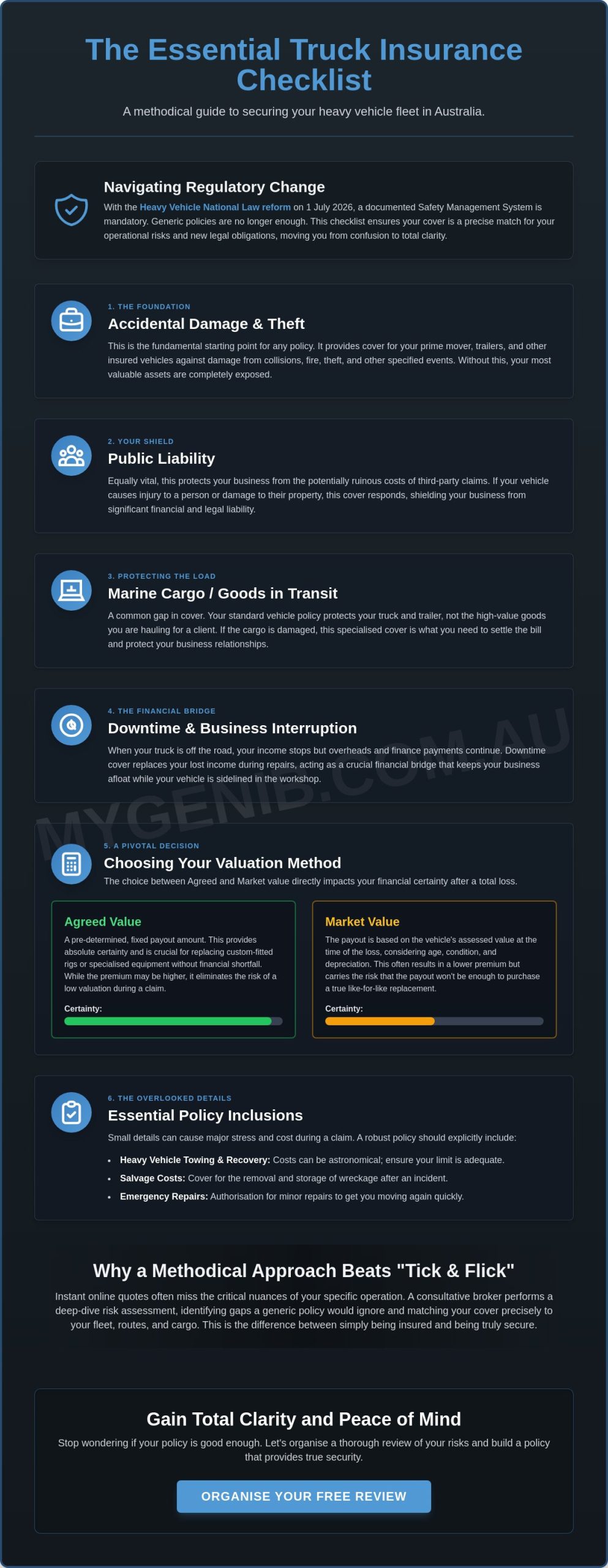
The Essential Truck Insurance Checklist: 6 Points to Organise
Organising your truck insurance shouldn’t feel like guesswork. We’ve seen too many operators struggle because they treated their policy as a single line item rather than a multi-layered safety net. A methodical checklist ensures you aren’t just “covered,” but protected against the specific frictions of the Australian transport industry. It’s about moving from a place of uncertainty to a position of professional confidence.
Start with the basics: Accidental Damage and Theft. This is your foundation, but it’s only the beginning. Public Liability is equally vital; it shields your business from the potentially ruinous costs of third-party injury or property damage claims. Beyond the vehicle itself, you must consider Marine Cargo insurance. If the goods in your trailer are damaged, your vehicle cover won’t help you settle the bill with your client. Finally, Downtime and Business Interruption cover acts as a financial bridge, keeping your bills paid while your rig is sidelined in the workshop.
Evaluating Your Coverage Levels
Choosing between Agreed Value and Market Value is a pivotal decision for your investment. While Market Value might seem cheaper, an Agreed Value policy provides the certainty of a fixed payout, which is often necessary to replace a custom rig in today’s market. You’ll also need to balance your excess. A higher excess lowers your monthly premium but increases your out-of-pocket risk during a claim. Downtime Cover is the specific mechanism that replaces your lost income during repairs. If you’re unsure which structure fits your fleet, our team can help you organise a thorough review of your current risks.
Inclusions You Might Have Overlooked
Small details often cause the most stress during a loss. Heavy vehicle towing and recovery costs can be astronomical, so ensure these are explicitly included in your policy. We also recommend checking for cover regarding driver personal effects and specialised tools. For subcontractors, liability for non-owned trailers is crucial. Aligning these details with the safety standards set by the National Heavy Vehicle Regulator ensures your business remains both compliant and resilient on the road.
Why a Consultative Broker Approach Beats ‘Tick and Flick’ Policies
In an industry where speed is often mistaken for efficiency, it’s tempting to settle for an automated quote. You’ve likely seen the ads promising a truck insurance price in under sixty seconds. While that speed feels convenient, it often masks a lack of rigour that can leave you exposed when a major loss occurs. We believe you deserve more than a generic transaction. Our team acts as a protective mentor; we do the heavy lifting to ensure your policy offers precision suitability rather than a one-size-fits-all compromise.
Choosing a broker means choosing a long-term partner who understands the inherent stress of the transport industry. We don’t just hand over a policy and disappear. We stand by you during the claims process, acting as your advocate with major Australian underwriters to ensure a fair and timely outcome. This methodical approach turns a high-friction experience into one that feels managed and secure, allowing you to focus on keeping your fleet moving.
The Problem with Automated Quotes for Trucks
The “tick and flick” model used by many online providers often misses the critical operational details that define your risk. If a form doesn’t ask about your specific cargo, your exact routes, or your driver training protocols, it isn’t providing a genuine assessment. This lack of depth creates a significant risk: your claim could be denied due to unintentional non-disclosure or incorrect categorisation in an automated system. To understand how these risks fit into the broader landscape, you can explore The Complete Guide to Business Insurance in Australia. It’s also worth understanding how commercial vehicle insurance differs from standard motor policies, particularly as Australian premium costs have surged by 42 per cent between 2019 and 2024. If you operate multiple vehicles, consolidating them under a single fleet insurance for small business policy can eliminate dangerous coverage gaps and reduce the administrative burden of managing separate renewal dates.
The MyGen Difference: Looking Beneath the Surface
Our process is built on investigation and discovery. We look beneath the surface to identify hidden risks that others might skim over, such as specific professional liability gaps if you provide logistics advice or consultancy. For those managing complex contracts, it’s worth checking out Insurance for Consultants in Australia: 5 Dangerous Myths Debunked to see how professional exposures are often misunderstood. We take pride in being “deep-divers” who value integrity over volume, ensuring that every truck insurance policy we place is a stabilising force for your business.
Securing Your Fleet for the Road Ahead
We understand that managing a transport business is a high-pressure endeavour; however, your truck insurance doesn’t have to be a source of constant anxiety. By moving away from generic policies and focusing on the essential checklist items like downtime cover and public liability, you build a resilient foundation for your operations. You’ve worked too hard to let an overlooked detail or an automated quote compromise your future. True security comes from a methodical investigation of your specific risks, ensuring that every rig and every load is precisely protected.
At MyGen, we’re a proudly Australian owned and operated firm that values depth over speed. Led by Anthony Simpson with over 20 years of industry experience, our team performs a thorough risk-assessment process to uncover the gaps that others might miss. We’re here to do the heavy lifting so you can focus on the road. We invite you to request a personalised truck insurance review from our expert brokers today. It’s time to trade confusion for clarity and move forward with the confidence that your livelihood is in safe hands.
Frequently Asked Questions
Is truck insurance mandatory in Australia?
Compulsory Third Party (CTP) insurance is the only legal requirement for vehicle registration across all Australian states and territories. While this covers personal injury to others, it doesn’t protect your assets or business interests. Most transport operators find that additional truck insurance, such as public liability and comprehensive cover, is practically mandatory to meet the requirements of freight contracts and finance agreements.
How much does truck insurance typically cost for an owner-driver?
The cost of your policy is determined by a range of specific factors, including the age of your vehicle, its mass limit, and the type of freight you transport. Because every operation is unique, we avoid generic pricing models in favour of a methodical risk assessment. We look at your claims history and safety protocols to ensure the premium reflects your actual exposure rather than a broad industry average.
What is the difference between comprehensive and third-party truck insurance?
Comprehensive insurance provides the most thorough protection, covering accidental damage to your own vehicle, theft, and damage you cause to third-party property. In contrast, third-party insurance only covers the costs associated with damage your truck causes to other people’s vehicles or property. Choosing a comprehensive policy offers the relief of knowing your own rig is protected against the unexpected.
Does my truck insurance cover the cargo I am carrying?
Standard vehicle policies generally don’t cover the goods you are hauling. To protect the freight itself, you’ll need a specific Marine Cargo or Goods in Transit policy. This is a critical distinction; without it, you could be personally liable for the full value of a lost or damaged load, which often far exceeds the value of the truck itself.
What happens if my truck is off the road for several weeks?
If your truck is sidelined for repairs, your fixed costs like finance payments and rego continue even though your income has stopped. This is why we advocate for Downtime Cover, which acts as a financial bridge by replacing lost revenue during the repair period. It’s a vital component for maintaining cash flow and ensuring a single accident doesn’t jeopardise your entire business operation.
Can a broker help me find better truck insurance than going direct?
A broker’s value lies in their ability to navigate the complex market to find precision suitability rather than just the lowest initial price. While direct insurers often use “one-size-fits-all” models, we use our industry expertise to negotiate with multiple underwriters. This deep-dive approach often leads to better long-term value by ensuring you aren’t paying for unnecessary extras while remaining fully protected against major losses.