
Does your current insurance policy actually cover your newest apprentice if they’re behind the wheel of the company ute during a morning delivery? Many Australian business owners spend their Sundays juggling multiple renewal dates and different insurers, constantly worrying whether their employees are truly protected while on the road. You probably feel that managing each vehicle individually is the only way to maintain control, but this fragmented approach often leads to higher premiums and dangerous gaps in your cover.
We understand that your vehicles are the lifeblood of your operations, and you deserve a strategy that protects them with precision rather than guesswork. This guide will show you how to consolidate your vehicles into a single, cost-effective fleet insurance for small business policy that provides deeper protection than standard retail insurance. By moving away from individual retail policies, you can secure professional-grade wording that includes flexible driver clauses for any authorised employee.
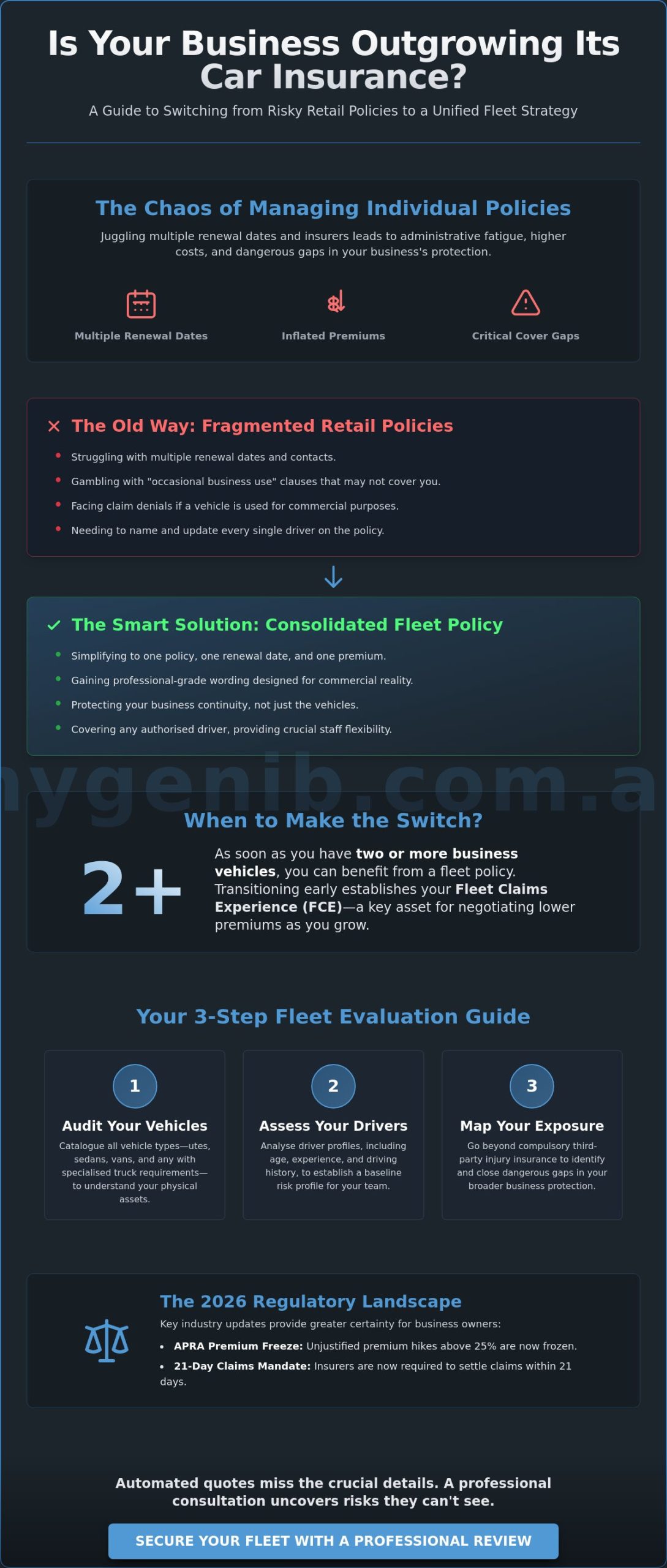
We will walk you through the 2026 landscape, including the recent APRA regulations that freeze unjustified premium hikes above 25 percent and the new 21 day claims settlement mandate. You will discover how to simplify your administration into one single renewal date while ensuring your business assets are shielded by the most current safety standards and tax-efficient structures available today.
Key Takeaways
- Learn how moving to a master contract provides a more robust safety net for your assets than a fragmented collection of retail policies.
- Discover how fleet insurance for small business simplifies your life by consolidating multiple renewal dates into a single, manageable premium.
- Master the essential steps for auditing your vehicles and driver history to ensure your cover’s precisely tailored to your operational risks.
- Understand why a methodical risk assessment identifies dangerous gaps in your broader business insurance that automated online quotes simply won’t detect.
Understanding Fleet Insurance for Small Business: Why Personal Policies Fall Short
Transitioning from a collection of individual car policies to a dedicated fleet insurance for small business strategy often feels like a significant leap, but it’s usually the moment your operations truly mature. At its core, a fleet policy is a single master contract that brings anywhere from 2 to 20 or more vehicles under one protective umbrella. While it’s easy to focus on the vehicles themselves, fleet insurance is actually a strategic tool designed to protect your business continuity by ensuring a single accident doesn’t derail your entire week’s schedule.
We often see owners struggling with renewal fatigue, where different vehicles expire in different months, leading to missed payments or administrative chaos. Consolidating these into one premium with a single renewal date and one point of contact provides immediate relief. Before diving into the complexities, it’s helpful to understand Vehicle insurance basics to see where retail cover ends and commercial protection begins.
To better understand this concept, watch this helpful video:
A common danger for growing SMEs is the usage trap. This occurs when personal insurers decline a claim because they discover a vehicle was used primarily for commercial purposes. If your van is full of tools or your sedan is constantly visiting clients, a standard retail policy might not stand up when you need it most. Professional-grade wording is designed to handle these commercial realities without the hair-splitting often found in consumer-level products.
The Risk Gap: Business Use vs. Private Use
Relying on occasional business use extensions on a personal policy is a gamble that rarely pays off for a busy trade or service business. Comprehensive commercial vehicle insurance is built to cover the heavy-duty reality of your work, including specialised equipment, custom shelving, and expensive signage that retail policies often exclude. Perhaps most importantly, fleet structures typically allow for any authorised driver. This means you don’t have to call your insurer every time a new staff member needs to run a quick errand in the company ute.
When to Transition: The Two-Vehicle Rule
You don’t need a massive logistics arm to benefit from a fleet structure. Most Australian insurers define a small fleet as consisting of 2 to 15 vehicles, meaning you can transition as soon as you put a second vehicle on the road. Starting early allows you to establish a Fleet Claims Experience (FCE). This is a dedicated claims history for your business rather than individual drivers. A clean FCE is a powerful asset; it gives us the leverage to negotiate lower premiums as your business grows, rewarding your commitment to safety and methodical risk management.
Buying Guide: How to Evaluate Your Business Auto Insurance Needs
Evaluating your fleet insurance for small business requires a methodical eye. You can’t simply guess what you need; you have to look at the reality of your daily operations to ensure your safety net is actually wide enough to catch you. We begin by looking beneath the surface of your current setup to identify where your biggest risks live.
Step 1 involves a thorough audit of your vehicle types. Your fleet might include the sales team’s sedans, several work utes, or vehicles with truck insurance requirements that demand specialised wording. Step 2 focuses on your people. In a tight labour market, you need the flexibility to hire staff quickly, so assessing driver profiles, including age and experience, is essential for setting your baseline cover.
Step 3 addresses your legal and financial exposure. While you must maintain compulsory motor vehicle insurance for personal injury liability, most Australian fleets require at least $20 million in Third Party Property Damage to protect against catastrophic incidents. Finally, Step 4 reviews “Loss of Use” benefits. This ensures that if a key vehicle is off the road after an accident, your business stays mobile with a replacement, protecting your revenue from a sudden halt.
Evaluating Coverage Levels: Comprehensive vs. Third Party
Comprehensive cover remains the gold standard for high-value assets because it protects against accidental damage, fire, and theft. For older vehicles that aren’t critical to your daily operations, Third Party Property Damage (TPPD) is the absolute minimum you should consider. It ensures that if a driver clips a luxury vehicle or damages public property, your business isn’t left with a debt that could threaten its future. Fire and Theft cover can serve as a practical middle ground for mid-range assets that don’t justify a full comprehensive premium.
Essential Clauses: Driver Flexibility and Excess Structures
Structuring your policy with an “Any Authorised Driver” clause is a vital move for growing teams. It prevents the stress of claim denials if a new staff member gets behind the wheel before you’ve had a chance to update the insurer. You also need to understand the “Age Excess” and how it applies to your younger tradies. While employing drivers under 25 may increase your costs, choosing a higher excess can help you balance your immediate cash flow. We also look for “Automatic Additions and Deletions” clauses, which allow you to scale your fleet up or down without constant paperwork. If you want to ensure your driver clauses match your current team, our Commercial Motor Insurance specialists can help you refine these details.
The MyGen Approach: Why Consultation Beats Automated Fleet Quotes
In a market flooded with “instant” online calculators, it’s tempting to think a few clicks can solve your complex logistics needs. However, these “tick and flick” forms often overlook the specific details that matter most, such as custom signage or high-value tool kits. We believe in a methodical, consultative risk assessment that looks beneath the surface of your operations. This approach allows us to identify dangerous overlaps or gaps in your wider business insurance portfolio, ensuring you aren’t paying twice for the same cover or, worse, leaving a vital asset unprotected.
When it comes to managing your business insurance, having a steady hand to guide you through the claims process is invaluable. Under the 2026 APRA mandate, underwriters must now settle clear commercial claims within 21 days. We act as your advocate during these high-pressure moments, ensuring large insurers meet their obligations while you focus on keeping your team on the road. This relationship model means we don’t just find you a policy; we grow as your fleet grows, adjusting your cover as your risk profile evolves.
Beyond the Premium: The Value of Expert Advocacy
The cheapest quote often carries the highest hidden cost through restrictive clauses that limit who can drive or where your vehicles can be stored. It’s a reality that insurance brokers provide the diligence that algorithms simply cannot match, especially when navigating a fleet insurance for small business policy. We look for the traps that automated systems ignore, ensuring your “any authorised driver” clause is robust enough to handle real-world staff changes.
Proactive Risk Management to Lower Your Premiums
Securing a sustainable premium requires more than just a good claims history; it requires proof of care. Documenting your safety protocols, such as mandatory driver safety training and secure overnight parking, makes your fleet significantly more attractive to underwriters. With the 2026 market focusing heavily on loss ratios, fleets that maintain a ratio below 40 percent are in the strongest position to negotiate. Simple steps like installing telematics or implementing the new General Safety Accreditation (GSA) standards help you stay within these sustainable thresholds and protect your bottom line.
Securing the Road Ahead for Your Business
Managing a growing business is demanding enough without the constant worry of uninsured drivers or fragmented paperwork. By moving to a dedicated fleet insurance for small business strategy, you trade administrative chaos for a single renewal date and professional-grade wording. You’ve seen how auditing your vehicles and documenting safety protocols can shift your fleet from a high-risk liability to a well-managed asset. This transition isn’t just about finding a lower price; it’s about building a foundation that supports your growth.
We believe that your business deserves more than a generic online quote. With over 20 years of Australian insurance expertise, we provide a personalised consultative approach that looks beneath the surface of your risk profile. As specialists in Commercial Motor and SME risk management, we act as your advocate during the claims process to ensure your operations stay mobile. Speak with Anthony Simpson for a personalised fleet risk assessment and gain the clarity you need to move forward with confidence. Your team is ready to hit the road, and we’re here to make sure they’re protected every kilometre of the way.
Frequently Asked Questions
Does fleet insurance cover my employees for private use of company vehicles?
Yes, fleet policies can be tailored to include private use for employees, provided this is clearly outlined in your policy schedule. This coverage is essential for businesses where staff use company vehicles for personal errands or commuting. We ensure your policy reflects these real-world habits so that a weekend accident doesn’t result in a denied claim. It’s about providing your team with peace of mind during their time off.
Can I keep my No Claims Bonus if I move from a personal policy to a business fleet policy?
You cannot transfer a personal No Claims Bonus directly into a fleet policy; however, your individual history acts as a vital proof point for your initial rating. Insurers use your past performance to help establish your Fleet Claims Experience (FCE) rating. This shift allows your business to build its own reputation over time, eventually decoupling your premiums from the individual ratings of specific drivers as your fleet grows.
How much does small business fleet insurance cost in Australia?
Several factors influence the cost of fleet insurance for small business, such as the total value of your assets and the age of your youngest drivers. Your claims history and the specific safety measures you’ve implemented, like secure overnight storage, also play a significant role. We help you navigate these variables to find a sustainable premium that balances comprehensive protection with your business’s monthly cash flow requirements.
What happens to my fleet insurance if I add a new vehicle mid-year?
Your policy will typically accommodate new vehicles through a pro-rata premium adjustment that covers the time remaining until your next renewal. Many professional-grade policies include an “Automatic Additions” clause, which provides temporary cover for new purchases for a specific window, usually 14 to 30 days. This feature ensures your new ute or van is shielded immediately, allowing you to focus on getting your new asset into the field.