
You have finally landed that major contract, but the project is stalled because the site manager is demanding a document you thought you already sent. It is a stressful moment that many Australian business owners face when they realise their Policy Schedule does not satisfy the specific “proof of cover” requirement. Learning how to get a certificate of currency for business insurance is about more than just checking a box; it is about ensuring your professional reputation remains intact. We recognise the urgency you feel when a deadline is fast approaching and the concern that your current limits might not be enough to get you through the gate.
We believe that your insurance should act as a stabilising force, not a source of last-minute friction. This guide will show you exactly how to secure and verify a valid Certificate of Currency so you can satisfy contract requirements with absolute confidence. We will explore the methodical steps to ensure interested parties are listed correctly and explain how to navigate the 2026 landscape of digital issuance. Our goal is to move you from a state of confusion to one of certainty, ensuring that a professional PDF is in your inbox and your new contract starts on time.
Key Takeaways
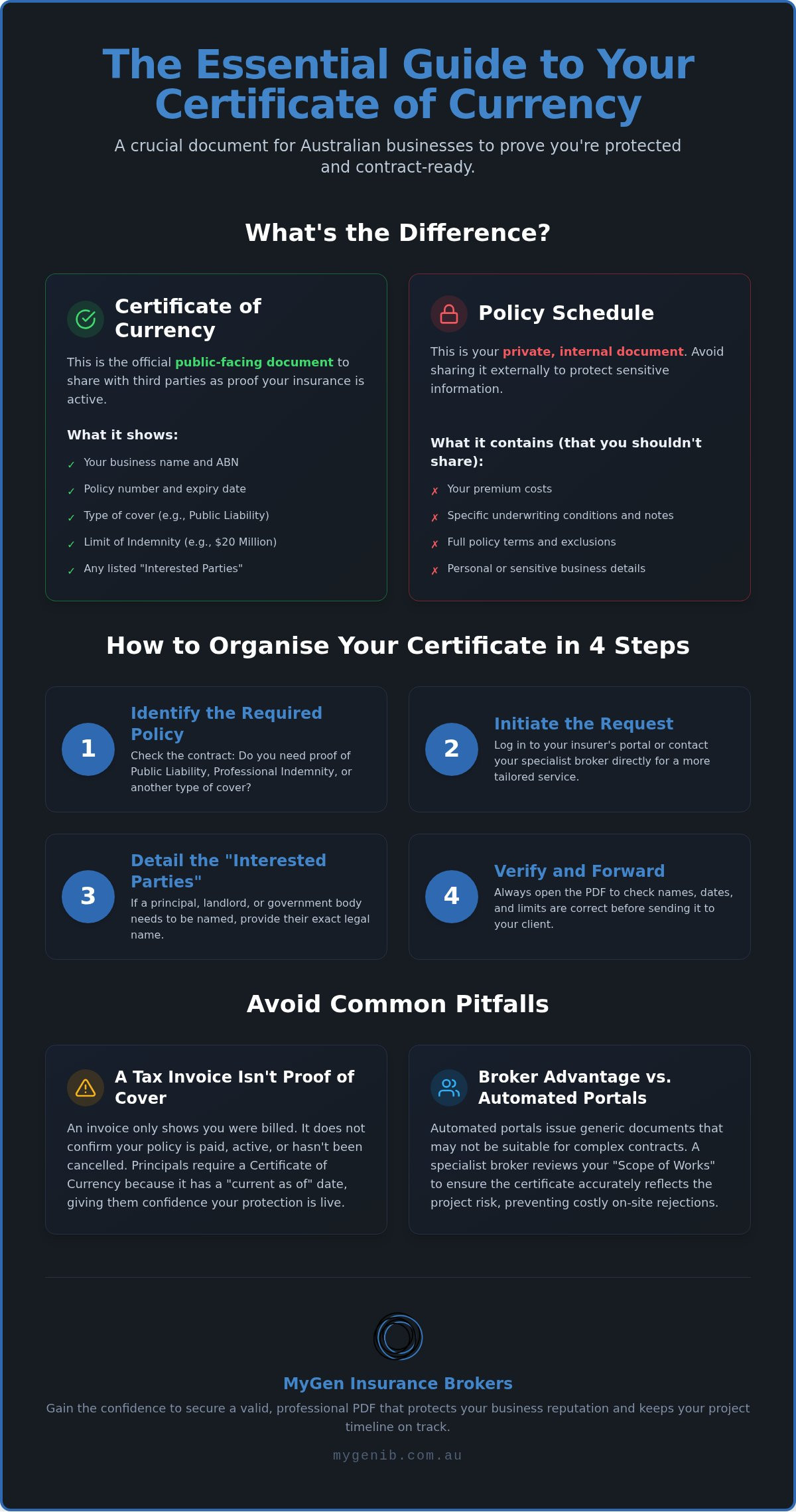
- Distinguish between your private Policy Schedule and the Certificate of Currency to ensure you share only the necessary proof of cover with external parties.
- Master the process of how to get a certificate of currency for business insurance quickly, whether you need to log into a portal or coordinate with a specialist broker.
- Verify that your “interested parties” and “scope of works” are accurately listed to satisfy rigorous contract requirements and avoid site access delays.
- Understand why a standard certificate might not be enough for complex contracts and how a seasoned expert can help you tailor the document for high-stakes projects.
- Gain the confidence to secure a valid, professional PDF that protects your business reputation and keeps your project timeline on track.
What is a Certificate of Currency and Why Does Your Business Need One?
In the fast-paced world of Australian commerce, a simple handshake is rarely enough to satisfy a new partner. Whether you are tendering for a high-value government project or signing a commercial lease, you will inevitably be asked for a Certificate of Currency. This formal document, issued by your insurer or broker, confirms that your policy is active and the premium is fully paid. It acts as an official Proof of Insurance that you can share with confidence. Essentially, a Certificate of Currency is a snapshot of your protection at a specific point in time.
Many business owners wonder why their Policy Schedule isn’t sufficient for these requests. While a schedule contains your full policy details, it also includes sensitive information like your premium costs and specific underwriting notes that you likely wish to keep private. A Certificate of Currency is designed for public verification, providing only the essential data needed to satisfy a principal or landlord. Knowing how to get a certificate of currency for business insurance allows you to maintain your privacy while proving you are a responsible, protected operator.
Key Details Included in a Valid Certificate
A valid certificate must be precise to be accepted by a third party. It typically includes your policy number, the expiry date, and the specific type of cover, such as Public Liability or Professional Indemnity. One of the most critical figures is the “Limit of Indemnity.” If your contract requires $20 million in cover but your certificate only shows $10 million, you won’t be allowed on site. We always recommend checking that your legal entity name and ABN match the contract exactly to avoid frustrating administrative delays.
Why a Tax Invoice is Never Enough
It is a common mistake to assume a paid tax invoice serves as proof of cover. While an invoice shows you were billed, it doesn’t confirm the policy remains active or that it hasn’t been cancelled since the payment was made. Principals require a Certificate of Currency because it includes a “current as of” date. This gives them the peace of mind that your protection is live at the very moment you start work, protecting both your business reputation and their own interests.
The Step-by-Step Process to Organise Your Certificate of Currency
Organising this document shouldn’t feel like a hurdle that keeps you from starting work. The process of how to get a certificate of currency for business insurance is logical, provided you follow a methodical path to ensure the final PDF meets every contractual obligation. We have seen many business owners rush this step, only to have their paperwork rejected at the site gate because a tiny detail was overlooked. To avoid this, follow these four clear steps:
- Step 1: Identify the required policy. Determine if your client needs proof of Public Liability, Professional Indemnity Insurance, or Commercial Motor cover.
- Step 2: Initiate the request. You can typically log into your insurer’s portal or, for a more personalised touch, contact your insurance broker directly. This is a standard part of understanding how to get a certificate of insurance that actually stands up to scrutiny.
- Step 3: Detail the “Interested Parties”. If a principal or government body requires their name on your document, you must specify this now.
- Step 4: Verify and forward. Always open the PDF to check the expiry dates and limits before sending it to your client.
The Broker Advantage vs. Automated Portals
While automated portals promise instant downloads, they often lead to a “tick and flick” trap. These systems are designed for simplicity, not the complexity of high-stakes contracts. A portal might issue a generic document, but it won’t investigate if your “Scope of Works” accurately describes the risk of the new project. We take a different approach by doing the heavy lifting for you, ensuring that the certificate provides real protection rather than just a superficial tick. If you find the portal process frustrating, you can always speak with a specialist broker to manage the paperwork for you.
Timeline and Delivery Expectations
In most cases, we can organise a certificate within 24 hours of your request. However, if your contract requires complex endorsements or manual underwriting approval, it may take a few business days to finalise. If you are facing a strict deadline, clear communication is vital. Let us know the urgency so we can prioritise your request and keep your project timeline on track.
Verifying Your Certificate: Ensuring it Meets Contractual Requirements
Once you have discovered how to get a certificate of currency for business insurance, the next vital step is verification. A document that doesn’t align with your contract is effectively useless. We often see business owners present a certificate only to have it rejected because it lacks a specific “Interested Parties” clause. Many principals demand their legal name appears on your certificate to ensure they are noted in the event of a claim, which provides them with the security they need to let you on site.
Matching the “Scope of Works” is equally critical. Your business description on the certificate must cover the specific job you are performing. If there is a mismatch, the principal’s compliance team will likely flag it, leading to delays. You should also be mindful of the “expiry date” trap. If your policy expires mid-contract, you must provide an updated document immediately upon renewal to maintain your compliance. Ultimately, a certificate is only as strong as the business insurance policy it summarises.
What to Do if Your Certificate is Rejected
Rejections usually stem from insufficient limits, incorrect entity names, or missing endorsements. This Certificate of Liability Insurance guide explains how these small details form the backbone of a valid document. When a certificate is knocked back, we act as your advocate. We negotiate directly with insurers to secure the specific endorsements your principal requires, ensuring you know how to get a certificate of currency for business insurance that satisfies even the most rigorous site requirements.
The Peace of Mind of a Professional Review
The final step in our consultative process is moving you from confusion to absolute clarity. Having a specialist insurance broker review your contract’s insurance clauses before you sign is vital. We look beneath the surface of the requirements to ensure your cover is suitable and your documentation is flawless. This methodical approach protects your professional reputation and ensures your project begins on a foundation of genuine security.
Securing Your Business Future with Precision
Managing your insurance documentation shouldn’t be a source of stress or a barrier to your business growth. We have explored how a Certificate of Currency acts as a vital bridge between your policy and your clients, providing the specific proof required to move a project forward. By focusing on the precision of interested parties and ensuring your scope of works is accurate, you protect your professional reputation from the friction of contract rejections. Understanding how to get a certificate of currency for business insurance is the first step toward a more managed and secure professional journey.
At MyGen, we move away from the “tick and flick” nature of automated portals to provide a truly consultative experience. Anthony Simpson brings over 20 years of industry expertise as an Authorised Representative of the Community Broker Network, acting as a steady hand for complex business risks. We do the heavy lifting to ensure your documents are flawless and your protection is deep. Let MyGen organise your business insurance and certificates with professional precision. We are here to ensure you start your next contract with absolute confidence and peace of mind.
Frequently Asked Questions
How long is a Certificate of Currency valid for in Australia?
A Certificate of Currency is valid until the expiry date of your current insurance policy, which is typically a 12-month period. Because it is a “live” document, it only remains valid as long as the policy stays active and the premiums are paid. If you cancel your cover or change insurers mid-term, any previous certificate becomes instantly void. Most site managers or government bodies will request a new version every year upon your policy renewal to ensure there has been no gap in your protection.
Can I get a Certificate of Currency before I pay for the policy?
In most cases, insurers will not issue a formal Certificate of Currency until the premium has been paid in full or a premium funding arrangement is finalised. The document’s primary purpose is to confirm that the policy is currently in force; issuing it before payment would create a legal risk for the insurer. If you are facing an urgent deadline, we can sometimes provide a “Letter of Placement” to satisfy a principal while your payment is being processed, though this depends on the specific requirements of your contract.
Does a Certificate of Currency cost extra money to request?
Obtaining a standard certificate is typically free for business owners in Australia. The cost is generally covered by your existing policy premium or your broker’s service fee. You shouldn’t expect to pay a separate fee for a basic proof of cover. However, if your contract requires complex manual endorsements or the addition of multiple “additional insured” parties, some insurers might charge a small administrative fee to reflect the extra underwriting work involved. This is a common detail to check when researching how to get a certificate of currency for business insurance for larger projects.
What is the difference between an interested party and a co-insured on a certificate?
An “interested party” is a person or entity noted on your certificate so the insurer can notify them if your policy is cancelled or changed. They do not have the right to claim under your policy; they are simply being kept in the loop for compliance reasons. A “co-insured” is much more significant, as it grants that party the same rights and protection as you under the policy. We recommend discussing these terms with a specialist to ensure you aren’t unintentionally giving away your policy limits. Getting this right is a crucial part of how to get a certificate of currency for business insurance that truly safeguards your interests.