
What if the simple act of clicking “renew” on your policy is actually the biggest risk your business faces this year? With average insurance quotes rising by nearly 15 per cent in the lead up to June 2026, the pressure to find savings is immense. However, overlooking the common mistakes at business insurance renewal can leave your firm exposed to devastating gaps in coverage. We know how frustrating it is to watch costs climb while you’re already stretched for time; it feels like another administrative hurdle when you’d rather be focusing on your team and your customers.
We understand that the 2026 market feels volatile, especially with ASIC now making insurance claims and complaint handling a top enforcement priority. You deserve to know that if the worst happens, your claim will actually be paid without a fight. In this guide, we’ll help you identify the critical errors that lead to underinsurance and show you how to satisfy your Duty of Disclosure with absolute confidence. We’ll explore why a “tick and flick” approach fails complex Australian businesses and how a methodical review ensures your policy reflects exactly how you operate today.
Key Takeaways
- Moving beyond the “set and forget” mindset to ensure your policy isn’t a stale document that fails to reflect your firm’s current growth.
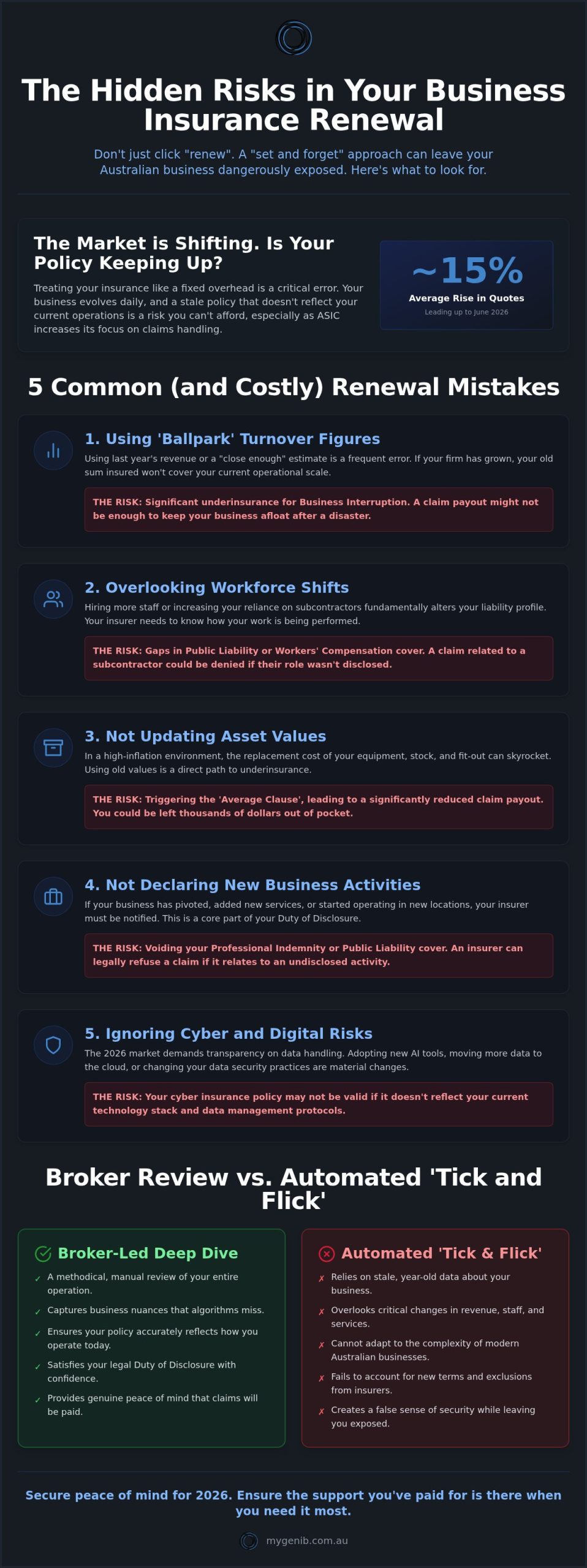
- Identifying the common mistakes at business insurance renewal, such as using “close enough” turnover figures that can lead to significant gaps in your business interruption cover.
- Recognising how shifts in your workforce mix, including the use of subcontractors, can fundamentally alter your liability profile and risk exposure.
- Understanding why a manual, deep-dive review by a seasoned broker provides a level of security that automated “tick and flick” algorithms simply cannot match.
- Securing peace of mind for 2026 by meeting your Duty of Disclosure, ensuring that if you ever need to claim, the support you’ve paid for is actually there.
Beyond the Premium: Why the ‘Set and Forget’ Approach Fails Australian Businesses
It’s understandable why many Australian business owners view their insurance premium as just another fixed overhead, much like electricity or rent. However, treating your policy as a “set and forget” item is one of the most common mistakes at business insurance renewal. In a market where premiums have risen significantly, the urge to simply find the cheapest price is strong. But focusing solely on the bottom line ignores the fact that your risk is variable, not fixed. A policy that saved you $500 today could easily leave you $50,000 out of pocket if a claim is declined due to outdated information.
Your business isn’t a static entity. Over the last 12 months, you’ve likely changed your turnover, hired new staff, or perhaps invested in new equipment. If your policy hasn’t been updated to reflect these shifts, it becomes a “stale” document. When you begin Understanding your Business Owner’s Policy (BOP), you realise that the “Total Sum Insured” must be accurate to ensure full protection. We’ve seen firms grow their revenue by 30 per cent but leave their business interruption cover at 2024 levels, creating a massive gap that only becomes visible when a disaster strikes.
The Myth of the “Standard” Renewal
Don’t assume that a renewal notice is a carbon copy of last year’s cover. Insurers frequently adjust their terms, exclusions, and definitions to account for new risks like cyber threats or changing weather patterns. Your cover might have “shrunk” even if you haven’t changed a thing. This is why a methodical audit is better than a quick signature; it ensures you aren’t paying more for less protection.
Duty of Disclosure: Your Legal Obligation
Under the Australian Insurance Contracts Act, you have a strict legal Duty of Disclosure to tell your insurer anything that might influence their decision to cover you. Failing to update your insurer about new business activities is one of those common mistakes at business insurance renewal that can have dire consequences. If you fail to mention a significant change in your operations, you give the insurer a legal “out” to reduce or even refuse your claim entirely.
The Critical Renewal Audit: Identifying Changes That Could Void Your Cover
Securing your firm’s future requires looking beneath the surface of your standard renewal notice. One of the most common mistakes at business insurance renewal is treating revenue figures as “ballpark” estimates. For business interruption cover, “close enough” is never good enough. If your turnover has increased but your sum insured remains stagnant, you are effectively self-insuring a portion of your risk without even knowing it. Similarly, shifts in your workforce mix, such as a heavier reliance on subcontractors, fundamentally alter your liability profile. Taking the time to review your business insurance with a professional ensures these nuances are captured before they become liabilities.
If your firm has pivoted or added new billable activities, your professional indemnity insurance must be updated to reflect the specific advice you provide today. The U.S. Small Business Administration suggests Rethinking Insurance Coverage at Renewal to ensure your policy keeps pace with operational shifts, including new equipment or satellite offices that may have been added throughout the year. Even small changes in stock levels can lead to significant underinsurance if your policy limits aren’t adjusted to match current replacement costs.
Emerging Risks in 2026
The 2026 market demands transparency regarding your data handling and AI tool usage. If you’ve integrated generative AI into your workflow or moved more operations to the cloud, these changes must be disclosed to your cyber insurer to maintain valid cover. Review any new client contracts signed this year; many modern agreements now demand higher indemnity limits or specific clauses that your existing policy may not yet accommodate.
The Underinsurance Trap
In a high-inflation environment, replacement costs for physical assets can skyrocket. If you under-report asset values, you may trigger the “Average Clause.” This means if you insure your equipment for only 80 per cent of its true replacement value, the insurer may only pay 80 per cent of any claim, even for a partial loss. It’s a costly penalty that catches many businesses off guard. Calculating precise replacement costs is a vital step in protecting your solvency.
Navigating the 2026 Market: Why a Personalised Broker Review Beats an Algorithm
In an era of instant gratification, it’s tempting to rely on “tick and flick” online quotes that promise cover in minutes. However, trusting a generic algorithm to understand your life’s work is one of the most common mistakes at business insurance renewal. These automated systems are built for speed and volume, not for the intricate nuances of a growing Australian firm. They often miss the subtle details of your risk profile, such as specific safety protocols or unique contractual obligations, which can lead to a policy that looks good on paper but fails during a claim. We believe that true protection requires a human touch; an experienced hand that knows how to look beneath the surface of a standard application.
When you work with a consultative broker, you gain an advocate who does the heavy lifting on your behalf. We don’t just accept the first price an underwriter offers. Instead, we “deep-dive” into your operations to present your risk in the best possible light, often negotiating terms that an algorithm simply couldn’t access. This process turns your annual renewal into a strategic opportunity to optimise your business insurance structure, ensuring every dollar spent contributes to your long-term stability and peace of mind.
The MyGen Consultative Process
Our approach is built on the belief that suitability is more important than speed. We take the time to investigate your current operations, identifying hidden exposures that may have emerged as your business evolved over the past year. By prioritising a deep understanding of your firm over quick, generic transactions, we foster a partnership that values your security above all else. This methodical investigation ensures that the cover we recommend is tailored specifically to your needs, providing a stabilizing force in an unpredictable market.
3 Steps to a Stress-Free Renewal
- Step 1: Start the conversation 60 days early. Avoiding a last-minute rush gives us the time needed to conduct a thorough market review and negotiate the best possible terms for your firm.
- Step 2: Collate accurate data. Gather your latest figures on turnover, wages, and any new client contracts; precision here is the best defence against the common mistakes at business insurance renewal that lead to underinsurance.
- Step 3: Schedule a dedicated risk review. Set aside time for a focused conversation with your broker to discuss your vision for the coming year and any new risks on your horizon.
Securing Your Business Resilience for the Year Ahead
Protecting your firm in 2026 requires moving past the distraction of rising premiums to focus on the actual quality of your cover. By ditching the “set and forget” mindset and conducting a thorough audit of your turnover, staff, and emerging digital risks, you move from a state of uncertainty to one of total confidence. We’ve seen how easily common mistakes at business insurance renewal can lead to declined claims, but these pitfalls are entirely avoidable with the right investigative approach. Your renewal shouldn’t be a source of anxiety; it’s a strategic opportunity to reinforce your firm’s foundation.
You don’t have to navigate these complexities alone. As an Australian owned and operated broker with over 20 years of industry experience, we’re here to act as your protective mentor. Our consultative risk management approach is designed to find the gaps that algorithms ignore, giving you the peace of mind that comes from knowing your Duty of Disclosure has been met with precision. We take pride in doing the heavy lifting so that you can focus on leading your team and serving your community.
Take the first step toward a more secure future and Book a Personalised Renewal Review with MyGen today. It’s time to replace the stress of the unknown with the clarity of a policy that truly fits.
Frequently Asked Questions
What happens if I forget to tell my broker about a change in my business at renewal?
If you fail to disclose significant changes, your insurer may have the legal right to reduce or refuse a claim payment entirely. This is one of the most damaging common mistakes at business insurance renewal, as it leaves you vulnerable at the exact moment you need support. Even accidental omissions can be viewed as a breach of your obligations, which is why we conduct a methodical interview to uncover any operational shifts you might have overlooked.
Why has my business insurance premium increased even though I haven’t made a claim?
Premiums are heavily influenced by broader market conditions, such as inflation and the rising cost of replacement materials, rather than just your individual history. In the year leading up to June 2026, many sectors saw significant price adjustments as insurers responded to increased natural disaster risks and higher reinsurance costs. Your premium also reflects the collective risk of your industry, meaning external trends can impact your costs even if your own firm remains claim-free.
Can I change my business insurance broker at the time of renewal?
Yes, renewal is the most logical time to switch to a broker who offers the depth of investigation your business deserves. You aren’t locked into a relationship that no longer serves you, and appointing a new broker can often reveal hidden gaps in your previous cover. We manage this transition by reviewing your current policy and conducting a fresh risk assessment, ensuring your new protection is both accurately priced and tailored to your current operations.
What is the “Duty of Disclosure” and does it apply to every renewal?
The Duty of Disclosure is your ongoing legal obligation to inform your insurer of any facts that could influence their decision to cover you. This duty applies to every renewal, requiring you to be transparent about changes in turnover, staff numbers, or the services you provide. Avoiding common mistakes at business insurance renewal begins with this transparency; it’s the only way to ensure your policy remains a valid, enforceable contract that will actually pay out when you need it.