
Did you know that delays in claim handling were the most common issue reported to the Australian Financial Complaints Authority last year? When your livelihood is on the line, the dense wording of a Product Disclosure Statement is often the last thing you want to decipher. We know the pressure you’re under when trying to figure out how to make a business insurance claim while simultaneously keeping your doors open and your staff paid. It’s a high-stakes situation where the fear of a rejected claim can feel just as heavy as the physical loss itself.
We’re here to replace that uncertainty with a methodical, protective approach to your recovery. You deserve a settlement that covers the full extent of your loss without the friction of endless negotiations. This guide provides a clear framework to navigate the Australian claims process, from gathering evidence to understanding your rights under the 2026 General Insurance Code of Practice. We’ll show you how to manage the documentation and communication required so you can focus on getting your business back to its best.
Key Takeaways
- Master the immediate 24-hour response required to secure your premises and mitigate further loss before the formal assessment begins.
- Learn how to make a business insurance claim that stands up to scrutiny by capturing the specific visual evidence and financial records insurers require.
- Demystify the role of the loss adjuster and prepare for the assessment phase with a clear understanding of your rights under the 2026 General Insurance Code of Practice.
- Discover how professional advocacy can manage the heavy lifting of negotiations, ensuring your settlement reflects the true cost of business interruption.
- Gain clarity on the mandatory timeframes for claim decisions to help you manage cash flow and maintain operational stability during recovery.
Immediate Actions: What to Do in the First 24 Hours
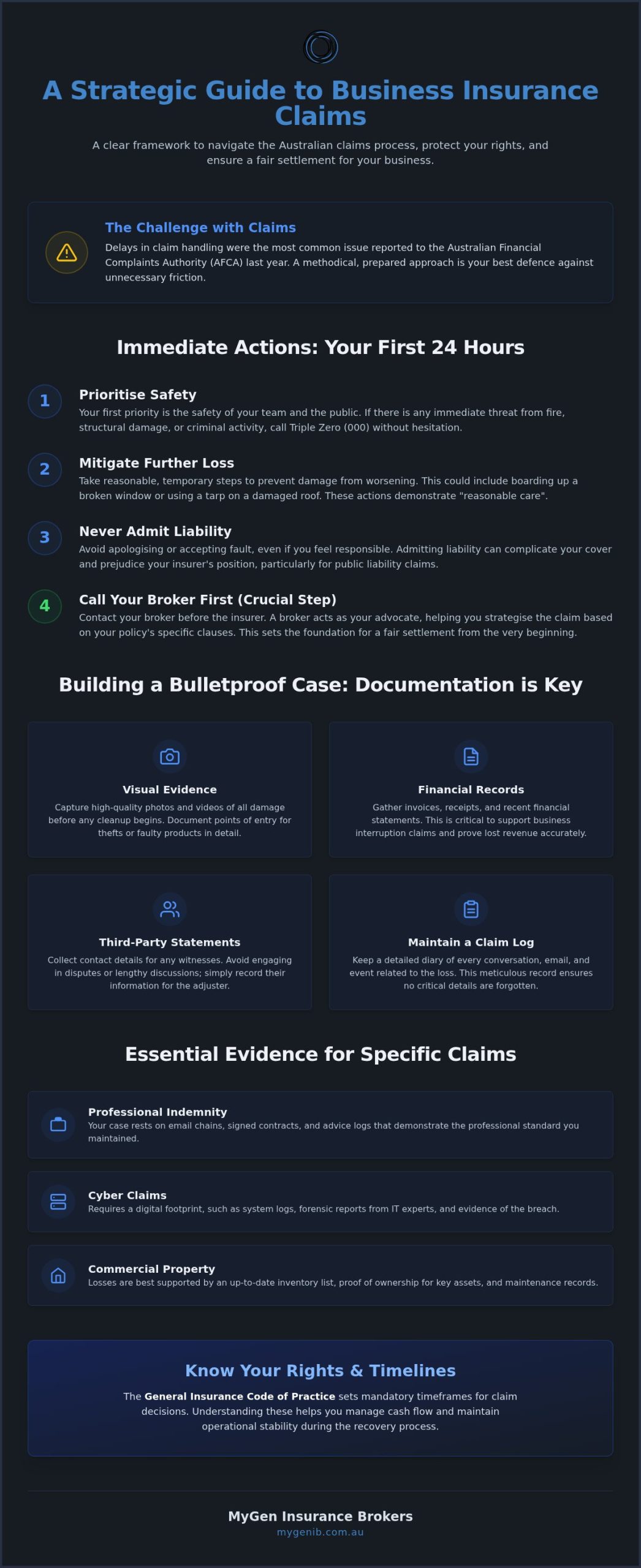
The moments following a fire, storm, or break-in are often a blur of adrenaline and anxiety. Your priority must always be the safety of your team and the public. If there is an immediate threat, call Triple Zero (000) without hesitation. Once the area is safe, your focus shifts to understanding the insurance claims process and how it applies to your specific situation. Knowing how to make a business insurance claim effectively starts with these first few hours of response.
To better understand the fundamentals of this process, watch this helpful video:
While it’s natural to want to apologise or fix everything immediately, caution is your best ally. Never admit liability or accept fault, even if you feel responsible. Doing so can prejudice your insurer’s position and complicate your cover under a public liability or professional indemnity event. Instead, focus on “reasonable care” by taking steps to prevent further damage. This might include boarding up a broken window or tarping a damaged roof. These actions demonstrate you’re acting as a prudent uninsured person would to protect the asset.
Securing the Scene and Preventing Further Damage
A standard requirement in Australian policies is the duty to mitigate loss. This doesn’t mean you should perform permanent repairs. It means you should take logical, temporary steps to stop the damage from getting worse. We recommend organising emergency trades through your broker’s authorised network. These professionals understand the documentation required for a claim and won’t perform work that compromises your future payout or obscures the cause of the loss from the adjuster.
The Role of Your Broker as an Advocate
Many owners make the mistake of calling their insurer’s automated hotline first. However, calling your broker is far more strategic. We don’t just “lodge” a claim; we help you strategise it. By interpreting your Business Insurance PDS, we identify the specific clauses that work in your favour. This ensures your initial statement is accurate and protective, setting the foundation for a fair settlement that reflects the true depth of your loss.
Building a Bulletproof Case: Documentation and Evidence
Proof is the foundation of every successful recovery. When you’re learning how to make a business insurance claim, you’ll quickly realise that insurers rely on objective data rather than verbal accounts. This is where your role as a diligent business owner becomes critical. By treating the documentation phase as a methodical investigation, you provide the precision required for a fair settlement. The Australian Government’s guide on managing your business insurance highlights that keeping accurate records is not just about compliance; it’s about protecting your financial interests during a crisis.
- Visual evidence: Capture high-quality photos and videos of damage, points of entry for thefts, or faulty products before any cleanup begins.
- Financial records: Gather invoices, receipts, and recent financial statements to support business interruption claims and prove lost revenue.
- Third-party statements: Collect contact details for witnesses, but avoid engaging in disputes; let the documented facts speak for themselves.
- The claim log: Maintain a diary of every conversation, email, and event related to the loss to ensure nothing is lost in the complexity of the recovery.
Essential Evidence for Different Claim Types
Different risks require specific types of proof to satisfy an insurer’s requirements. For Professional Indemnity Insurance, your case often rests on email chains, signed contracts, and advice logs that demonstrate the professional standard you maintained. Cyber claims require a digital footprint, such as system logs or forensic reports from IT experts, while commercial property losses are best supported by an up-to-date inventory list and proof of ownership. Having these organised before an incident occurs is the best way to ensure a smooth process.
Common Pitfalls: What Could Derail Your Claim?
Understanding how to make a business insurance claim also means knowing what to avoid. A common mistake is disposing of damaged stock or equipment before an assessor has inspected it; this often leads to a denial because the evidence no longer exists. If a crime has occurred, you must report it to the police and secure a report number immediately. Finally, avoid providing “guessed” values on claim forms. Inaccurate figures can lead to delays or underinsurance complications that are difficult to resolve later. If you’re concerned about your current level of protection, you might want to reach out for a personalised risk assessment to ensure your documentation is ready when it matters most.
The Settlement Process: Navigating Assessments and Approvals
The final phase of your recovery is where the methodical preparation of your evidence meets the insurer’s evaluation process. Once you understand how to make a business insurance claim, the focus shifts to the assessment period. Under the General Insurance Code of Practice, insurers are generally required to make a decision on your claim within four months of lodgement. However, if we’ve provided all the necessary information and inquiries are complete, a decision must be made within 10 business days. This timeframe is vital for maintaining your business’s cash flow and operational stability.
You’ll likely be presented with different settlement options depending on your policy and the nature of the loss. A cash settlement offers the most flexibility, allowing you to manage repairs or replacements on your own terms. Alternatively, the insurer may offer to manage the repair and replacement process through their own authorised network. We’ll help you weigh these options to ensure the outcome doesn’t just tick a box but actually restores your business to its pre-loss position.
Working with Loss Adjusters and Assessors
A loss adjuster is an independent professional appointed by the insurer to investigate the cause of the loss and verify the value of the claim. While they are experts, their perspective is naturally aligned with the insurer’s guidelines. We recommend having your broker present during any major site assessments. This creates a level playing field, ensuring the adjuster sees the full context of the damage and that no detail is overlooked. It’s about making sure the “fine print” is interpreted fairly in your favour.
Finalising the Claim and Reviewing Your Risk
Before the funds are released, you’ll be asked to sign a “claim release” document. It’s a legal agreement that usually signifies the end of the claim, so it’s essential to review it thoroughly with us before signing. Once the immediate crisis has passed, we conduct a post-claim review. Expert Insurance Brokers don’t just close the file; we look for ways to strengthen your risk management to prevent a similar incident from occurring again. This long-term perspective is what turns a stressful event into a foundation for a more resilient future.
Turning Risk into Resilience: Your Path to a Full Recovery
Navigating a loss is one of the most challenging experiences any business owner will face. By prioritising immediate safety, capturing precise evidence, and understanding the nuances of the assessment process, you move from a state of crisis to one of controlled recovery. We’ve explored the methodical steps of how to make a business insurance claim effectively, but you don’t have to carry the weight of insurer negotiations on your own. True peace of mind comes from knowing you have a seasoned expert in your corner.
At MyGen Insurance Brokers, we believe in looking beneath the surface to ensure your livelihood is truly protected. With over 20 years of industry experience, Anthony Simpson and our team provide a personalised, consultative approach that replaces the cold nature of automated services with dedicated claims advocacy. We manage the heavy lifting of the claims process and the complexities of the PDS so you can stay focused on your daily operations. Let MyGen Manage Your Business Risks and Claims Advocacy and provide the professional confidence you deserve. Your recovery is our priority, and we’re here to ensure your business emerges stronger than before.
Frequently Asked Questions
How long does a business insurance claim usually take in Australia?
Most Australian insurers are required to make a decision on your claim within four months of receiving it under the General Insurance Code of Practice. However, if you’ve provided all the necessary information and all inquiries are complete, a decision must be made within 10 business days. We focus on meticulous documentation at the start to ensure your file moves through the system as quickly as possible.
What is an “excess” and when do I have to pay it?
An excess is the pre-agreed amount you contribute toward the cost of a claim, which helps keep your overall premium lower. Depending on the situation, you’ll either pay this amount directly to a repairer or have it deducted from your final settlement. We’ll clarify the specific excess structures in your policy during our initial strategy call so you aren’t caught off guard by out-of-pocket expenses.
Can I still make a claim if I don’t have all my original receipts?
Yes, you can still proceed by providing alternative proof of ownership such as bank statements, photos of the items in your premises, or digital copies of invoices from your suppliers. Understanding how to make a business insurance claim without a paper trail is a common hurdle, but we can help you gather the secondary evidence required to satisfy an insurer’s requirements for a fair settlement.
What happens if my business insurance claim is denied?
If a claim is denied, you have the right to challenge the decision through the insurer’s Internal Dispute Resolution process. If the outcome remains unsatisfactory, the matter can be escalated to the Australian Financial Complaints Authority (AFCA), which saw over 111,000 complaints in 2025. We act as your advocate throughout this process, using our 20 years of expertise to negotiate and fight for a more equitable result.
Will making a claim increase my insurance premiums next year?
A claim doesn’t always lead to a premium increase, but it does affect how an insurer views your business’s risk profile. While the commercial market has seen some softening in 2026, your individual claims history is still a factor in future pricing. We help you implement post-claim risk management strategies that demonstrate to insurers that you’ve taken proactive steps to prevent a repeat incident.
Do I need to call the police for every business insurance claim?
You only need to involve the police if the claim involves a crime, such as theft, burglary, arson, or malicious damage. In these cases, securing a police report number is a mandatory step that must be completed before the insurer will process your lodgement. For accidental damage or professional errors, a police report isn’t necessary, though your internal incident logs remain vital for the assessment.
Leave a Reply