What if the very policy designed to protect your professional reputation is actually leaving you exposed because it hasn’t kept pace with how your business has evolved? We understand that the annual renewal process often feels like a race against the clock, marred by the tedious nature of manual data collection and the worry that a simple oversight could lead to a denied claim. It’s frustrating to see premiums rise without a clear explanation, especially when you’ve worked hard to manage your risks. Using a comprehensive professional indemnity insurance renewal checklist is the most effective way to move from uncertainty to a state of total confidence.
We’ve crafted this guide to help you look beneath the surface of your operations and ensure your cover is as precise as the services you provide. With recent industry data showing more stable conditions and even premium reductions in some Australian sectors, there’s never been a better time to ensure your policy is working as hard as you are. By following our methodical approach, you’ll gain a seamless renewal experience that accounts for every new activity you’ve undertaken over the past twelve months. We’ll explore how to audit your current exposures, gather the right documentation, and secure a policy that reflects your actual risk rather than a generic industry average.
Key Takeaways
- Understand why the “claims-made” nature of professional indemnity means your renewal date is a vital legal junction for maintaining continuous protection.
- Utilise our comprehensive professional indemnity insurance renewal checklist to accurately capture fee income, staffing shifts, and new business activities.
- Learn how to document changes in your technical staff and offshore contractors to ensure every arm of your operation is properly accounted for.
- Discover why a consultative broker’s deep-dive investigation provides far more security than a generic, automated quote from a search engine.
- See how professional advocacy can help tell the story behind your data, potentially leading to fairer premiums that reflect your specific risk profile.
Why Your Professional Indemnity Renewal Requires More Than a ‘Tick and Flick’ Approach
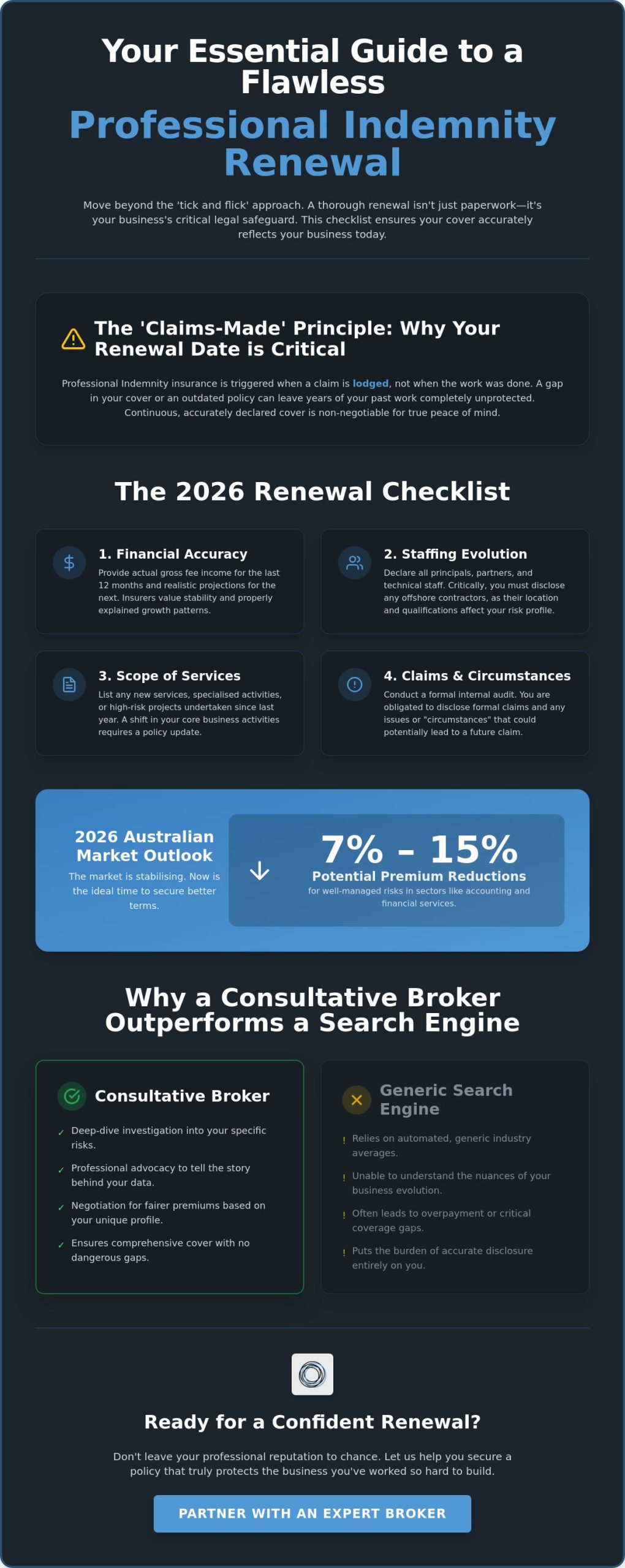
Renewing your cover isn’t just another task on the to-do list; it’s a critical moment for your business’s legal safety. Most people think of insurance based on when an event happened, but what professional indemnity insurance is actually hinges on a ‘claims-made’ trigger. This means you must have a valid policy in place at the exact moment a claim is lodged against you, regardless of when you performed the actual work. If you let your cover lapse or fail to disclose new activities during the renewal window, you might find yourself standing alone against a lawsuit for work you completed years ago.
To better understand how this specific type of protection works in the Australian context, watch this helpful video:
We often see professionals feel a sense of dread when the renewal notice arrives. The fear that a claim might be denied due to an outdated detail is real, and it’s usually born from a ‘set and forget’ mentality that doesn’t account for how much a business grows in twelve months. Instead of a simple transaction, we encourage you to view this process as a comprehensive risk audit. Using a tailored professional indemnity insurance renewal checklist ensures that your policy reflects your actual risk profile today, not a generic industry average or an outdated snapshot from three years ago.
The Danger of Outdated Policy ‘Declarations’
Your policy is built on the ‘Scope of Works’ you declared when you first signed up. If you’ve started offering new specialised services or taken on larger projects without updating these details, your insurer may have grounds to deny a claim. A Retroactive Date is the specific date in the past from which your insurer agrees to cover you, and maintaining this date without any breaks is the only way to ensure your previous work remains protected under your 2026 policy.
Understanding the 2026 Australian Insurance Market
The Australian insurance market is currently showing signs of stabilisation after years of ‘hard’ market conditions. Data from late 2025 indicated that many professionals, particularly accountants and financial services licensees, saw premium reductions between 7% and 15% for well-managed risks. By providing deeper, more granular data through a professional indemnity insurance renewal checklist, you give your broker the evidence they need to negotiate better terms on your behalf.
The Essential Professional Indemnity Insurance Renewal Checklist for 2026
Gathering the right information doesn’t have to be a frantic scramble. By following a structured professional indemnity insurance renewal checklist, you can ensure your broker has the precise details required to present your business in the best possible light. We recommend starting this process at least 90 to 120 days before your expiry date. This lead time allows for a thorough investigation into your actual risk, rather than a rushed estimate that could lead to overpayment or coverage gaps.
- Financial Accuracy: Provide your actual gross fee income for the past 12 months and realistic projections for the year ahead. Underwriters look for stability or explained growth.
- Staffing Evolution: Update your records for all principals, partners, and technical staff. It’s vital to disclose any offshore contractors, as their location and qualifications significantly impact your risk profile.
- Scope of Services: List every new service or high-risk project undertaken since your last renewal. Even a slight shift in your primary activities can change your policy requirements.
- Claims and Circumstances: Conduct a formal internal audit. You must disclose not only formal claims but also any potential issues or “circumstances” that might lead to a claim later.
Contractual and Regulatory Compliance
We often find that professionals inadvertently sign client contracts containing ‘Hold Harmless’ clauses or indemnity agreements that exceed their policy limits. It’s essential to review these during your renewal to ensure your professional indemnity insurance remains compliant with your association’s requirements or any applicable Professional Standards Scheme. These schemes can provide significant liability caps, but only if your policy is correctly structured to meet their strict criteria.
Risk Management and Quality Control
Showing an underwriter that you’re a “diligent” risk is the fastest way to secure favourable terms. Document your internal peer-review processes, updated cyber security protocols, and any new quality control measures you’ve implemented. When you demonstrate a proactive approach to preventing errors, you move from being a generic industry statistic to a preferred client. If you’re unsure how to document these improvements, our team can help you organise your risk profile for a more effective submission.
Navigating the Renewal: Why a Consultative Broker Outperforms a Search Engine
In a world of “instant quotes” and automated algorithms, the human element of insurance is often undervalued. While a search engine can provide a price in seconds, it lacks the ability to understand the nuance of your professional journey. A business insurance broker provides a protective layer that software simply cannot replicate. We don’t just process forms; we advocate for your business by telling the story behind the numbers to the underwriters who hold the pen. This advocacy is what turns a generic policy into a bespoke shield.
Timing is your greatest asset during this period. We recommend opening your “renewal window” at least 60 days before your policy expiry. This timeframe provides the necessary leverage to negotiate terms and explore the market without the pressure of an impending deadline. At MyGen, we act as the steady hand that guides you through the complexities of your professional indemnity insurance renewal checklist, ensuring that every piece of data serves to strengthen your position rather than just fill a box.
The Value of Manual Risk Assessment
Algorithms are designed to find patterns, but expert insurance brokers are trained to find the exceptions. A personalised review can identify critical needs like ‘Run-off’ cover for past directors or ‘Automatic Reinstatement’ clauses that protect you against multiple claims in a single year. These are the “hidden” risks that an automated system might overlook, potentially leaving you exposed when you need protection the most.
Preparing for Your Renewal Discussion
To make the most of your consultation, we suggest taking these simple steps to organise your documentation before we meet:
- Collate your updated fee statements and project lists for the current financial year.
- Identify any new client contracts that contain unusual indemnity requirements or ‘Hold Harmless’ clauses.
- Summarise any changes to your internal risk management protocols, such as new peer-review or cyber security measures.
By preparing these details in advance, you allow us to focus on the deep-dive investigation that secures your future. We’re here to help you move from the seasonal stress of renewal to a state of calm, certain protection. Let’s work together to ensure your expertise is fully shielded for the year ahead.
Secure Your Professional Legacy for 2026 and Beyond
Transitioning from the friction of renewal season to the certainty of a well-structured policy requires a shift in perspective. We’ve explored how the claims-made nature of your cover makes the renewal date a vital legal junction and why a thorough professional indemnity insurance renewal checklist is your best defence against coverage gaps. By auditing your financial projections, staffing changes, and contractual obligations early, you ensure your policy reflects the reality of your current risk profile today.
At MyGen Insurance Brokers, we believe you deserve more than just a generic transaction. Led by Anthony Simpson, our team brings over 20 years of industry expertise to every consultation, offering national coverage with a boutique, human-centric approach. We focus on personalised risk management rather than just policy placement, doing the heavy lifting to find those hidden vulnerabilities that automated systems often miss.
Don’t let your hard-earned reputation be undermined by an outdated policy. You can book a consultative renewal review with MyGen Insurance Brokers today to turn the complexity of insurance into a simplified, secure outcome. We’re here to be your steady hand and protective mentor, ensuring you can move forward with total peace of mind.
Frequently Asked Questions
When should I start the professional indemnity renewal process?
You should ideally begin your internal review 90 to 120 days before your current policy expires. This timeframe allows you to work through your professional indemnity insurance renewal checklist without the pressure of a looming deadline; ensuring you accurately capture every shift in turnover or staffing. Starting early means that by the time you reach the 60-day negotiation window, your broker has a robust and well-documented case to present to underwriters.
What happens if I forget to disclose a change in my business activities at renewal?
Failing to disclose a significant change in your business activities can lead to a total denial of cover if a claim is eventually lodged. Because professional indemnity is a “claims-made” policy, the insurer relies on your most recent declaration to define exactly what they are protecting. If you’ve branched into a new specialised area without informing them, you risk having your policy voided or being left to fund your own legal defence from your own pocket.
Can I change my professional indemnity broker at the time of renewal?
You can certainly change your broker at the time of renewal, and many professionals find this the most logical point to seek a fresh, more protective perspective. By appointing a new broker before the renewal window opens, you allow them to conduct a deep-dive investigation into your current risks. This transition is typically managed through a simple “Letter of Appointment,” which gives your new representative the authority to negotiate with insurers on your behalf.
Why has my professional indemnity premium increased even though I haven’t had a claim?
Premiums often rise due to broader market conditions or an increase in the average cost of claims across your entire profession. Even if your own history is clean, insurers may adjust rates to account for “social inflation” and the rising complexity of legal disputes in the Australian market. Providing high-quality data through a professional indemnity insurance renewal checklist helps your broker demonstrate that your business is a lower risk than the industry average, which can help mitigate these external price hikes.