
You are just moments away from signing a major contract or finalising a property loan when the request arrives: “Please provide a current Certificate of Currency.” You quickly attach your Policy Schedule and hit send, only to be told it doesn’t meet the requirements. It’s a frustrating moment of friction that can stall your progress just as you’re reaching the finish line. We understand that when you’re under pressure to perform, these technicalities feel like unnecessary hurdles. Most Australians find themselves asking exactly what is a certificate of currency and why do I need one when a bank or client demands more than just a simple receipt of payment.
We’ve helped countless clients manage this exact situation, and we believe that clarity is the best way to reduce that stress. You deserve to know why a standard invoice isn’t enough and how a properly formatted certificate acts as a real-time passport for your business or property. In this guide, we’ll explain the specific details your lenders are looking for; we’ll also walk through the “Interested Party” clause and show you how to obtain the right document without the usual automated portal headaches. By the time you’ve finished reading, you’ll have the knowledge to secure your approvals with confidence and ease.
Key Takeaways
- Distinguish between a policy schedule and a Certificate of Currency to ensure you provide the specific legal proof that your insurer is currently “on risk” for a project or loan.
- Gain a clear understanding of what is a certificate of currency and why do I need one to satisfy the mandatory compliance requirements of Australian lenders and principal contractors.
- Learn how to correctly manage the “Interested Party” clause, a vital step for securing commercial leases and ensuring your property settlement proceeds without delay.
- Discover why a professional broker is often the most efficient way to secure a compliant certificate, especially when automated portals fail to handle complex contractual demands.
Defining the Certificate of Currency: More Than Just a Policy Document
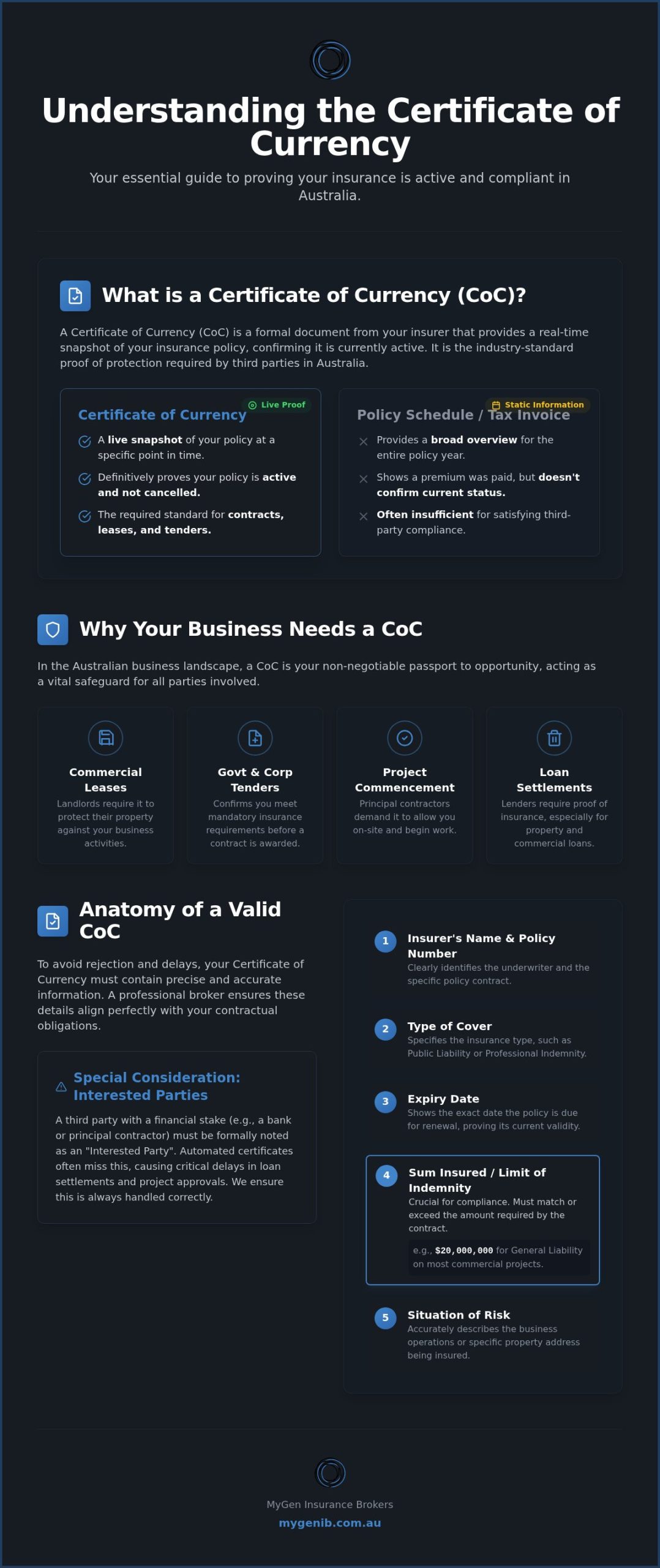
A Certificate of Currency (CoC) is the professional confirmation that your protection is live and fully funded. It is an official document issued by your insurer or broker that confirms your insurance policy is active and paid for. While an invoice shows you have been billed, a CoC acts as formal proof of insurance, verifying that the underwriter is legally “on risk” for your specific liabilities or assets. Essentially, it serves as a real-time snapshot of your policy’s status, including the exact expiry date and the total sum insured. Because business circumstances can shift quickly, these certificates are typically valid for a short window, often 30 to 90 days, or until the policy reaches its natural expiry.
Certificate of Currency vs. Policy Schedule: What is the Difference?
It’s easy to confuse these two documents, but they serve very different roles. Your Policy Schedule is a comprehensive, internal roadmap that lists every sub-limit, exclusion, and specific detail of your cover. It’s meant for your records, not necessarily for your clients. In contrast, a CoC is a condensed summary designed specifically for third-party viewing. A schedule doesn’t always prove the premium has been paid, whereas a CoC is only issued when the policy is in force. This distinction is often at the heart of the question: what is a certificate of currency and why do I need one? You need it because it provides the “paid and active” certainty that a schedule lacks.
What Details are Typically Included?
When a lender or principal contractor asks for this document, they are looking for specific markers of security. A standard certificate will clearly outline the following details:
- The Insured Entity: Your full legal business name or personal name as it appears on the policy.
- Type of Cover: The specific class of insurance, such as Public Liability Insurance.
- Policy Specifics: The unique policy number, the precise dates of the coverage period, and the limit of indemnity.
By providing these facts in a single, verified page, you give your partners the peace of mind they need to proceed with your contract or loan. It’s a small document that carries significant weight in the Australian commercial landscape.
Why You Need One: Common Scenarios in the Australian Market
Understanding what is a certificate of currency and why do I need one often begins with a request from a third party who has a stake in your property or your professional work. These requests usually arrive at high-pressure moments, such as the final days of a property settlement or just before a major contract is signed. In the Australian market, this document acts as a vital bridge of trust between you and the organisations you partner with. It provides the certainty they need to move forward with confidence, knowing that the risks involved are properly managed and funded.
Australian banks are perhaps the most frequent requesters of this document. Whether you are purchasing a first home or refinancing an existing mortgage, your lender will rarely allow settlement to proceed until they have a certificate proving the property is insured. This ensures their financial interest is protected from the very first day. For those in the professional sector, the requirement is equally strict. Principal contractors often mandate that you provide evidence of Professional Indemnity Insurance or Public Liability before you can set foot on a worksite. The Tasmanian Government’s guide to Certificates of Currency highlights how critical this verification is for licensed occupations to maintain compliance and safety standards.
Commercial landlords also require proof of glass and liability cover before they will hand over the keys to a new retail or office space. Similarly, if you are applying for government tenders, you will need to provide evidence of high-level coverage to meet rigorous compliance benchmarks. If you’re finding these requirements complex to manage, speaking with a dedicated broker can help you align your coverage with the specific demands of your contract.
The “Interested Party” and Financial Interest Clause
Banks and clients frequently ask to be named as an “Interested Party” on your certificate. This isn’t a mere formality; it’s a protective measure. By listing them, your insurer agrees to notify that party if the policy is cancelled or significantly altered. It gives the lender or client peace of mind that the insurance they require to be in place hasn’t lapsed without their knowledge, protecting their financial stake in your assets or projects.
When a General Certificate Isn’t Enough
A “blanket” certificate sometimes fails to meet the specific demands of a complex contract. If your indemnity limits don’t match the contract requirements, or if the legal name on the certificate doesn’t exactly match the name on your loan documents, the document will likely be rejected. Precision is essential. Matching the details of your insurance to the specific clauses of your lease or contract is the only way to avoid delays and ensure your documentation is accepted the first time.
How to Organise Your Certificate and Why a Broker Makes it Effortless
Securing your certificate might seem like a simple administrative task, but the method you choose can significantly impact your timeline. While many direct insurers encourage you to use a self-service portal to generate a PDF, these automated systems often struggle with the nuances of commercial contracts. This is where the value of a professional insurance broker becomes clear. We don’t just click a button; we look beneath the surface to ensure the document aligns perfectly with the specific requirements of your lease or lender. Understanding what is a certificate of currency and why do I need one is only half the battle; the other half is ensuring the document is actually compliant with the party requesting it.
The risk of relying on automated errors is real and can be costly. A simple typo in the “Interested Party” section, such as a misspelt bank name or an incorrect ABN, can delay a multi-million dollar property settlement or a critical contract start date. These high-friction moments are exactly what we aim to avoid. At MyGen Insurance Brokers, we treat every request with diligence, ensuring your business insurance documentation is accurate, verified, and delivered when you need it most.
How Long Does it Take to Get a Certificate?
Timeframes vary depending on the complexity of your request. While automated portals offer instant downloads, they often fail if you need to add a specific mortgagee or principal contractor. Manual, broker-led requests typically take between 24 and 48 hours because they involve a human review of the details. We recommend requesting your CoC at least 48 hours before any hard deadline. This allows enough time for thorough verification and any necessary adjustments to the wording.
What to Do if Your Certificate is Rejected
If a bank or client rejects your document, it’s usually due to insufficient indemnity limits, an expired date, or a missing interested party. These setbacks are frustrating, but they aren’t final. A broker can advocate for you with the underwriter, negotiating specific wording that satisfies the third party while maintaining your policy’s integrity. We handle the heavy lifting and the technical conversations, turning a stressful rejection into a managed, secure outcome.
Securing Your Future with Accurate Documentation
Navigating the technicalities of insurance shouldn’t be a source of stress when you’re on the verge of a major milestone. By now, you should have a clear answer to the question of what is a certificate of currency and why do I need one, seeing it as the essential “passport” that validates your protection to the outside world. Whether you’re satisfying a bank’s “Interested Party” clause or proving your professional liability to a new client, the accuracy of this single page is paramount to your success. A small error can lead to a significant delay, but with the right approach, these administrative hurdles become simple, manageable steps.
At MyGen Insurance Brokers, we bring over 20 years of industry experience and a personalised consultative approach to every client we serve. With national Australian coverage, we have the reach and the expertise to ensure your documentation is precise and compliant with even the most complex contracts. Talk to a MyGen Broker today for personalised insurance advice. We’re here to do the heavy lifting so you can focus on growing your business or moving into your new home with complete peace of mind.
Frequently Asked Questions
Is a Certificate of Currency the same as a tax invoice?
No, these documents serve entirely different roles in your records. A tax invoice is simply a financial record that proves you’ve been billed or have made a payment; however, it doesn’t confirm that the policy is actually active. A Certificate of Currency is the specific document that verifies the insurer is “on risk” and your protection is live at this very moment.
Can I get a Certificate of Currency if I pay my insurance by monthly instalments?
Yes, you can certainly secure a certificate while paying through monthly instalments. As long as your premium payments are current and the policy hasn’t lapsed, your broker or insurer can generate the document for you. This is a helpful feature for small businesses asking what is a certificate of currency and why do I need one, as it allows for better cash flow without sacrificing contract compliance.
How long is a Certificate of Currency valid for in Australia?
Most Australian organisations consider a certificate valid for 30 to 90 days from the date it was issued. While your insurance policy might last for twelve months, lenders and clients often request a new certificate every few months to ensure the cover hasn’t been cancelled or modified in the interim. It’s a snapshot in time, so it’s wise to request a fresh copy shortly before any major project milestone or settlement date.
What happens if I cancel my policy after providing a Certificate of Currency to a client?
If you cancel a policy that has an “Interested Party” listed, the insurer is typically obligated to notify that party of the cancellation. This can lead to immediate complications, such as being barred from a worksite or breaching the mandatory insurance conditions of your home loan. Maintaining the policy for its full term is essential to stay compliant with the legal and financial agreements you’ve signed based on that certificate.