
The details you share with your broker are more than just boxes to tick, they are the blueprint for your financial survival when a claim eventually lands on the desk. We understand that figuring out exactly what information does an insurance broker need can feel like a daunting task, especially when you’re already juggling the demands of running a business or managing a household. You might worry about being underinsured or simply feel frustrated by the complex jargon that often makes the industry feel inaccessible. It’s natural to feel some anxiety about the time required to organise your records, but we’re here to steady the ship.
We believe that securing your future shouldn’t be a high-friction experience. Our team takes a deep-dive approach to look beneath the surface of your risks, but we need the right foundations to start that investigative process. In this guide, you’ll learn exactly which documents and details to gather to ensure we can secure the most precise and cost-effective protection for your specific risks. We’ll provide a clear, actionable list of requirements so you can feel confident letting us do the heavy lifting, giving you the peace of mind that your policy will actually perform when it matters most.
Key Takeaways
- Understand the vital role of your Duty of Disclosure in ensuring your policy stands firm and provides the protection you expect when it’s time to make a claim.
- Learn exactly what information does an insurance broker need to move beyond generic quotes and identify the specific gaps in your current coverage.
- Prepare for your consultation with a clear list of essential documents, including previous policy schedules and business details, to save time and reduce stress.
- Discover how documenting your risk mitigation efforts, such as security upgrades or safety protocols, allows your broker to present a stronger case to underwriters.
- Shift from the frustration of “tick and flick” automated systems to a personalised, consultative approach that prioritises your long-term financial security.
Why Your Insurance Broker Asks Detailed Questions
An Insurance broker acts as your professional advocate, standing firmly on your side of the table rather than representing the interests of the insurance company. This distinction is vital; while an agent sells for the insurer, we work for you. To perform this role effectively, we need to understand the unique contours of your life or business. By asking deep-dive questions, we can identify risks you might not even know exist, ensuring that your safety net is actually strong enough to catch you.
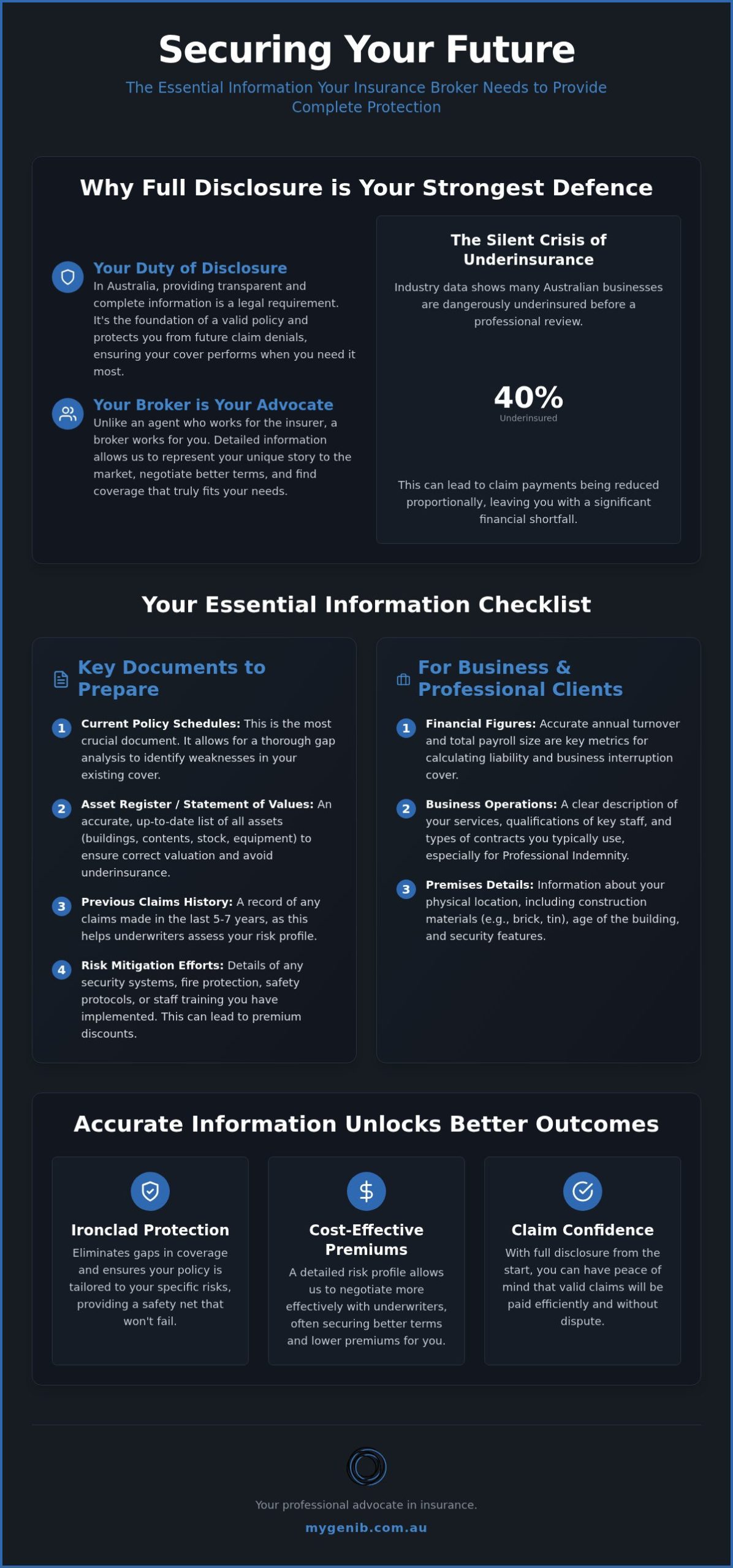
In Australia, the “Duty of Disclosure” is a fundamental principle that requires you to be completely transparent about any facts that might influence an insurer’s decision. While it might feel intrusive to answer so many questions, providing a high level of detail is actually a protective measure. It ensures that when you ask, “what information does an insurance broker need,” you’re actually building a shield against future claim denials. Honesty truly is the best policy here, as it prevents insurers from voiding your cover when you need it most.
To better understand this concept and how a broker serves your interests, watch this helpful video:
When we have a comprehensive data set, we can “shop the market” with much greater precision. Instead of presenting a generic risk to insurers, we tell your specific story. This allows us to negotiate better terms and lower premiums because underwriters feel more confident when they have a clear, detailed picture of what they are actually insuring. We take the burden of this investigation off your shoulders, doing the heavy lifting to find the right fit for your budget and risk profile.
The Risk of Underinsurance in Australia
Underinsurance is a quiet crisis in the Australian market. Industry data suggests that roughly 40% of businesses are underinsured before they engage a broker for a professional review. When you provide “estimated” figures instead of exact data, you risk a pro-rata settlement. This means if you’re only insured for half the value of your assets, the insurer may only pay half the claim, even for a minor loss. Precise information is the only way to avoid this trap.
Moving Beyond Automated Quotes
It’s tempting to use a 30-second online form for a quick price, but these “tick and flick” systems often leave massive gaps in your protection. They can’t capture the nuances of a home-based business or a complex commercial fleet. We move beyond these superficial interactions to ensure nothing is missed. You can read more about why expert insurance brokers provide more value than automated quotes to see how this consultative approach protects your bottom line.
The Essential Information Checklist for Your First Consultation
Gathering paperwork often feels like a chore, but it’s the most effective way to ensure your cover actually works when you need it most. When people ask what information does an insurance broker need, they’re often surprised by the breadth of the list. We don’t ask these questions to be difficult. We do it to build a precise map of your risks. If you have an existing policy, the most important document to bring is your current policy schedule. This allows us to perform a thorough gap analysis, looking beneath the surface to see where your current protection might fail you. Along with this, an accurate Asset Register or Statement of Values is vital to ensure no item is left vulnerable.
For Business and Professional Clients
Professional risks require a high level of detail to ensure suitability. For those seeking professional indemnity insurance, we’ll need to see your qualifications, typical contract types, and any previous claim history. We also require a clear view of your financials, specifically your annual turnover and payroll size, as these are key markers for insurers. If you have physical premises, we’ll look at the construction materials, security features, and fire protection systems. An accurate Asset Register is essential here; it ensures every piece of equipment is accounted for at its true value.
For Home and Landlord Clients
Domestic insurance requires a different set of keys. We’ll need to know the year your home was built, the type of roof, and details of any recent structural renovations. For landlords, we look for specific liability risks like swimming pools or whether you’re engaging in short-term holiday letting. If you have high-value items like jewellery or art, we’ll need to specify these individually. Even for your vehicles, having the information needed for an auto policy ready, such as driver history and usage details, helps us secure a better rate.
While the list might look long, your broker is there to help you navigate what is actually relevant to your situation. We’ll do the heavy lifting of sorting through the data to find the best fit. If you’re ready to see how a deeper look at your details can lead to better protection, start a conversation with our experts today. We’ll ensure you understand exactly what information does an insurance broker need for your specific circumstances, turning a complex process into one of clarity and calm.
How Accurate Information Secures Better Premiums and Protection
Precision pays off. When we gather specific details about your risk mitigation strategies, such as back-to-base security alarms, staff safety training programmes, or fire management plans, we use that data as a tool for negotiation. Insurers reward transparency and proactive management. When an underwriter sees a risk that is well-documented and actively managed, they’re far more likely to offer competitive rates and broader coverage terms. This level of professional diligence is also seen at Paterson Insurance Brokers, where tailored risk management is used to secure optimal outcomes for clients. We don’t just pass on your data; we craft a comprehensive underwriting submission that tells your unique story, positioning you as a preferred client in a crowded market.
Beyond the initial premium, the depth of our knowledge serves as your greatest asset during a crisis. As your advocate, we handle the heavy lifting when things go wrong. Because we’ve already done the deep-dive into your specific risks, we can move quickly to resolve issues without the typical friction of a standard claim. This long-term relationship, built on a foundation of thorough investigation, ensures that your policy isn’t just a piece of paper, it’s a functional safety net that performs exactly as intended when the pressure is on.
The Claims Process: Why Preparation Matters
It’s vital to realise that the information gathering phase is actually the start of your future claim. When you answer the question, “what information does an insurance broker need,” you’re essentially pre-validating your future losses. Having accurate records, such as an up-to-date asset register or clear financial statements, prevents insurers from disputing the value of your loss. This preparation removes the ambiguity that often leads to pro-rata settlements or lengthy delays, ensuring you receive your full entitlement without the stress of a protracted legal battle.
Securing Your Peace of Mind
The transition from anxiety to clarity happens the moment you provide the necessary details and let us take over. We understand that the initial process can feel overwhelming, but our methodical approach is designed to turn that complexity into a managed, effortless experience. For a deeper look at how we protect your commercial interests, you can explore the complete guide to business insurance in Australia. Once we have the right foundations, you can return your focus to your business or home, knowing that we have seen every scenario and have you firmly covered.
Securing Your Future Through Clarity
We’ve explored why detailed disclosure is far more than an administrative hurdle; it’s the foundation of a policy that actually performs when you need it most. By categorising your assets and documenting your risk mitigation efforts, you empower us to negotiate from a position of strength. This preparation is the first step in ensuring your financial survival at claim time, turning potential vulnerabilities into a robust shield for your business or home.
Understanding exactly what information does an insurance broker need is the key to moving from frustration to peace of mind. At MyGen, we specialise in complex Australian business risks and take a deep-dive approach to identify the gaps that automated quotes often miss. Anthony Simpson uses his 20 plus years of industry experience to act as your protective mentor, handling the heavy lifting on your behalf so you don’t have to face the complexity alone.
Let MyGen organise your protection with a personalised risk consultation. We’re here to turn a high-friction process into a managed, effortless journey, ensuring you can move forward with the absolute certainty that your most important assets are truly secure.
Frequently Asked Questions
Do I need to have all my documents ready before our first phone call?
You don’t need a complete folder of paperwork just to start a conversation with us. The initial consultation is designed to help us understand your general situation, which then allows us to guide you on exactly what information does an insurance broker need for your specific circumstances. We’ll identify the high-priority items together so you don’t feel overwhelmed trying to find every single record at once.
Will my information be kept confidential by the insurance broker?
Your privacy is protected by strict Australian privacy laws and our own professional code of conduct. We handle sensitive financial and personal data with the utmost care, ensuring it is only shared with insurers for the purpose of securing your cover. We view our relationship as a partnership built on trust, so you can feel secure knowing your details are managed with the highest levels of discretion and security.
What happens if I accidentally provide the wrong information?
If you realise you’ve made an honest mistake, you should notify us immediately so we can update the insurer. Accuracy is vital because incorrect data can lead to claims being reduced or denied under your Duty of Disclosure. When we discuss what information does an insurance broker need, we aim for total precision to ensure your policy remains valid and continues to provide the protective shield you’re paying for.
How far back does my claims history need to go?
Most insurers require a claims history covering the last five years, though this can vary depending on the specific type of risk being insured. Having a clear record of any previous incidents, or even confirming a “clean” history for this period, helps us present a more stable profile to underwriters. This transparency allows us to negotiate more favourable premium rates and broader coverage terms on your behalf.