
If you cannot clearly see the price tag on your broker’s expertise, how can you be certain they are truly working for you? It is a question that lingers for many Australian business owners who feel that insurance is often a black box of hidden costs and confusing jargon. You might worry that a specific policy recommendation is steered more by a high commission than by the actual suitability of the cover for your unique risks. Understanding exactly how do insurance brokers get paid in Australia is the essential first step toward a professional partnership built on genuine trust rather than guesswork.
We believe that you deserve total clarity to feel confident that your assets are properly protected. Under the Delivering Better Financial Outcomes (DBFO) Act 2024, which introduced strict informed consent rules in July 2025, the industry has moved toward much higher standards of transparency. This guide will walk you through the current commission and fee structures for 2026, explaining how to interpret your Financial Services Guide (FSG) and why the right remuneration model supports expert, long-term protection. We will show you how to look beneath the surface of a premium to ensure you are receiving the methodical, protective service your business requires.
Key Takeaways
- Differentiate between insurer-paid commissions and professional fees to understand the true cost of your expert protection.
- Discover how the ‘Best Interests Duty’ ensures that policy recommendations prioritise your business’s unique vulnerabilities over broker incentives.
- Learn exactly how do insurance brokers get paid in Australia so you can confidently evaluate the transparency of your Financial Services Guide (FSG).
- Realise that broker remuneration supports a methodical investigation into your risks and provides a steady hand during the claims process.
- Identify why the shift toward informed consent in 2026 empowers you to demand full visibility on all payment structures.
The Mechanics of Broker Remuneration: Commission vs. Fees
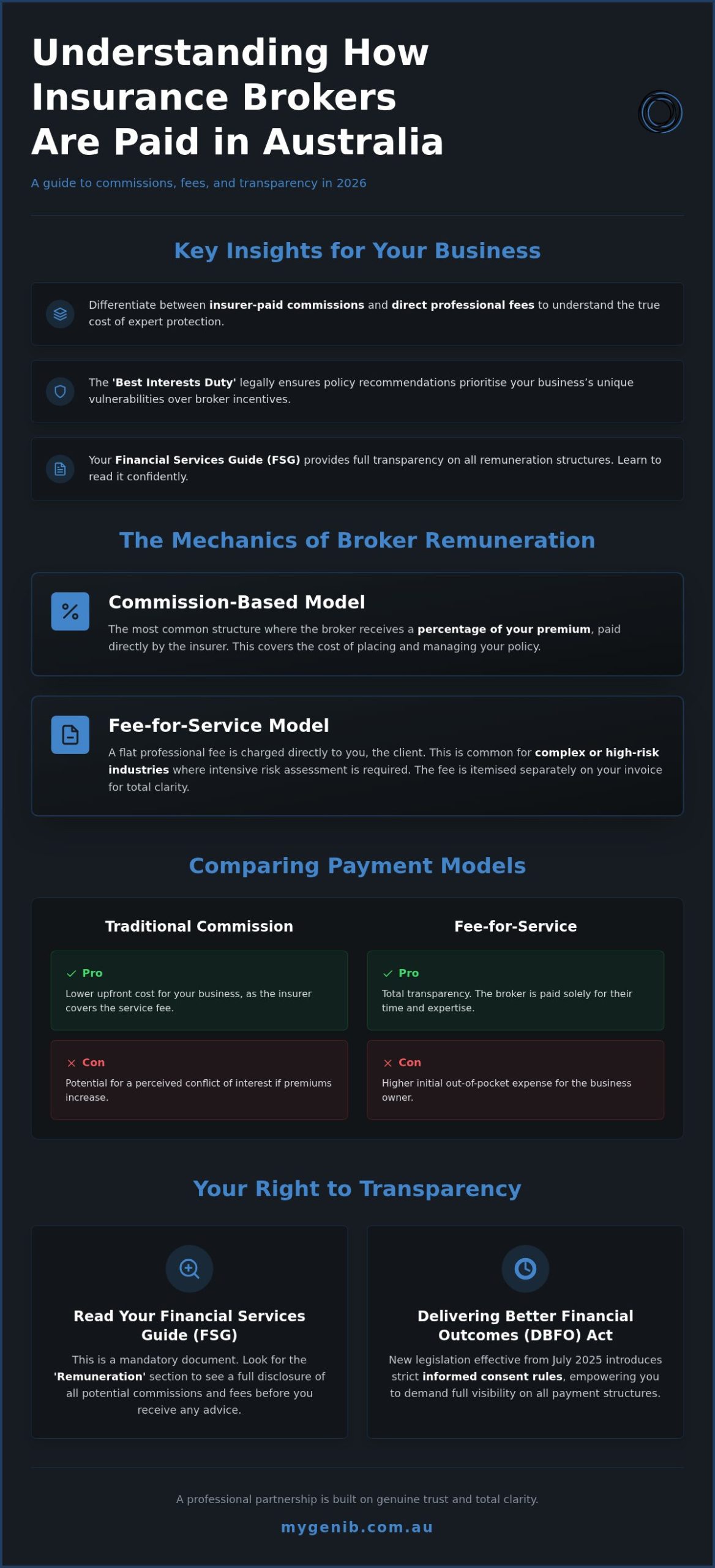
Understanding how do insurance brokers get paid in Australia starts with recognising the two distinct ways they’re remunerated. Most brokers receive a base commission, which is a percentage of the premium paid by the insurer to the broker for managing the placement of your policy. However, for more complex requirements like bespoke Business Insurance or Professional Indemnity Insurance, a flat professional fee may be charged instead or in addition to commission. This dual model ensures that the broker is compensated for the intensive labour and deep-dive risk assessment required to protect your specific assets.
To better understand the value a broker provides beyond the quote, watch this helpful video:
This structure is overseen by strict Insurance Broker Regulation in Australia, which ensures that every dollar of income is accounted for. All these details are contained within the Financial Services Guide (FSG); this is the primary legal document where all remuneration must be disclosed to you before any advice is given. It’s your first line of defence in ensuring you’re getting genuine value for money.
What is a Broker Fee?
A broker fee is often more appropriate for high-risk industries or highly specialised commercial motor fleets where a standard commission doesn’t reflect the hours of investigation involved. These fees provide a high level of transparency because they’re itemised separately on your invoice, allowing you to see exactly what you’re paying for professional advice. It moves the relationship away from a simple transaction and toward a consultative partnership where you pay for expertise rather than just a policy placement.
How to Read Your Financial Services Guide (FSG)
The FSG is your roadmap to transparency. It’s a mandatory document that every broker must provide, outlining their services and exactly how they’re compensated. When you open it, look specifically for the ‘Remuneration’ section. This area will detail the range of commissions or fees the broker may receive, including any potential benefits from the Community Broker Network. Checking this section ensures you aren’t walking into a ‘black box’ of costs and confirms that your broker is acting as a protective mentor rather than just a salesperson.
Transparency and the Potential for Conflict of Interest
It’s natural to feel uneasy when you realise your broker’s income might rise alongside your premium. This tension is the heart of the debate around how do insurance brokers get paid in Australia, yet it’s exactly where a professional mentor proves their worth. A dedicated broker doesn’t just chase the highest commission; they are legally and ethically bound by a ‘Best Interests Duty’ to ensure your coverage is genuinely suitable for your risks. They look beneath the surface of a quote to find the security you actually need.
Compliance with the Insurance Brokers Code of Practice means transparency isn’t just a courtesy; it’s a requirement. A transparent broker will always be happy to walk you through their earnings and explain why a more robust policy was chosen over a budget alternative that might leave you exposed. Ultimately, the real cost of insurance is never the premium you pay today; it’s the devastating financial loss of an unpaid claim tomorrow because of poor advice or gaps in cover.
Commission vs. Fee-for-Service: A Comparison
Choosing the right payment model often depends on the complexity of your business risks. Here is how the two main structures compare for an Australian small business:
| Model | Pros | Cons |
|---|---|---|
| Traditional Commission | Lower upfront cost for the client as the insurer covers the service fee. | Potential for perceived conflict if premiums increase. |
| Fee-for-Service | Total transparency; the broker is paid solely for their time and expertise. | Higher initial out-of-pocket expense for the business owner. |
The Role of the Community Broker Network
Being part of a larger collective like the Community Broker Network provides brokers with superior market access and rigorous oversight. This network doesn’t just offer scale; it enforces professional standards that ensure ethical remuneration practices across the board. By operating within this structure, we can focus on being your protective mentor while the network ensures our compliance is beyond reproach. If you value a partnership that prioritises suitability over speed, this oversight provides an extra layer of certainty for your peace of mind.
Why the Payment Model Supports Expert Risk Protection
The income a broker receives is far more than a transaction fee for “buying a policy.” It represents the resources required for a deep-dive investigation into your business’s unique vulnerabilities. While an ASIC report on broker remuneration details the technical side of these arrangements, the human side is about securing a protective mentor. When you understand how do insurance brokers get paid in Australia, you see that these funds allow us to act as a stabilising force, organising your protection so you can focus entirely on running your business.
The Consultative Approach vs. Automated Quotes
Instant quotes from “tick and flick” websites often miss the critical nuances of your risk profile. For example, specific Professional Indemnity requirements for a niche consultancy can’t be captured by a generic algorithm. A broker’s time, funded by their commission or fee, is spent looking beneath the surface to identify gaps that automated systems simply ignore. This is exactly why expert insurance brokers provide more value than automated quotes in 2026; we prioritise suitability over the false economy of speed.
Your Partner in Claims Advocacy
Perhaps the most vital part of a broker’s paid service occurs when you are at your most vulnerable: during a claim. We act as your representative, using our industry literacy to ensure the insurer pays out fairly and promptly. Navigating a complex claim without a seasoned expert is a significant risk in itself. As outlined in The Complete Guide to Business Insurance in Australia, the intricacies of modern policies require a steady hand to manage effectively. Your broker’s remuneration ensures that when the worst happens, you aren’t standing alone against a distant corporate entity.
Securing Your Future with Clear and Honest Protection
True security comes from knowing that your broker’s interests are perfectly aligned with your own. We have explored how the balance of commissions and fees funds the meticulous investigation required to identify your business’s unique risks; from professional indemnity to cyber threats. By prioritising the Best Interests Duty over quick transactions, a professional broker moves beyond the superficiality of a cheap quote to provide the deep-dive suitability you deserve. Understanding how do insurance brokers get paid in Australia allows you to move forward with a partner who acts as a protective mentor rather than a distant salesperson.
This commitment to being a protective mentor is a global hallmark of professional service, exemplified by established firms like Henrich Insurance Group LLC that focus on long-term stability rather than quick transactions.
With over 20 years of industry experience, MyGen Insurance Brokers provides a personalised, consultative approach that explicitly avoids the “tick and flick” nature of automated systems. We believe that your protection should be as unique as your business itself. To ensure your assets are guarded by a steady, experienced hand, request a personalised risk assessment from MyGen Insurance Brokers today. We are here to turn the complexity of insurance into a managed, effortless experience that gives you back your peace of mind.
Frequently Asked Questions
Is it cheaper to buy insurance directly from an insurer than through a broker?
It isn’t always cheaper to go direct. While a direct insurer might offer a lower initial premium, they typically use a one-size-fits-all model that can leave you underinsured. A broker’s value lies in their ability to negotiate with multiple insurers and access wholesale markets that aren’t open to the public, often resulting in more robust cover for a similar price.
The real saving occurs during a claim. A broker acts as your advocate to ensure the insurer pays out fairly, whereas going direct leaves you to manage complex negotiations alone. Paying for expert advice ensures your business is actually protected when it matters most.
Do I have to pay my insurance broker an upfront fee in Australia?
Whether you pay an upfront fee depends on the complexity of your risk profile and the specific services required. For standard domestic policies, brokers are often paid solely via commission from the insurer. However, for intricate business needs like Professional Indemnity or Cyber Insurance, a broker may charge a flat professional fee to cover the extensive research and bespoke assessment involved in your protection.
What is the typical commission percentage for a business insurance broker?
While there is no single legislated rate, a standard commission of 20% is common in several sectors, such as strata insurance. When exploring how do insurance brokers get paid in Australia, you’ll find that total intermediary charges can sometimes range from 25% to 40% of the base premium if additional service fees are included. These figures must always be clearly disclosed in your documentation.
Can I ask my broker exactly how much they are making from my policy?
You absolutely can, and should, ask for full disclosure of your broker’s remuneration. Under the Delivering Better Financial Outcomes Act 2024, which came into full effect in July 2025, brokers providing personal advice must obtain your informed consent before receiving commission. This means they are legally required to provide a clear and effective breakdown of their earnings, including the commission rate and any fees, before you finalise your cover.
When asking how do insurance brokers get paid in Australia, you’ll find that current regulations empower you to demand total clarity. A transparent broker will welcome this conversation as it builds the trust necessary for a long-term, protective partnership.