
The “tick and flick” insurance quote you bought in five minutes might be the most expensive mistake your market business ever makes. We know the pressure of an upcoming market day, where the stress of organising stock and managing council paperwork often leads to choosing the quickest insurance option available. It’s tempting to grab the first policy you find, but securing public liability insurance for market stalls involves more than just meeting a permit requirement. It’s about ensuring your livelihood is protected when things go wrong.
In this guide, we’ll explain why a professional risk assessment provides a far sturdier shield than an automated system, especially when you’re caught between $10M and $20M cover requirements. We’ll explore how to protect yourself from product defect claims and the most efficient way to get your Certificate of Currency into the hands of organisers so you can trade with peace of mind.
Key Takeaways
- Understand why public liability insurance for market stalls requires a tailored approach to ensure you’re genuinely protected against third-party injuries and property damage.
- Learn why $20 million is becoming the required standard for many Australian organisers and how your specific products influence your premium.
- Discover the pitfalls of “tick and flick” automated systems and how a broker’s investigation identifies gaps that generic policies often miss.
- Prepare for your next event by documenting high-risk activities like food handling or selling children’s toys to streamline the underwriting process.
What is Public Liability Insurance for Market Stalls?
Public liability is your financial safety net. It protects you against the significant costs associated with being found liable for third-party injury or death. This protection extends to property damage, such as when a gust of wind sends your gazebo into the expensive stock of the stall next to yours. In an Australian market environment, your duty of care is the legal obligation to take reasonable steps to prevent foreseeable harm to anyone visiting or working near your stall. Because the risks in a crowded public space are high, most Australian market organisers and local councils make this cover mandatory before you can trade.
Understanding What is Public Liability? is about more than just compliance; it’s about protecting your livelihood. When you secure public liability insurance for market stalls, you’re transferring the risk of expensive legal fees or compensation claims to an insurer. This allows you to focus on your customers while we ensure your protection is robust and reliable.
The Crucial Link: Public vs Product Liability for Makers
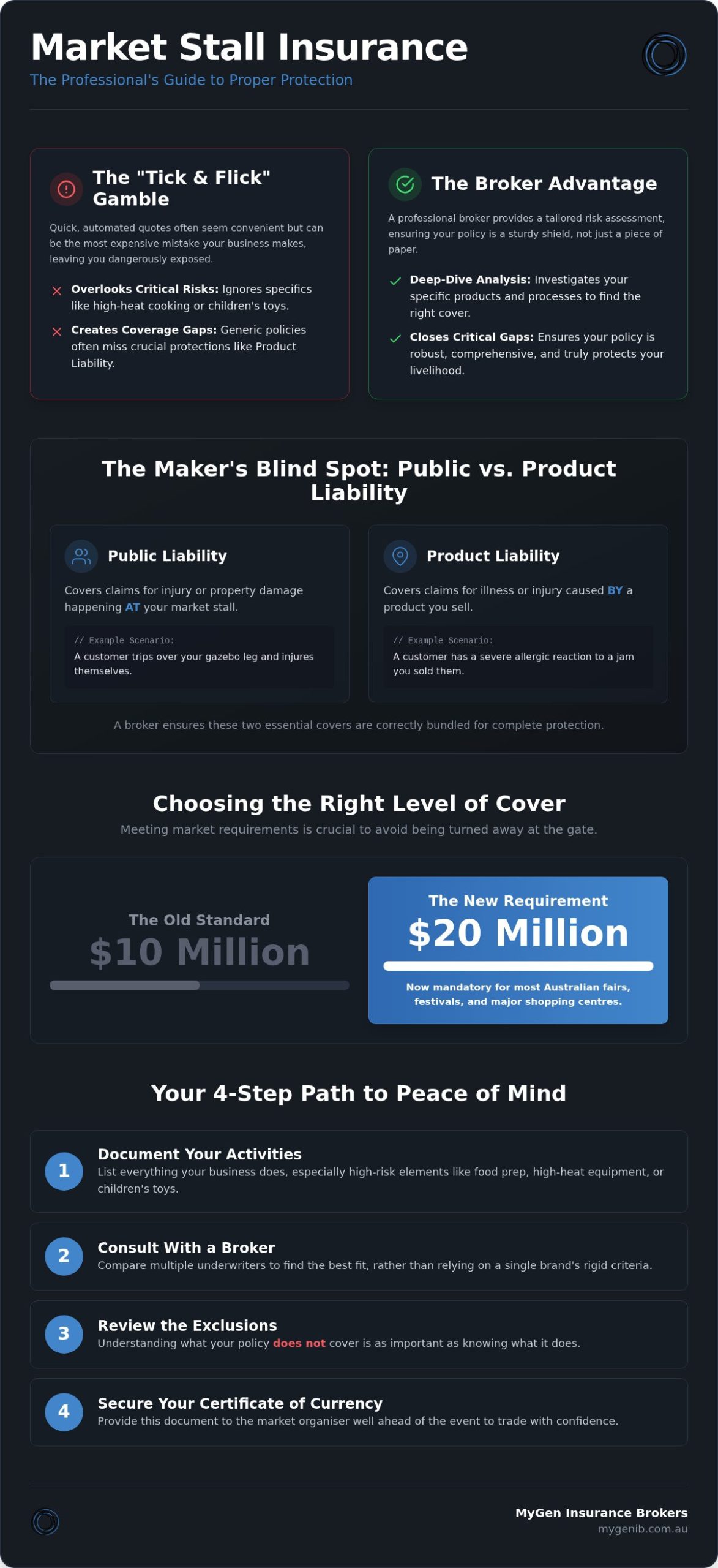
For artisans and food vendors, public liability is only half the story. While it covers a customer tripping over your gazebo leg, it won’t help if that same customer has a severe allergic reaction to a jam you’ve sold. This is why product liability must be included in your public liability insurance for market stalls. We’ve seen many “tick and flick” policies that exclude these risks by default. A professional broker does the heavy lifting, investigating your specific craft to ensure these two covers are correctly bundled. This methodical approach ensures your policy is a genuine shield, not just a piece of paper to show the organiser.
Choosing the Right Level of Cover: $10 Million vs $20 Million
While a $10 million limit was once the industry standard, $20 million is rapidly becoming the new requirement for Australian fairs, festivals, and major shopping centres. This shift isn’t just about red tape; it’s a response to the increasing costs of medical care and legal proceedings. When you seek public liability insurance for market stalls, several factors influence your final premium. Your annual turnover, the physical location of your stall, and the nature of your products all play a part in determining your risk profile. You can explore these factors further in The Complete Guide to Business Insurance in Australia.
Relying on a generic, automated policy without professional advice often leads to the danger of under-insurance. A “one-size-fits-all” approach rarely accounts for the specific nuances of a local stallholder’s operations. General principles found in the SBA Guide to Business Insurance highlight that choosing the right coverage is a foundational step in launching any successful venture. Ensuring your limits match the expectations of your specific market organisers prevents last-minute stress at the gate.
Why Automated “Instant” Quotes Can Leave You Exposed
The “tick and flick” nature of instant quote systems often overlooks unique risks that could void your cover. If your business involves high-heat cooking, children’s toys, or imported components, a standard algorithm might miss these critical details. This is why expert insurance brokers provide such significant value. We perform a deep dive into your business model to find and close gaps that automated systems ignore. Having a human advocate to manage the heavy lifting during a complex claim ensures you can stay focused on your customers. If you feel your current policy might be a mismatch for your actual risks, speaking with a dedicated insurance partner can restore your peace of mind.
How to Organise Your Market Stall Insurance
Organising your cover doesn’t have to be a source of stress. We follow a methodical path to ensure nothing is missed, protecting both your stock and your reputation. This is how we manage the process together:
- Step 1: Document every activity your business performs, paying special attention to high-risk elements like food preparation, high-heat equipment, or children’s toys.
- Step 2: Consult with a broker to compare multiple underwriters rather than relying on a single brand’s rigid criteria.
- Step 3: Review the policy exclusions carefully. Understanding what you aren’t covered for is just as vital as knowing what you are.
- Step 4: Secure your Certificate of Currency and provide it to your market organiser well before the event date.
Exclusions deserve your full attention because a “tick and flick” policy might exclude the very thing you sell. Once we’ve secured the right public liability insurance for market stalls, we’ll issue your Certificate of Currency so you can focus on your customers.
The Certificate of Currency and “Interested Parties”
Think of the Certificate of Currency as your passport to trade. Without it, most Australian markets won’t let you unpack your vehicle. Often, local councils or private organisers will ask to be noted as an “Interested Party” on your policy. This is a standard request that we handle on your behalf to ensure compliance with their specific permit requirements.
Your business is a living entity. If you introduce new product lines or move from a small local fair to a massive regional festival, keep your broker updated. This ensures your public liability insurance for market stalls remains valid and that no new risks have slipped through the cracks as you grow.
Trade with Confidence and Clarity
Your market stall is more than just a weekend project; it’s a reflection of your hard work and creativity. Ensuring you have the right public liability insurance for market stalls shouldn’t be a source of anxiety. We’ve explored why the industry is shifting toward higher limits and how a deep dive into your specific products prevents costly gaps in cover. By choosing a methodical risk assessment over a quick, automated quote, you protect your livelihood from the unexpected.
With over 20 years of industry experience, we act as your protective mentor, doing the heavy lifting to ensure your security is absolute. It’s time to move from confusion to total certainty. Request a personalised market insurance consultation with MyGen today. We’re here to help you secure your spot at the next big event with peace of mind.
Frequently Asked Questions
Do I need my own insurance if the market organiser has a policy?
Yes, you almost certainly need your own cover because an organiser’s policy typically only protects the management and the venue. If a customer trips over your specific display or reacts to a product you sold, you are the one held responsible. Carrying your own public liability insurance for market stalls provides the specific protection you need for your individual business activities.
Does public liability insurance cover the theft of my own stock or gazebo?
No, this specific policy does not cover the theft or damage of your own stock, gazebos, or equipment. Public liability is designed exclusively to protect you against claims made by third parties for injury or damage to their property. To safeguard your own assets, you’ll need to discuss business contents or general property cover with your broker to ensure your gear is protected.
Can I get market stall insurance for just a single day or weekend?
Yes, single-event or weekend policies are available for casual traders who only attend one or two markets annually. However, if you trade more frequently, an annual policy for public liability insurance for market stalls usually offers better value. We can help you weigh up the costs to ensure you aren’t overpaying for short-term cover when a yearly policy might be more economical.
What is the difference between a sole trader and a company for insurance purposes?
This distinction determines who is legally protected by the policy and how the insured name is listed on your Certificate of Currency. A company is a separate legal entity, while a sole trader is personally responsible for the business. We take the time to verify your structure so your protection matches your legal obligations, preventing any issues during a claim.