
The cheapest public liability policy on the market is often the most expensive mistake an Australian contractor can make. We understand the frustration of jumping through hoops just to get on-site, only to find that securing the right public liability insurance for contractors Australia has become a complex moving target. You’ve likely felt the pressure to just “tick and flick” a generic form to keep the work flowing. It’s a heavy burden when a simple oversight can leave your personal assets exposed.
This 2026 guide will show you how to secure coverage that actually stands up when a claim hits, moving beyond automated quotes to provide genuine security. We’ll explore the latest state-specific mandates, the truth about current premium trends, and how a consultative risk assessment protects your livelihood better than any algorithm. You’ll discover how to align your coverage with the specific risks of your trade to ensure you’re protected for the long term.
Key Takeaways
- Understand why Australian contractors face unique liability exposures compared to employees and how to identify your specific site-based risks.
- Learn how to navigate complex commercial contracts to ensure your public liability insurance for contractors Australia meets every site entry requirement without leaving your assets exposed.
- Discover why automated “tick and flick” policies often fail during a claim and how a manual risk assessment identifies critical gaps in your protection.
- Identify “hidden” risks such as high-depth excavation or work in restricted zones that generic automated quotes frequently overlook.
Understanding Public Liability: Why Australian Contractors Face Unique Risks
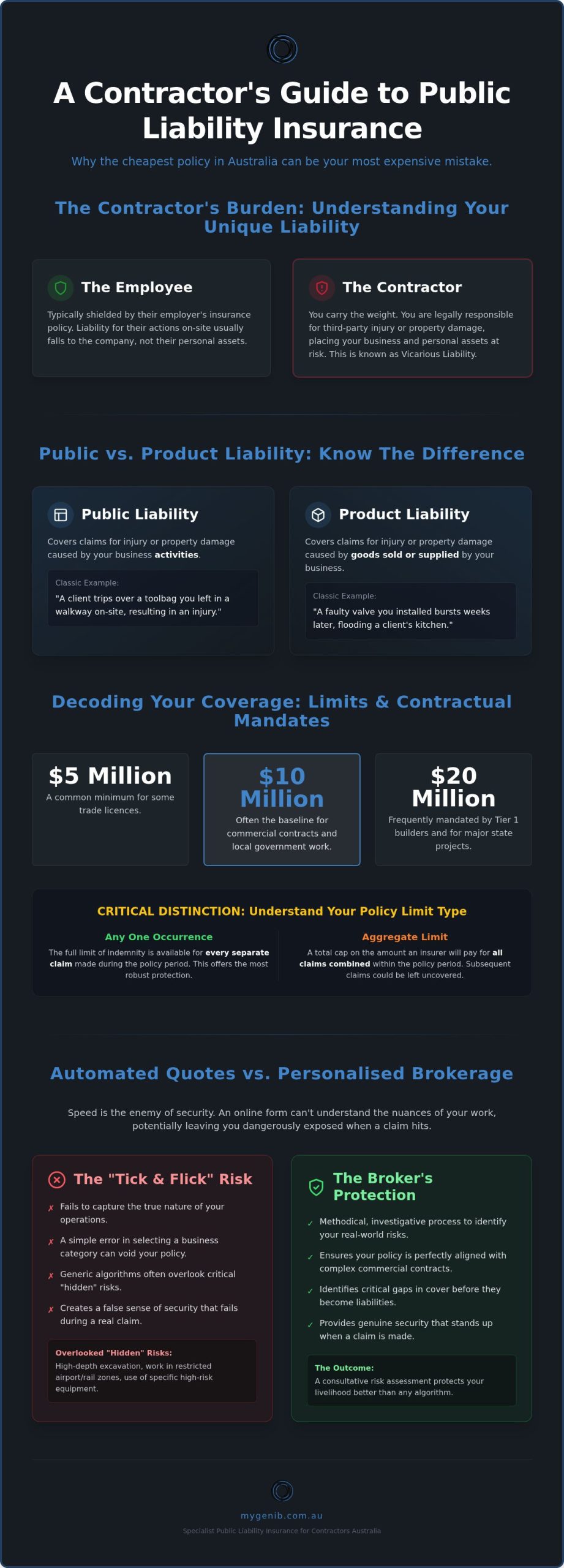
In Australia, your duty of care isn’t just a suggestion; it’s a legal obligation that follows you onto every job site. Understanding Public Liability is about recognising that you are legally responsible for any third-party injury or property damage caused by your business activities, which is why securing public liability insurance for contractors Australia is a fundamental requirement. Unlike employees who are often shielded by an employer’s policy, you carry the weight of vicarious liability for your own actions and those of your subcontractors. This exposure makes your choice of coverage a critical pillar of your business structure.
To better understand this concept, watch this helpful video:
A single mistake can lead to catastrophic financial consequences that reach far beyond your business bank account. Beyond the settlement itself, the legal defence costs alone can bankrupt a small business before a case even reaches a courtroom. We’ve seen how a steady hand in choosing public liability insurance for contractors Australia provides the peace of mind needed to focus on the tools rather than the legalities. We focus on the precision of your policy to ensure you’re never left facing these third-party claims alone.
The Distinction Between Public and Product Liability for Tradies
Many contractors don’t realise that public liability has a sibling: product liability. If you’re a plumber who installs a faulty valve that later bursts and floods a kitchen, that’s a product liability issue because it involves “goods sold or supplied”. However, if you leave your toolbag in a walkway and a client trips over it, that’s a classic public liability claim. We investigate these dual risks thoroughly to ensure your policy covers both the work you do and the parts you provide, leaving no room for expensive gaps in your protection.
Determining Your Coverage: Limits, Costs, and Contractual Requirements
Securing public liability insurance for contractors Australia isn’t just about the premium; it’s about matching the policy to your actual operational footprint. Insurers look at your annual turnover, your specific trade, and your work radius to calculate risk. If you’re working on a local residential site, your risks differ vastly from someone operating near a major airport or shopping centre. We believe in looking beneath the surface of these numbers to ensure your premium reflects your reality, not a generic industry average.
Before you sign a new commercial contract, you must scrutinise the insurance clauses. These documents often contain specific indemnity requirements that can leave you in breach of contract if your policy isn’t perfectly aligned. A seasoned broker acts as your steady hand here, negotiating with underwriters to find a “fit” that satisfies the principal’s demands while protecting your personal assets. If you’re feeling overwhelmed by the fine print, speaking with a specialist broker can turn that confusion into clarity.
Why a $10 Million Limit is Often the Australian Baseline
While $5 million is a common minimum for some licences, most Australian government bodies and Tier 1 builders now mandate a $10 million or $20 million minimum. The limit of indemnity is the maximum amount your insurer will pay for a single claim, making it the most critical figure on your Certificate of Currency. It’s also vital to distinguish between “any one occurrence” and “aggregate limits.” An “any one occurrence” policy provides the full limit for every separate incident, whereas an aggregate limit caps the total payout for all claims within the policy period. This distinction is the difference between true security and a policy that runs dry when you need it most.
Navigating the Market: Why Personalised Brokerage Beats Automated Quotes
Speed is often the enemy of security when you’re arranging public liability insurance for contractors Australia. While an online portal might promise a certificate in minutes, these “tick and flick” forms rarely capture the nuance of your daily operations. If you accidentally select the wrong business category or fail to disclose a specific activity, you risk your policy being voided exactly when you need it most. We prefer a methodical, investigative process that identifies risks before they become liabilities, ensuring your protection is grounded in reality rather than an algorithm’s guess.
Identifying the Hidden Gaps in Generic Insurance Policies
Generic policies often hide restrictive clauses that can catch you off guard during a claim. We frequently see exclusions for work over a certain height, “hot work” involving welding or grinding, and limited cover for “care, custody, and control” of property. Understanding the value of an insurance broker means having a partner who performs a deep-dive into these details to ensure your policy is a perfect fit for your trade, not a generic compromise.
Our deep-dive methodology ensures your specific activities, whether it’s high-depth excavation or work in high-risk zones like mines or airports, are accurately described to the insurer. This diligence builds a foundation of long-term security that automated quotes simply cannot match. We don’t just place your policy; we stand by you as a protective mentor during the claims process. Having a steady hand to navigate the complexities of the Australian insurance market means you can focus on your work while we manage the heavy lifting of your risk profile.
Securing Your Business Legacy Beyond the Worksite
Protecting your contracting business requires more than a generic certificate; it demands a policy that mirrors the actual risks you face every day. We’ve explored how understanding the nuance between public and product liability, along with meeting the rising $10 million baseline, ensures your personal assets remain shielded. Relying on automated forms often leaves gaps that only appear when a claim is filed. By choosing public liability insurance for contractors Australia through a consultative lens, you move from a state of uncertainty to one of total clarity.
Led by Anthony Simpson with over 20 years of industry experience, MyGen Insurance Brokers provides the steady hand needed to navigate volatile markets. Whether you require national coverage or specialised professional indemnity insurance, our partnership ensures your security is never left to chance. Speak with a MyGen Insurance Brokers expert for a personalised risk assessment today and experience the relief of a managed outcome. Your hard work deserves the protection of an expert who understands your trade.
Frequently Asked Questions
Is public liability insurance compulsory for contractors in Australia?
No single federal law makes public liability insurance for contractors Australia compulsory for everyone, but it’s effectively mandatory through state licensing and site entry requirements. For instance, electrical contractors in Queensland must hold at least $5 million in cover to maintain their licence. Most principals won’t let you through the gate without a valid certificate of currency, making it a practical necessity for your daily operations.
How much does public liability insurance cost for a sole trader contractor?
Costs vary based on your specific trade risk and the level of cover required. A sole trader in the construction sector might pay between $500 and $1,200 annually for $5 million in cover, while higher risk trades like roofing can pay over $3,000. We focus on finding the right fit for your public liability insurance for contractors Australia to avoid overpaying for unnecessary inclusions.
Does public liability insurance cover my own tools and equipment?
Standard public liability insurance does not cover your own tools or equipment. Its primary purpose is to protect you against claims for third party injury or property damage caused by your business activities. To protect your gear against theft or damage, you’ll need to add a separate general property or tools of trade cover to your business insurance package to ensure your livelihood is protected.
What is the difference between public liability and professional indemnity?
Public liability covers physical mishaps, such as a client tripping over your equipment or accidental damage to their property. In contrast, professional indemnity insurance protects you against financial losses arising from your professional advice, designs, or errors in judgement. While a plumber needs public liability for a burst pipe, a consultant needs professional indemnity if their faulty advice leads to a client’s financial loss.