
An ‘A’ financial rating from S&P Global might look like an ironclad guarantee of security on paper, but for a business owner waiting years for a claim to settle, that rating is cold comfort. You need an insurer that’s large enough to weather a storm, yet you’re likely feeling a sense of unease regarding recent regulatory headlines and the complexity of modern policy wordings. In this Hollard commercial insurance review, we’re looking beneath the surface of their $2.3 billion annual revenue to see how they truly perform for Australian businesses in 2026.
We’ve done the heavy lifting to analyse whether their financial strength outweighs their recent legal hurdles with ASIC. You’ll discover if their specific industry focus aligns with your needs and how to secure cover that actually works when it’s time to lodge a claim. It’s about moving from uncertainty to a place of genuine protection and clarity.
Key Takeaways
- Evaluate Hollard’s ‘A’ financial rating alongside recent regulatory findings to see if their stability matches your specific risk profile.
- Gain clarity on the current ASIC proceedings and how the duty of “utmost good faith” affects the speed and fairness of your future claims.
- This Hollard commercial insurance review highlights why personalised risk management is essential for uncovering business exposures that automated online systems frequently miss.
- Learn how a broker’s advocacy can streamline complex claims processes, providing the peace of mind that your business remains protected during difficult times.
Hollard’s Position in the Australian Commercial Insurance Market
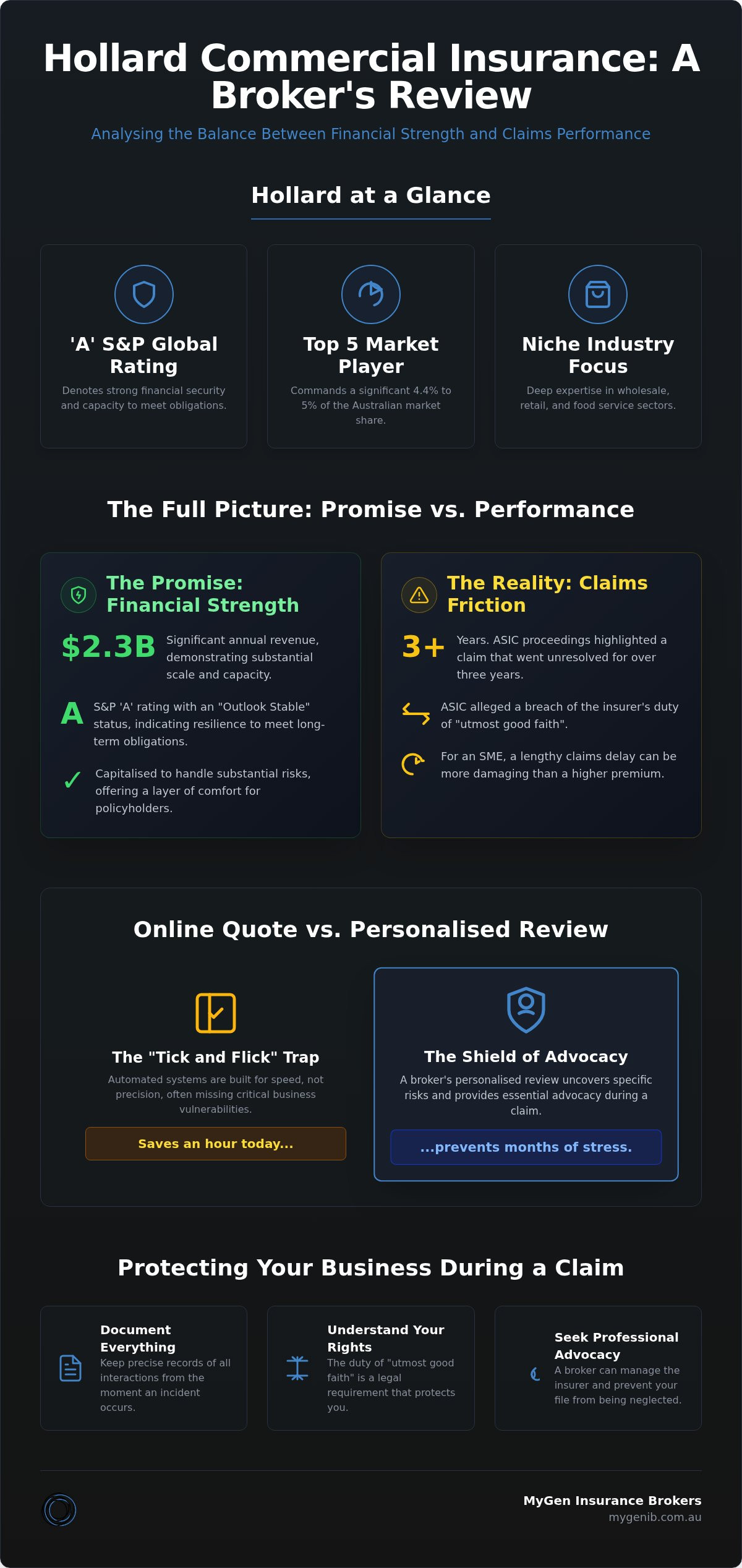
Hollard has established itself as a formidable challenger to the traditional insurance giants in Australia. While names like IAG or QBE might be more familiar at the dinner table, the Hollard Group commands a significant presence, holding approximately 4.4% to 5% of the local market. This isn’t a minor feat. It positions them as a top-five player with the scale to handle substantial risks across the country.
For your business, financial security is paramount. S&P Global Ratings assigned an ‘A’ rating to Hollard in late 2023, accompanied by an “Outlook Stable” status. This means they’ve got the capital to back up their promises. It offers a layer of comfort, suggesting that even in a softening market, they possess the resilience to meet their long-term obligations to policyholders.
To better understand this concept, watch this helpful video:
Hollard often leans into specific niches where they’ve developed deep expertise. We see them most active in the wholesale, retail, and food services sectors. By focusing on these areas, they’ve tailored their risk appetite to suit businesses that require robust protection for stock, equipment, and public liability.
Hollard’s Underwriting and Product Suite
Their core offerings typically centre on Business Insurance and Commercial Motor Insurance. As a major underwriter, they also provide the backbone for several well-known Australian brands and specialist agencies. When conducting a Hollard commercial insurance review, we look at policy wordings closely. While their documents are generally flexible, they’re often best suited for standard to mid-level risks. If your business has unique or highly complex exposures, you’ll want to ensure the fine print doesn’t leave you with a gap during a claim.
Claims Performance: Examining the ASIC Proceedings and AFCA Data
Financial strength is a vital metric, but it tells only half the story. The real test of any provider is how they respond when you’re at your most vulnerable. In April 2025, the ASIC proceedings against Hollard brought internal process failures into the spotlight. The regulator alleged a breach of the duty of “utmost good faith” under the Insurance Contracts Act, citing a claim that remained unresolved for over three years. This highlights a potential gap between Hollard’s impressive capital and their day-to-day service execution.
When you’re conducting a Hollard commercial insurance review, you’re essentially weighing global stability against local friction. While their ‘A’ rating suggests they’ll always have the funds to pay, the ASIC data suggests the path to that payment isn’t always smooth. For an SME, a delay is often more damaging than a slightly higher premium, as stagnant claims can paralyse business operations.
Navigating Regulatory Risks as a Policyholder
The Australian Financial Complaints Authority (AFCA) remains a critical resource for resolving disputes, yet prevention is always better than a tribunal hearing. We’ve observed that many complaints stem from poor communication rather than a lack of funds. To mitigate this, consider these factors:
- Document everything: Keep precise records of all interactions from day one.
- Understand your rights: The duty of utmost good faith is a legal requirement that protects you.
- Seek advocacy: Having a partner to manage the insurer can prevent your file from sitting at the bottom of a pile.
We’ve seen how these delays impact local businesses. If you’re feeling uneasy about your current cover, it’s worth having a professional review your policy to ensure your insurer’s processes match your business’s need for speed.
Why a Personalised Review Outperforms an Online Hollard Quote
While the allure of an instant online quote is understandable, it often leads to the “Tick and Flick” trap. Automated systems are built for speed, not precision. They rarely ask the probing questions required to uncover the specific vulnerabilities of your operation. In this Hollard commercial insurance review, we’ve seen that real value isn’t found in a five-minute web form but in the advocacy that follows. Buying direct might save an hour today, but it could cost you months of stress during a claim.
A broker acts as your shield during the claims process. Given the ASIC legal proceedings against Hollard regarding significant delays, having a professional negotiator in your corner is vital. We don’t just secure a policy; we manage the insurer to ensure they meet their obligations promptly. Our consultative approach involves looking beneath the surface to identify gaps that a standard algorithm would simply ignore. We take the time to understand your story and your specific risks.
Securing the Right Cover for Your Business
Moving beyond the initial price tag is the first step toward genuine security. You must evaluate the total cost of risk, which includes the potential financial friction of a stalled claim. For deeper insights, see The Complete Guide to Business Insurance in Australia. To organise a professional review of your current Hollard policy, reach out for a manual risk assessment. We focus on suitability so you can focus on your business.
Securing Certainty in an Evolving Insurance Market
Choosing a provider involves more than checking a price tag or a financial rating. This Hollard commercial insurance review has shown that while their capital position is robust, the real value for your business lies in how a policy performs when a claim is lodged. You need a partner who understands the nuances of local regulatory changes and has the experience to navigate complex disputes. We bring 20+ years of expert industry experience to every consultation, ensuring your cover is built on precision rather than guesswork. Our consultative approach is focused on claim-time protection for SMEs across Australia. Take the first step toward genuine peace of mind by contacting us today.
Request a personalised risk review from MyGen Insurance Brokers and ensure your business is actually protected. We’re here to turn a complex process into a simple, secure outcome.
Frequently Asked Questions
Is Hollard a reliable insurance company for Australian small businesses in 2026?
Hollard remains a top-five insurer with a solid ‘A’ rating from S&P Global, signifying strong capital backing. While they’re financially secure, their reliability in service has been tested by recent regulatory cases. For Australian SMEs, true reliability means receiving a fair payout without years of litigation. A comprehensive Hollard commercial insurance review indicates they’re best suited for businesses that have professional advocacy to manage the relationship.
What happened with the ASIC lawsuit against Hollard Insurance?
In April 2025, ASIC initiated legal action against Hollard regarding serious failures in their claims-handling processes. The regulator alleged that the insurer breached its duty of utmost good faith after a claim took nearly three and a half years to settle. These proceedings reveal significant internal delays that can paralyse a small business. It’s a clear signal that policyholders need to look beyond just the premium cost.
Can I buy Hollard commercial insurance through a broker?
Hollard actually prefers this model, distributing most of its commercial products through brokers and specialist partners. Buying through a broker allows you to skip the “tick and flick” automated systems and receive a tailored risk assessment instead. This approach ensures your business is correctly categorised and that you have a dedicated expert to fight your corner if a claim is ever disputed or delayed.
Does Hollard offer Professional Indemnity insurance for consultants?
Yes, they offer Professional Indemnity insurance as part of their suite of business protections. This cover is vital for consultants who provide advice or professional services that could lead to financial loss for a client. While their wordings are robust, they’re often designed for standard risks. We suggest a manual review of the fine print to ensure the specific exposures of your consultancy are fully covered.
How does Hollard’s financial strength compare to QBE or NRMA?
Hollard holds an ‘A’ financial strength rating, which places them in the same league as major players like QBE in terms of capital adequacy. While they’ve a smaller market share of about 5% compared to the IAG group, which includes NRMA, their global presence provides a stable foundation. The main distinction lies in their claims-handling track record, making a Hollard commercial insurance review essential for comparison.