
What if the insurance policy you’ve paid for doesn’t actually cover the one risk that could close your doors tomorrow? Most Australian business owners feel a lingering sense of exposure, even with basic coverage in place. You’ve likely felt that prickle of anxiety when hearing about a local litigation case or a sudden change in WHS regulations. Using a comprehensive public liability risk assessment checklist isn’t just about ticking boxes; it’s about finding the gaps that standard policies often overlook. We understand that interpreting complex regulations can feel overwhelming, but true protection requires a deep dive into your unique business DNA. We’ll help you master the art of identifying hidden vulnerabilities using our methodical, Australian-focused risk management framework. This guide previews the latest 2026 regulatory updates and provides a clear priority list to move your business from a state of uncertainty to one of professional calm.
Key Takeaways
- Categorise your business threats into four essential pillars to move beyond basic safety checks and identify vulnerabilities that often hide in plain sight.
- Utilise our methodical 2026 public liability risk assessment checklist to identify exactly where your current safety protocols might be falling short under new Australian standards.
- Master the use of a Risk Matrix to prioritise your mitigation efforts, allowing you to focus your resources on the threats that pose the greatest impact to your operations.
- Learn why a deep-dive consultative approach is the only way to bridge the gap between identifying a risk and successfully transferring it to professional insurance.
Understanding the Four Pillars of Small Business Risk
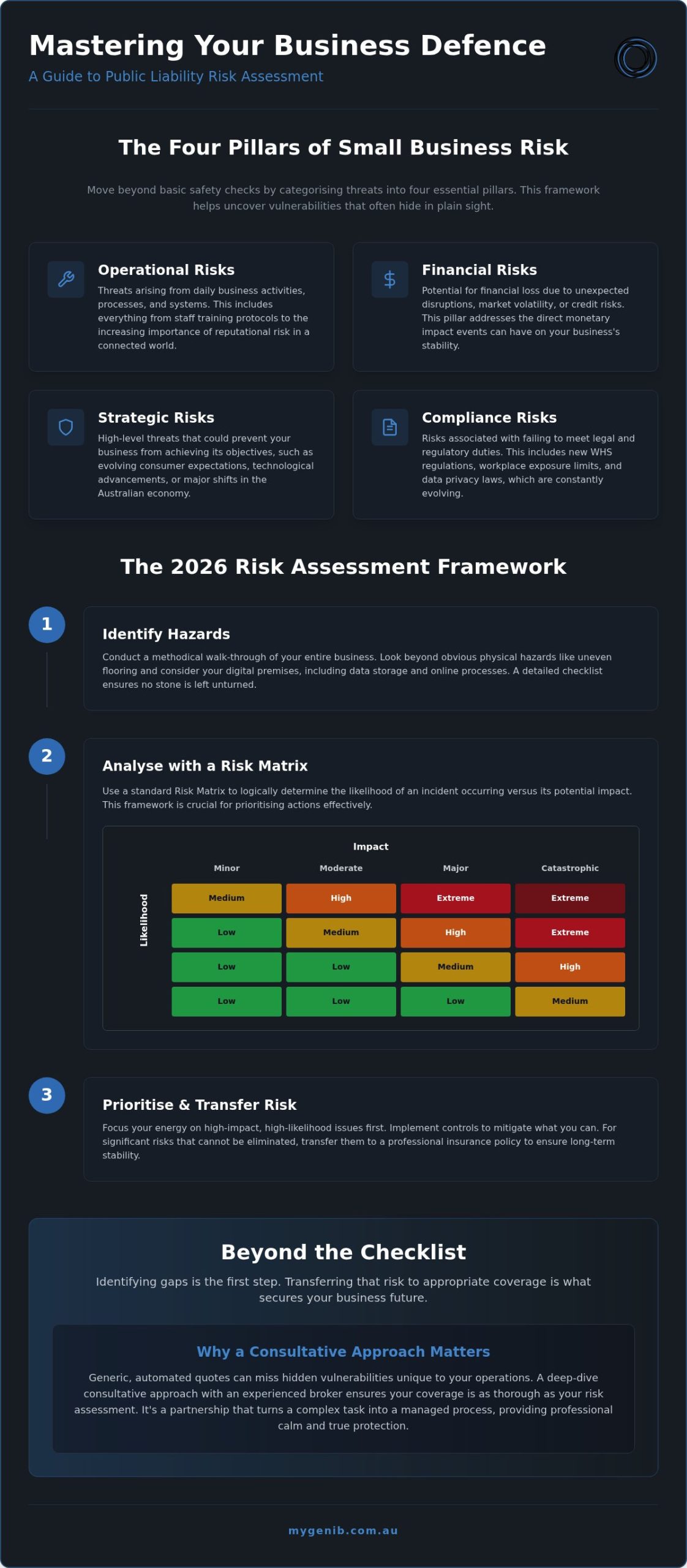
Many owners view risk management as a dry compliance hurdle, something to tick off to keep regulators happy. We believe it should be a deliberate process of investigation and protection designed to secure your life’s work. By conducting a formal risk assessment and utilising a public liability risk assessment checklist, you move beyond surface-level safety and look deep into the four pillars of your organisation: Operational, Financial, Strategic, and Compliance. Australian small businesses are currently facing rapid market shifts, which makes them particularly vulnerable if they only skim their risk profiles rather than doing a deep dive into their specific vulnerabilities.
A robust public liability risk assessment checklist helps you categorise these threats so they don’t feel like an unmanageable mountain. Operational risks cover your daily activities, while financial risks address the potential costs of unexpected disruptions. Compliance risks involve meeting your legal duties, such as the new workplace exposure limits taking effect later this year. Strategic risks require a higher-level view of where your industry is heading.
The Difference Between Internal and External Threats
Internal factors, such as staff training and physical safety protocols, are within your direct control. External threats like sudden regulatory changes or shifting economic conditions require a more watchful eye. Strategic Risk in the 2026 Australian economy is the danger that your current business model may no longer align with evolving consumer expectations or technological advancements. Reputational Risk has also become a critical operational reality; in our connected world, a single public liability incident can damage your brand’s standing in the community far more than the immediate financial cost of a claim.
The 2026 Small Business Risk Assessment Checklist
Developing a comprehensive public liability risk assessment checklist begins with a methodical walk-through of your entire business. You should look beyond the obvious physical hazards, like uneven flooring or loose cabling in your office, and consider your digital premises as well. Identifying these vulnerabilities is a core part of the Australian Government’s guide to risk planning, which emphasises that you cannot effectively manage what you haven’t first spotted in detail. Using a public liability risk assessment checklist ensures no stone is left unturned during this investigative phase.
Once you’ve identified potential hazards, you must analyse each one with precision. We recommend using a standard Risk Matrix to determine the likelihood of an incident occurring versus its potential financial and legal impact. This logical framework allows you to prioritise your actions, focusing your energy on high-stakes issues first. High-impact risks that you cannot fully eliminate through physical controls should be transferred to a professional policy. It’s about finding a balance between internal mitigation and external protection to ensure long-term stability.
Digital and Cyber Security Vulnerabilities
In 2026, your digital assets are often just as exposed as your physical storefront. It’s vital to assess your data privacy protocols to ensure they align with the latest Australian standards, particularly as social engineering tactics become more sophisticated and harder to detect. Employee training gaps are frequently the weakest link in any defence; a single misclicked link can lead to a devastating breach of sensitive client information. This is why many firms now view cyber insurance australia as a non-negotiable part of their broader risk strategy. If you’re feeling exposed, it’s a wise move to consult with an experienced broker who can help you identify these hidden digital gaps.
Beyond the Checklist: Transferring Risk to Professional Coverage
While a public liability risk assessment checklist is a powerful tool for discovery, it doesn’t solve the problem on its own. It identifies the gaps, but insurance provides the stabilising force that protects your business when the unexpected happens. Many platforms offer tick-and-flick automated quotes that treat your business like a generic transaction. We reject this superficial model. A deep-dive consultative approach is essential to uncover hidden vulnerabilities that an algorithm might miss. By following Safe Work Australia’s hazard control process, you can mitigate what’s possible, but transferring the remaining high-impact risk requires a professional hand.
Think of your broker as a protective mentor rather than a distant service provider. We look beneath the surface of your operations to ensure your coverage is as thorough as your initial investigation. This partnership turns a complex, high-friction task into a managed process that offers genuine peace of mind. It’s about moving from a state of feeling exposed to one of professional calm.
Mapping Risks to Essential Policy Types
Your risk profile is unique, so your coverage must be too. If your checklist reveals potential for errors in advice or service, you’ll likely need professional indemnity insurance to shield your firm from negligence claims. For physical accidents, such as a customer slipping on your premises, public liability insurance frameworks provide the necessary safety net. Every business has different pressure points, which is why a business insurance broker is vital to tailor these connections specifically for your firm, ensuring you aren’t paying for what you don’t need while being fully protected where it counts.
Securing Your Business Future in 2026
Protecting your life’s work requires moving beyond surface-level safety checks to understand the specific DNA of your operations. A methodical public liability risk assessment checklist is your first line of defence, helping you categorise hazards across the four pillars of your firm. By identifying physical and digital vulnerabilities now, you can implement controls that provide immediate relief and long-term stability. However, the final step is transferring the risks you can’t control to a policy that actually fits. We invite you to request a personalised risk consultation with MyGen Insurance Brokers to ensure your protection is as deep as your diligence. With over 20 years of industry expertise and a consultative approach that looks beneath the surface of complex Professional Indemnity and Cyber risks, we help you find what others miss. Let’s work together to protect your future.
Frequently Asked Questions
How often should a small business perform a risk assessment in Australia?
You should perform a risk assessment at least once every twelve months to ensure your safety protocols remain current. It’s also vital to review your framework whenever you introduce new equipment, move premises, or change your service model. Regular updates help you stay ahead of evolving Australian regulations and ensure your insurance coverage still matches the actual threats your business faces daily.
Is a risk assessment checklist a legal requirement for Australian businesses?
Managing workplace health and safety risks is a legal requirement under the Work Health and Safety (WHS) Act 2011. While the law doesn’t mandate a specific public liability risk assessment checklist format, it does require you to identify hazards and implement controls. Documenting this process provides essential proof of your diligence if a regulator ever investigates an incident at your place of business.
What is the most common risk overlooked by Australian sole traders?
Digital vulnerabilities and psychosocial hazards are the most frequently overlooked risks among Australian sole traders. Many small operators mistakenly believe they’re too small to be targeted by cyber criminals, yet data breaches can be financially devastating. Additionally, new 2026 standards place greater emphasis on managing work-related stress and mental health; these are now treated with the same legal gravity as physical injuries.
Can I perform my own risk assessment or do I need a professional broker?
You can certainly conduct your own initial investigation, but partnering with a professional broker adds a layer of seasoned expertise. We act as protective mentors who look beneath the surface to identify gaps that a standard public liability risk assessment checklist might miss. While you know your daily operations best, we understand how to translate those specific risks into a robust, tailored insurance framework.