
If your company faced an unexpected ASIC investigation or a major ATO debt tomorrow, would the ‘corporate veil’ actually be enough to stop creditors from knocking on your family home’s front door? We understand that most directors step into their roles believing their personal assets are safely cordoned off from the business’s risks. However, with the 2026 regulatory landscape becoming increasingly rigorous, that sense of security can often be misplaced. In this guide, we’ll demystify the complexities of personal liability of company directors australia and show you how to build a robust firewall around what matters most. We’ll explore the latest 2026 compliance shifts, from Payday Super to industrial manslaughter laws, and provide a clear framework for choosing the right Management Liability or D&O insurance to ensure your peace of mind remains intact.
Key Takeaways
- Debunk the myth of the ‘impenetrable’ corporate veil and understand how 2026 regulatory shifts can put your family home at risk if things go wrong.
- Understand the complexities of personal liability of company directors australia by learning to identify high-risk triggers like Fair Work investigations and ATO penalty notices.
- Distinguish between standalone D&O and comprehensive Management Liability cover to ensure your insurance matches your company’s actual footprint rather than a generic template.
- Gain a clear framework for assessing your industry’s specific risk profile, so you can move from a state of uncertainty to one of calm, managed security.
The Reality of Personal Liability for Australian Small Business Directors
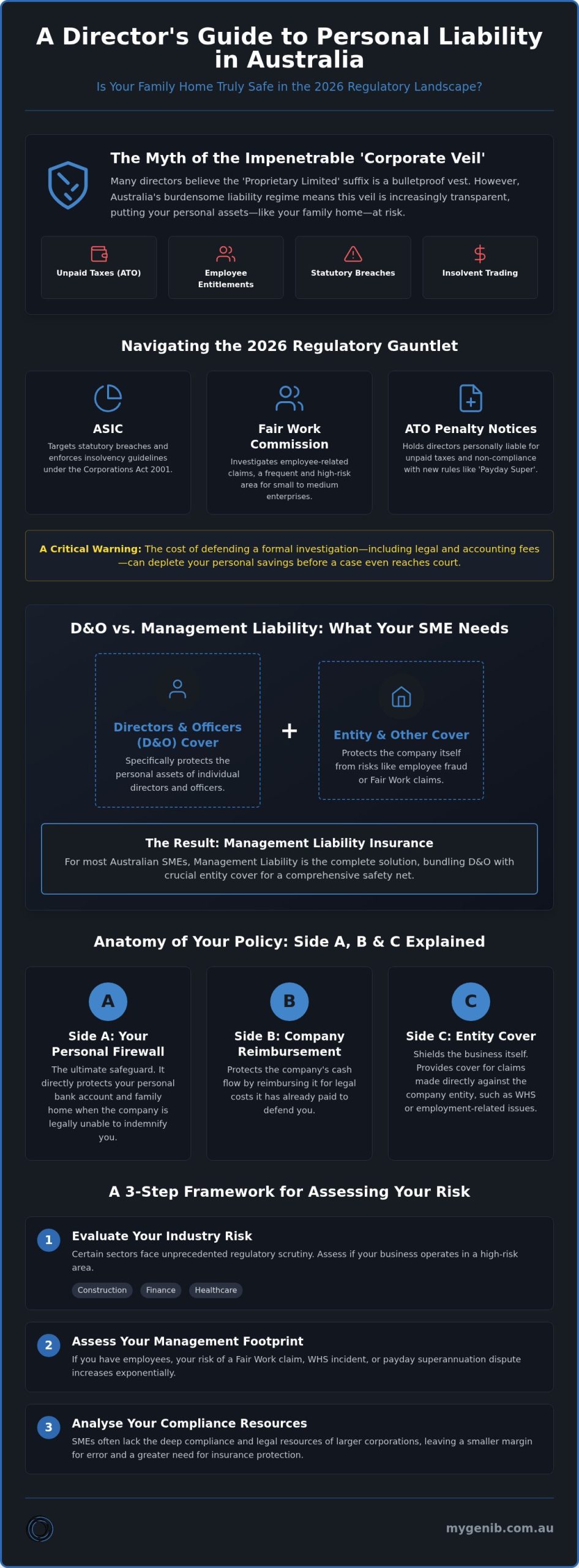
Many Australian directors believe that the ‘Proprietary Limited’ suffix on their company name acts as a bulletproof vest. While it offers some separation, the 2026 regulatory environment has made the ‘corporate veil’ increasingly transparent. Australia is widely regarded as having one of the most burdensome liability regimes in the world. This means the personal liability of company directors australia extends far beyond simple business debt. Directors can be held personally responsible for statutory breaches, unpaid taxes, and employee entitlements.
To better understand how these risks manifest, watch this helpful video:
Directors and Officers (D&O) insurance exists to protect the individual’s personal assets. Unlike standard business insurance that covers the entity, D&O acts as a personal firewall for your family home and savings. Small companies often face higher risks because they lack the deep compliance resources of larger corporations, leaving no margin for error when navigating Australian corporate law. We often see directors who are technically brilliant at their trade but struggle with the sheer volume of paperwork required to stay compliant.
The Regulatory Net: ASIC, Fair Work, and Statutory Breaches
Small firms are frequently targeted by bodies like ASIC and the Fair Work Commission for statutory breaches rather than the large-scale class actions seen in the news. Even if you’ve done nothing wrong, the cost of defending a formal investigation can be financially devastating. Legal fees and forensic accounting costs can quickly deplete your personal savings before a case even reaches court. Protecting yourself against the personal liability of company directors australia requires more than just good intentions. The Corporations Act 2001 (Cth) places personal responsibility on every director to ensure the company meets its legal obligations, regardless of the business’s turnover or size.
D&O vs Management Liability: What Does Your Company Actually Need?
For most Australian small-to-medium enterprises (SMEs), choosing between Directors and Officers (D&O) insurance and Management Liability isn’t a matter of one or the other. In the local market, D&O is typically bundled as a core component of a broader Management Liability policy. While D&O focuses specifically on the personal liability of company directors australia, Management Liability offers a wider safety net. It includes protection for the company entity against risks like employee fraud or Fair Work claims, which are far more frequent than high-level shareholder lawsuits.
We’ve seen how automated online quotes often leave dangerous gaps, such as inadequate sub-limits for statutory fines or specific WHS penalties. Unlike these generic platforms, we take a deep-dive approach to ensure your cover actually matches your operational reality. If you’re concerned about specific exposures, it’s often best to speak with an experienced broker who understands the nuances of the local regulatory environment.
Understanding Side A, B, and C Cover in Plain English
To truly grasp how your policy works, you need to understand the three ‘Sides’ of cover. Side A is your ultimate safeguard; it protects your personal bank account and family home when the company is legally unable to indemnify you. Side B steps in to reimburse the company for legal costs it has already paid to defend you, which helps protect the firm’s vital cash flow. Finally, Side C provides ‘entity’ cover for the company itself. This is particularly relevant when navigating ASIC guidelines on insolvency, as it helps manage the fallout from claims made directly against the business entity, further mitigating the personal liability of company directors australia.
A Risk Assessment Framework: Deciding if You Need Cover
Determining the right level of protection isn’t about following a generic checklist; it’s about understanding your specific exposure in a shifting market. We suggest a methodical three-step approach to evaluate your risk. First, evaluate your industry risk. In 2026, sectors like construction, finance, and healthcare are facing unprecedented scrutiny from regulators. Second, assess your ‘management’ footprint. If you have employees, the risk of a Fair Work claim or a payday superannuation dispute increases exponentially. Third, consider your growth strategy. Most sophisticated investors and non-executive directors will simply refuse to join a board unless robust D&O cover is already active.
Finding the right path through these choices requires a steady, experienced hand. This is why expert insurance brokers are essential for moving beyond ‘tick and flick’ automated quotes. We look beneath the surface to identify where the personal liability of company directors australia might actually manifest in your day-to-day operations.
When D&O Insurance Becomes Non-Negotiable
Attracting high-quality talent to your board requires a foundation of trust and security. Seasoned professionals are acutely aware of the various director liabilities that can arise from even well-intentioned decisions. Remember that while a professional indemnity insurance policy covers the advice you provide, D&O specifically shields your conduct as a leader. The cost of a single legal defence often exceeds a decade of insurance premiums for an Australian SME. By securing the right cover, you aren’t just buying a policy; you’re ensuring that the personal liability of company directors australia doesn’t become a roadblock to your future success.
Securing Your Professional Legacy and Personal Peace of Mind
Building a successful company shouldn’t come at the cost of your personal financial security. We’ve explored how the 2026 regulatory environment makes the personal liability of company directors australia a very real exposure, but it’s one that can be managed with the right strategy. By moving beyond generic, automated quotes and embracing a tailored Management Liability policy, you create a dedicated firewall between your business risks and your family home.
With over 20 years of industry experience, Anthony Simpson and our team provide national coverage to help you navigate these complex choices. We specialise in crafting bespoke business insurance solutions that look beneath the surface of your specific industry risks. Don’t leave your personal assets to chance. Speak with MyGen for a personalised D&O risk assessment today and gain the clarity you need to lead with confidence.
Frequently Asked Questions
Is D&O insurance compulsory for small companies in Australia?
No, D&O insurance isn’t a legal requirement under the Corporations Act 2001. However, while it isn’t mandated like workers’ compensation, it’s often a practical necessity for anyone wanting to protect their family home. Without it, the personal liability of company directors australia remains fully exposed to the costs of legal defence and potential settlements arising from management decisions.
How much does D&O insurance typically cost for a small PTY LTD?
There is no fixed price for this cover because every business faces a unique set of risks. Factors such as your industry sector, the complexity of your operations, and your total staff numbers will all influence the final premium. We avoid automated ‘tick and flick’ quotes to ensure you aren’t overpaying for irrelevant cover or left with dangerous gaps in your protection.
What is the difference between Professional Indemnity and D&O insurance?
These two policies serve very different purposes within your risk management strategy. Professional Indemnity insurance covers claims related to the professional advice or services you provide to third parties. D&O insurance specifically protects your personal assets from claims related to how you manage the company, such as alleged breaches of duty, reporting errors, or misleading statements made as a director.
Does D&O insurance cover criminal acts or fraud by a director?
Most policies explicitly exclude cover for intentional criminal acts or proven instances of fraud. However, a key benefit is that the policy often pays for your legal defence costs until a court reaches a final verdict of guilt. This is a vital safeguard because the personal liability of company directors australia can include the crushing financial burden of proving your innocence during a long investigation.