
What if a factory mistake made thousands of kilometres away was legally considered your own? Most Australian business owners see themselves as distributors or retailers, but under the Australian Consumer Law, you’re often the “deemed manufacturer” for every item you bring into the country. It’s a heavy realisation to carry, especially when you’re already managing the complexities of global logistics and supply chain volatility. We understand the anxiety that comes with wondering if an overseas supplier’s insurance will actually stand up in an Australian court. This guide explores why product liability insurance for importers in Australia is your most critical safety net. You’ll learn exactly how these legal obligations work, why the $100,000 consumer threshold matters, and how to ensure your policy provides the deep protection your business deserves. We’ll help you move from uncertainty to a place of total professional confidence.
Key Takeaways
- Recognise your legal status as a “deemed manufacturer” under the Australian Consumer Law and the extensive duty of care you owe to every local customer.
- Pinpoint the high-risk products and subtle labelling errors that can trigger a devastating claim against your business assets.
- Uncover the critical gaps in standard policies and why bespoke product liability insurance for importers in Australia is the only way to manage global sourcing risks properly.
- Move beyond “tick and flick” automated quotes to find a protective insurance strategy that accounts for specific supplier locations and long-term liability.
The Deemed Manufacturer Rule: Why Importers Face Unique Liability Risks
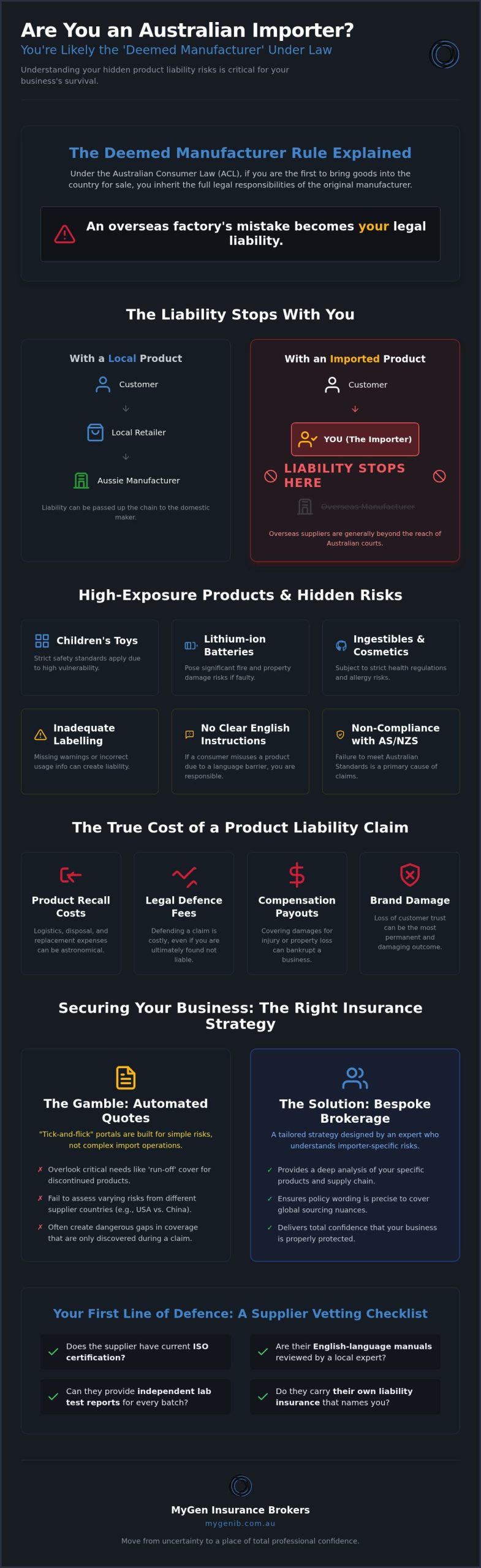
When you source goods from overseas, you aren’t just a shop owner or a wholesaler; you’re stepping into the shoes of the entity that made the item. Under the Competition and Consumer Act 2010, Australian law holds you to a much higher standard than a simple reseller. If a local shop sells a faulty Australian-made kettle, the manufacturer is usually liable. However, if you import that kettle from a factory in Shenzhen or Berlin, you become the “deemed manufacturer” because the actual maker has no presence here. This shift in status makes product liability insurance for importers in Australia a non-negotiable part of your risk management strategy.
To better understand this concept, watch this helpful video:
The ‘Deemed Manufacturer’ rule acts as the legal cornerstone for Australian wholesalers, ensuring that importers are held fully accountable for safety defects as if they had manufactured the goods themselves. This means you owe a direct duty of care to every customer who uses your products. Unlike a local reseller who can pass the buck to a domestic supplier, you are the final stop for any legal claim or compensation demand. We know how heavy that responsibility feels, particularly when you have limited control over a distant factory’s daily operations.
The Australian Consumer Law (ACL) and Your Business
The ACL is designed to protect consumers from products that don’t meet safety standards. It operates on the principle of strict liability. This means a claimant doesn’t need to prove you were negligent or that you knew the product was faulty; they only need to prove the product was defective and caused harm. We often see confusion between different cover types, so it’s vital to understand the difference between product and public liability before you commit to a policy. Because you are the first point of contact for claims, having robust product liability insurance for importers in Australia ensures your business doesn’t collapse under the weight of a single bad batch.
Assessing Your Risk: High-Exposure Products and Compliance
Identifying high-exposure goods is the first step in protecting your business from the “deemed manufacturer” trap. Products like children’s toys, lithium-ion batteries, and ingestibles carry significant inherent risks. A faulty battery can lead to property damage or fire, while ingestibles face strict health regulations. Even if the product itself is sound, hidden risks like inadequate labelling or a lack of clear English instructions can trigger a massive liability claim. If a consumer misuses a product because the warning wasn’t legible, you are the one held responsible.
A product recall is often the most expensive event an importer faces. Beyond the direct costs of reverse logistics and safe disposal, the damage to your brand’s reputation can be permanent. We recommend a methodical approach to vetting suppliers. Use this checklist to evaluate your partners:
- Does the supplier have current ISO certification?
- Can they provide independent lab test reports for every batch?
- Are their English-language manuals reviewed by a local expert?
- Do they carry their own liability insurance that names you as an additional insured?
Navigating AS/NZS Standards and Regulatory Compliance
Ensuring your goods meet Australian Standards (AS/NZS) is your strongest defence in a liability suit. The ACCC actively monitors imports, and failing to meet mandatory safety standards can void your product liability insurance for importers in Australia. We take a deep-dive approach to help you identify which specific regulations apply to your range, turning a complex compliance burden into a manageable process. If you’re feeling uncertain about your current coverage, speaking with a dedicated broker can provide the clarity you need to move forward with confidence.
Securing Your Business: Why Bespoke Brokerage Beats Automated Quotes
Relying on a “tick-and-flick” online portal is a gamble most importers simply can’t afford to take. These automated systems are built for standard, low-complexity risks, but they frequently overlook critical elements like run-off cover or specific cargo nuances that apply while your goods are in transit. When you source product liability insurance for importers in Australia, the policy wording must be incredibly precise. For example, importing from the USA requires a vastly different risk profile than sourcing from China due to the highly litigious nature of the American legal system.
Having an expert advocate by your side is invaluable when a third party makes a demand against your business. We don’t just set up a policy and walk away; we stand with you during the claims process to ensure the insurer honours their commitment and protects your interests. For a broader perspective on how these different protections fit into your overall strategy, you can explore the guide to business insurance in Australia.
The MyGen Consultative Approach to Import Risk
We take a “deep-dive” approach into your specific supply chain to uncover vulnerabilities that generic algorithms miss. By conducting a personalised risk assessment, we can often secure more favourable terms from underwriters who value the extra diligence and transparency we provide. This thoroughness transforms a complex, high-friction transaction into a protective partnership. We invite you to move from a state of persistent anxiety to one of absolute certainty by booking a consultation for a tailored insurance programme designed specifically for your unique import profile.
Protecting Your Future in the Global Market
Importing goods into Australia offers immense opportunity, but it also places the full weight of the “deemed manufacturer” rule on your shoulders. We’ve explored how the Australian Consumer Law views your business and why standard, automated policies often fail to account for the specific risks of your supply chain. With over 20 years of experience, we specialise in navigating these complexities to ensure your business remains resilient against unforeseen claims. Securing the right product liability insurance for importers in Australia isn’t just a compliance task; it’s about gaining the peace of mind that your livelihood is protected by a bespoke strategy rather than a generic template. We invite you to speak with a MyGen broker for a personalised import risk assessment to verify your coverage today. You don’t have to carry the stress of global sourcing alone.
Frequently Asked Questions
What exactly is the ‘deemed manufacturer’ rule for Australian importers?
Under the Australian Consumer Law, if the actual manufacturer is based overseas and doesn’t have a place of business in Australia, you are legally treated as the manufacturer. This means you carry the same responsibilities for safety defects as if you had built the product yourself. It’s a critical legal distinction that creates a significant duty of care toward every local customer.
Does my overseas supplier’s product liability insurance protect my Australian company?
Usually, it doesn’t. Overseas policies often don’t extend to Australian legal jurisdictions or meet local regulatory requirements. Even if you’re named as an “additional insured”, claiming against a foreign policy is notoriously difficult and slow. You need local product liability insurance for importers in Australia to ensure you have an advocate who understands the local legal landscape and responds quickly when it matters most.
How much product liability insurance does an importer typically need in Australia?
Coverage levels depend on your product risk and turnover, but many Australian businesses choose limits between $5 million and $20 million. High-risk items like electronics or children’s toys often require higher limits due to the potential for large-scale claims. We recommend a personalised assessment to determine a suitable limit that protects your specific business assets and ensures your long-term viability.
What happens if I import a product that doesn’t meet Australian Standards?
Importing non-compliant goods can lead to severe penalties from the ACCC and may void your insurance coverage. If a product causes harm and doesn’t meet mandatory AS/NZS standards, you face strict liability for any resulting damages. This is why we deep-dive into your supply chain to ensure your compliance processes are robust enough to satisfy both regulators and your insurance underwriters.
Does product liability insurance cover the cost of a product recall?
Standard product liability policies generally cover the legal costs and damages if a product causes injury, but they don’t always include recall expenses. You often need a specific “Product Recall” extension or a separate policy to cover the logistics, transport, and disposal costs of removing a faulty batch from the market. We help you identify if this extra layer of protection is necessary for your range.