
Your investment property isn’t a “set and forget” asset, and treating your insurance like a simple checkbox exercise is a gamble you likely can’t afford to lose. We understand the quiet anxiety that keeps you up at night, whether it’s the fear of a sudden rent default leaving your mortgage unpaid or the discovery of malicious damage. It’s frustrating when the difference between basic building cover and genuine landlord insurance feels like a maze of fine print. You deserve more than a “tick and flick” approach that leaves your hard-earned assets exposed.
We’ve designed this guide to help you move beyond generic policies to secure a solution that truly protects your rental income and property. We’ll explore how manual risk assessment and a protective, expert-led strategy provide the long-term security your portfolio requires in 2026.
Key Takeaways
- Learn why standard building insurance often falls short for investors and how a specialised policy acts as a comprehensive safety net for your property assets.
- Identify the essential inclusions, such as rent default and public liability, that are vital for maintaining your rental income continuity and legal protection.
- Discover the significant security advantages of manual risk assessment over automated quotes when choosing your landlord insurance in 2026.
- Understand the value of having a seasoned expert advocate for you during the claims process to ensure your investment is managed with professional diligence.
What is Landlord Insurance? Understanding Your Investment Safety Net
Think of landlord insurance as a tailored shield designed specifically for the unique financial pressures of property investment. While many owners see insurance as a passive expense, it’s actually an active tool that protects you from losses tied directly to tenant activities. It isn’t just about the building; it’s about safeguarding your cash flow and your future stability.
A standard home insurance policy is typically built for owner-occupiers, focusing primarily on the physical structure and personal belongings. It doesn’t account for the “human variable” of tenancies. If a tenant stops paying rent or causes accidental damage, a basic building policy often leaves you footing the bill yourself. In 2026, Australian rental regulations have become increasingly intricate, making the gap between basic cover and comprehensive protection even wider.
We believe in moving you from a state of constant worry about property inspections to a position of professional certainty. Having the right cover means you aren’t just reacting to problems; you’re managing a secure asset with the support of experts who understand the local landscape.
The Core Difference: Building Cover vs. Landlord Protection
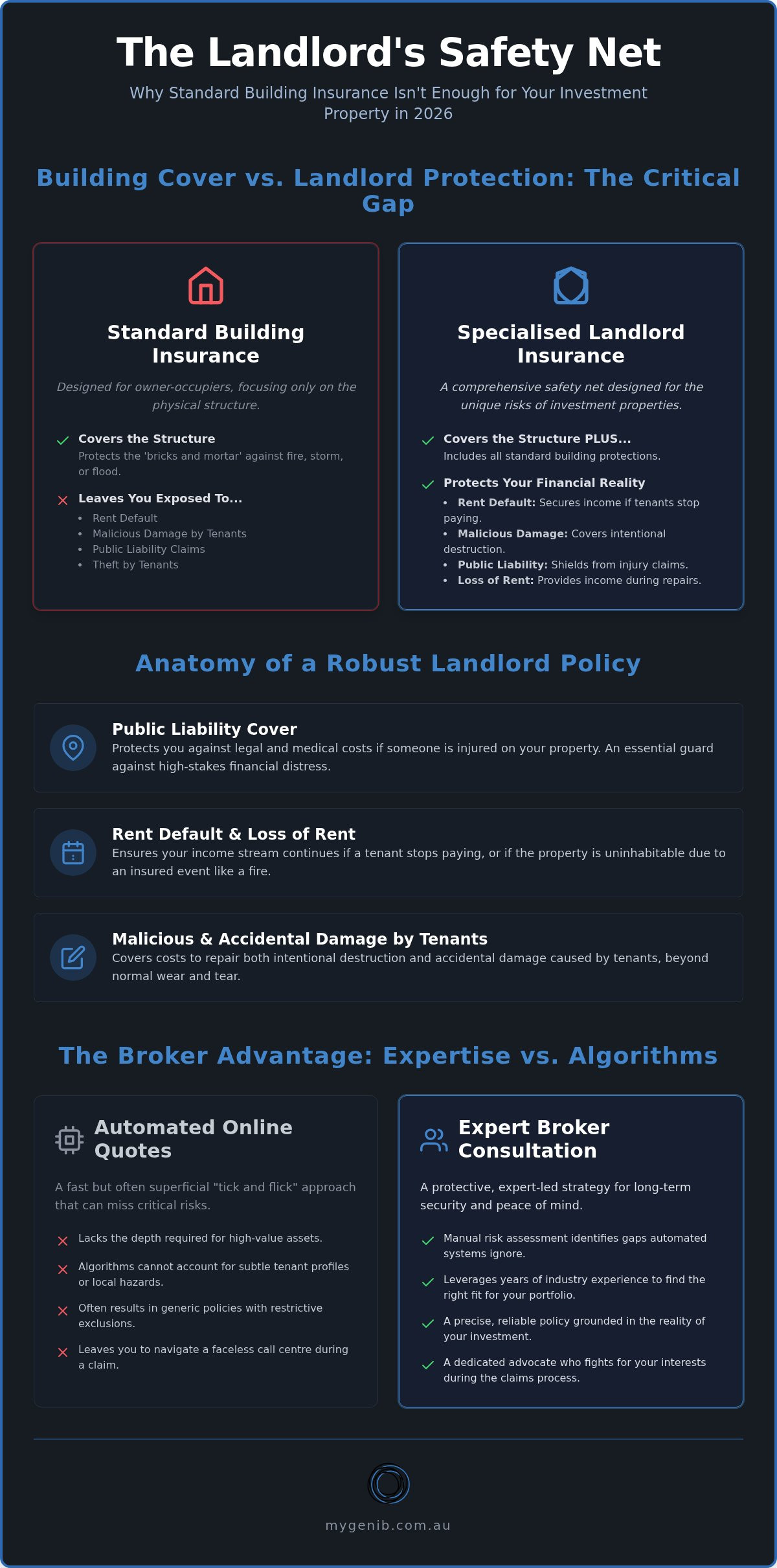
Building insurance safeguards the bricks and mortar against fire, storm, or flood. However, landlord insurance goes deeper by protecting the commercial reality of your asset. This includes specific risks like rent default, theft by tenants, and public liability. For investors managing multiple properties, we also discuss how professional indemnity insurance can offer an additional layer of security. Our methodical approach ensures we look beneath the surface to find the right fit for your portfolio.
Essential Policy Inclusions: What Every Australian Landlord Should Look For
Securing a policy is only half the battle; the real value lies in the specific inclusions that protect your cash flow. Rent default cover is arguably the most critical component. It ensures that if a tenant stops paying, your mortgage commitments don’t suddenly become a personal crisis. We also prioritise public liability cover, which protects you against legal claims if someone is injured on your property. This is a high-stakes area where a simple oversight can lead to significant financial distress.
Distinguishing between malicious damage and ordinary wear and tear is where many generic policies fail. While a scuffed wall is an expected part of renting, intentional destruction requires robust landlord insurance to recover your costs. Additionally, “Loss of Rent” cover provides a vital buffer if a fire or flood renders the property uninhabitable, ensuring your income remains steady during repairs. If you’re unsure how these layers fit together, our team can help you tailor a solution that matches your specific risk profile.
Looking Beneath the Surface: Exclusions and Limits
A low premium often masks restrictive exclusions hidden within the Product Disclosure Statement (PDS). We move beyond the “tick and flick” approach of automated systems by conducting a manual risk assessment. This thorough investigation identifies gaps, such as the need for specialised contents cover for your own appliances or fittings, which generic platforms often ignore. By looking deeper, we ensure your protection is precise, reliable, and grounded in the reality of your investment.
The Broker Advantage: Why Personal Consultation Beats Automated Quotes
While an online form promises speed, it often lacks the depth required to truly secure a high-value asset. An algorithm cannot account for the subtle nuances of your specific tenant profile or the historical local hazards that a seasoned professional identifies. By choosing a consultative approach with an expert like Anthony Simpson, who brings over 20 years of industry experience, you gain a partner who looks beneath the surface. We perform a manual risk assessment on every property, ensuring your landlord insurance is a precise fit rather than a generic guess.
The real value of an insurance broker becomes most apparent when you need to make a claim. Instead of navigating a faceless call centre, you have a dedicated advocate who manages the heavy lifting and fights for your interests. We act as long-term partners, organising and managing your policy so you can focus on growing your portfolio with absolute peace of mind. We’re here to ensure you’re never just another policy number in a database.
Moving from Complexity to Clarity
Our personalised consultation process moves you from confusion to a simplified, secure outcome. We start with a discovery phase to understand your unique situation, followed by a thorough investigation of the market to find suitable protection. You’ll enjoy a direct line to a professional who knows your history, rather than being passed between departments. This professional diligence is essential because property investment is a commercial venture. Just as business insurance principles require expert risk management, your rental assets deserve a steady, experienced hand to navigate the complexities of 2026 legislation.
Securing Your Property Portfolio for the Long Term
Protecting your Australian investment property requires more than a standard policy. It demands a strategy that accounts for the human variables of tenancy and the evolving legal landscape of 2026. By prioritising essential inclusions like rent default and public liability, you move from a position of vulnerability to one of professional certainty.
At MyGen, we reject the superficial “tick and flick” approach. As an Authorised Representative of the Community Broker Network, Anthony Simpson brings over 20 years of industry experience to every manual risk assessment. We act as your protective mentor, doing the heavy lifting to ensure your landlord insurance is precise and reliable.
You don’t have to navigate these complexities alone. Request a personalised landlord insurance consultation with MyGen today to gain the peace of mind you deserve. Your assets are far too valuable to be left to an algorithm.
Frequently Asked Questions
Is landlord insurance compulsory in Australia?
While it isn’t legally compulsory under Australian law, most mortgage lenders make it a mandatory condition of your investment loan. Even if you own the property outright, operating without landlord insurance exposes you to significant liability and financial loss. It’s a vital component of professional risk management that ensures a single incident doesn’t derail your entire long-term investment strategy.
Does landlord insurance cover unpaid rent if the tenant just leaves?
Yes, this is typically covered under the “Rent Default” section of your policy. If a tenant absconds or is legally evicted for non-payment, this inclusion helps recover the lost income. It’s important to ensure your specific policy doesn’t just cover damage, but also the “business” side of renting. We help you scrutinise these details to ensure your cash flow remains protected.
Can I claim for “wear and tear” on my landlord insurance policy?
No, insurance policies don’t cover gradual deterioration or “wear and tear.” Items like faded curtains, worn carpets, or scuffed floorboards are considered part of the property’s natural ageing process. These are maintenance responsibilities for the owner rather than insurable events. Insurance is designed to protect you against sudden, unforeseen, and accidental or malicious incidents that cause significant damage to your asset.
What is the difference between accidental and malicious damage?
Accidental damage refers to unintentional mishaps, such as a tenant dropping a heavy object on a tiled floor. Malicious damage is different because it involves an intentional act of destruction, like graffiti or smashed windows. Many automated policies have confusing limits on these categories. Our manual risk assessment ensures you understand exactly how your cover applies to each scenario before a claim occurs.