
If you believe your strata policy covers every tenant mishap, you might be leaving your investment dangerously exposed. It’s a common trap for many property owners who assume the body corporate handles the heavy lifting. When investigating landlord insurance for apartments vs houses australia, the boundaries of what you actually own can become blurred. We understand the anxiety that comes with wondering if you’re under-insured for tenant-related damage or legal liability claims; it’s a stressful position to be in.
This guide clears up the confusion by showing you exactly what strata covers versus what you must handle yourself to ensure your investment is fully protected. We’ll help you move from uncertainty to having total confidence that your specific property type is correctly insured. You’ll gain a clear understanding of how to organise a policy tailored to your actual risks, rather than a generic one that leaves you vulnerable.
Key Takeaways
- Recognise that while houses require full building cover, apartment owners must focus on the “internal shell” and contents that strata policies typically exclude.
- Pinpoint the specific fixtures and fittings, such as carpets and air conditioners, that often fall into the insurance gap between your policy and the body corporate’s coverage.
- Understand your legal liability obligations as a landlord to ensure you are protected against claims, regardless of whether your investment is a freestanding home or a unit.
- Master the nuances of landlord insurance for apartments vs houses australia to build a tailored policy that reflects your actual risk profile and provides long-term security.
House vs Apartment: Decoding the Australian Landlord Insurance Divide
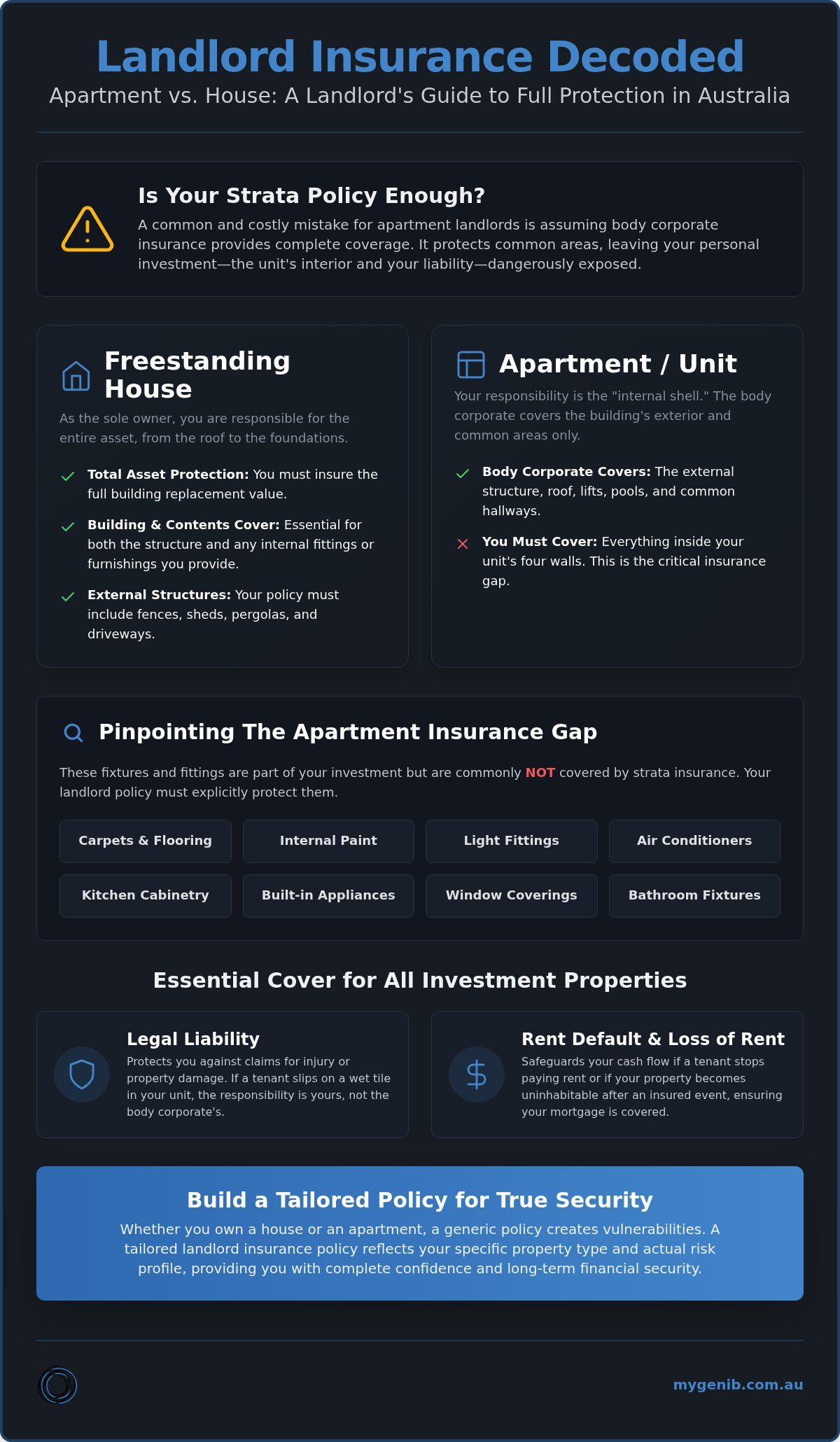
Choosing between a freestanding house and a strata-titled unit involves more than just a different mortgage; it changes your entire risk profile. For a house, you are responsible for the whole asset, meaning you need Building and Contents cover to protect everything from the roof tiles to the sub-floor. When assessing landlord insurance for apartments vs houses australia, the distinction becomes even sharper. While the body corporate handles the building’s “shell”, you remain the sole guardian of the space within your four walls. You are the sole protector. Understanding Rent Insurance Explained in the context of Australian property law ensures you don’t mistake a strata policy for a complete safety net. You must account for everything from the paint on the walls to the floorboards beneath your feet.
To better understand this concept, watch this helpful video:
Why Strata Insurance Isn’t a Safety Net for Landlords
Many owners feel a false sense of security because they pay body corporate fees. It’s vital to remember that strata insurance prioritises common areas like lifts, pools, and the external structure. It rarely covers the internal fixtures or the specific liability risks that arise during a tenancy. If a pipe bursts inside your kitchen or a tenant slips on a wet tile in your lounge room, the body corporate isn’t responsible; you are. We find that apartment risks often centre on water egress and internal damage, whereas house risks involve external structures like fences, sheds, and pergolas. Strata policies are not enough. We always recommend reviewing the specific Body Corporate policy to see where their protection ends and your personal responsibility begins.
Apartment Landlord Insurance: Navigating Fixtures and Fittings
The true complexity of apartment ownership lies in the “internal shell”. While your body corporate looks after the external walls, you are the sole manager of everything inside. This includes carpets, curtains, light fittings, and split-system air conditioners. When weighing up landlord insurance for apartments vs houses australia, the risk moves from external weather to internal mishaps. Even if you strictly follow the landlord responsibilities in NSW or your local state regulations, legal liability remains a personal burden. If a tenant slips on a wet kitchen tile, the body corporate won’t step in; that claim lands squarely on your desk.
Protecting your cash flow is equally vital in high-density markets where vacancies can fluctuate. Rent default and loss of rent are essential components of a robust policy. These features ensure that a tenant’s financial trouble doesn’t become your mortgage crisis. To better understand how to safeguard your monthly income, explore our guide on landlord insurance.
The Critical Role of Contents Cover in Unfurnished Units
Many investors mistakenly believe that an unfurnished unit requires no contents cover. This oversight leaves high-value assets like hybrid flooring, custom cabinetry, and built-in appliances dangerously exposed. These items are frequently excluded from strata policies, yet they represent a significant portion of your investment’s value. We specialise in identifying these “unseen” assets during our risk assessments. By looking beneath the surface, we ensure your policy is tailored to your unit’s specific fit-out rather than a generic template. If you want to ensure your internal assets are fully protected, reach out for a personalised review.
Freestanding House Insurance: Managing Total Asset Exposure
Owning a freestanding house means you are the sole architect of your financial protection. Unlike a unit, there is no body corporate to share the burden of structural maintenance or insurance. This makes precise Total Building Replacement values critical; if your property is destroyed, you are responsible for every brick. When evaluating landlord insurance for apartments vs houses australia, the house owner’s scope of risk extends to the very edges of the property line. Understanding the distinction between owner-occupied and investment risks is a vital first step, which you can explore further in our guide to home insurance.
External assets often face the harshest brunt of the Australian climate. You must ensure your policy covers fences, sheds, pergolas, and outdoor entertaining areas against fire and storm damage. Beyond the structures themselves, liability risks in outdoor spaces are significantly higher for houses. We often see claims arising from swimming pools, large overhanging trees, or uneven garden paths that cause tenant injuries. These are risks that simply don’t exist in the same way for apartment landlords. You are responsible for the safety of the entire lot.
The Hidden Dangers of “Tick and Flick” House Policies
Standard online quotes frequently fail to account for the true cost of a total rebuild. They often underestimate the expenses associated with clearing debris, professional fees, and meeting modern council requirements. We take a different approach. As brokers, we deep-dive into your specific environmental risks, such as bushfire or flood zones, to ensure no gaps remain. We also verify that your policy covers malicious damage to the building structure itself, not just the contents. This meticulous attention to detail transforms a generic policy into a protective shield for your most valuable asset.
Securing Your Investment with Precision
Deciding on the right protection depends on the structure of your investment. Whether you are managing internal fixtures in a unit or total asset exposure in a house, a generic policy is rarely enough. Navigating landlord insurance for apartments vs houses australia requires looking beneath the surface to identify gaps left by strata or standard building covers. You’ve worked hard to build your property portfolio; ensuring it’s protected from tenant mishaps and environmental risks is the final step toward peace of mind.
We bring over 20 years of experience and specialist knowledge to every consultation. Instead of automated quotes, we provide a manual risk assessment to ensure your policy matches your actual needs. Speak with a MyGen broker for a personalised landlord insurance review today. Let’s work together to secure your financial future with a policy that actually performs.
Frequently Asked Questions
Is landlord insurance compulsory for apartments in Australia?
No, landlord insurance isn’t legally compulsory in Australia, but it’s almost always a requirement from mortgage lenders. Even if you own the property outright, relying solely on strata is a significant risk. Strata only handles the building’s exterior and common areas, leaving your internal assets and rental income completely exposed to tenant-related mishaps or financial loss.
Does strata insurance cover my tenants’ accidental damage?
Strata insurance focuses on common property and the building’s shell; it does not extend to your tenants’ actions inside your unit. If a tenant causes accidental or malicious damage to your carpets, blinds, or cabinetry, the strata policy won’t provide any relief. Understanding this gap is a fundamental part of landlord insurance for apartments vs houses australia, as you must protect your own fixtures.
Can I get landlord insurance for a house that is currently vacant?
You can secure insurance for a vacant house, but specific conditions usually apply. Most standard policies include a vacancy clause that limits coverage if the property is empty for more than 60 or 90 consecutive days. It’s vital to inform your broker if your property is between tenancies for an extended period so we can ensure your protection remains active and valid.
How does rent default cover differ between a house and a unit?
The core benefit remains consistent, but the financial stakes often differ based on the rental value. Houses generally command higher weekly rents, which means a default can result in a more substantial total loss of income. For apartment owners, the focus might shift toward the frequency of tenant turnover in high-density areas. We provide a manual assessment to ensure your policy reflects these specific risks.