
If a roadside inspection happened tomorrow, are you certain your current policy aligns with the August 2026 Heavy Vehicle National Law updates? We understand that managing a fleet is heavy enough without the constant weight of shifting regulations or the nagging fear that a generic policy might leave your specific cargo risks exposed. It’s a high-stakes environment where a single oversight can lead to massive fines or a breach of your Chain of Responsibility duties. This guide simplifies the complex heavy vehicle insurance requirements Australia mandates, providing the clarity you need to keep your assets protected and your business compliant. We’ll break down the new two-tier Heavy Vehicle Accreditation scheme, distinguish between mandatory and recommended covers, and help you build a safety net that actually holds firm. By looking beneath the surface of these new mandates, we’ll ensure you can move forward with genuine peace of mind.
Key Takeaways
- Learn why the 4.5-tonne Gross Vehicle Mass (GVM) threshold is the critical benchmark for Australian heavy vehicle regulations and insurance categories.
- Understand the vital difference between mandatory CTP and the comprehensive cover required to protect financed fleets and high-value assets.
- Discover how to align your fleet with the 2026 heavy vehicle insurance requirements Australia mandates to satisfy your primary duties under the updated Chain of Responsibility laws.
- Gain the confidence to move past generic policies and automated quotes by focusing on risk-based safety management and precise cargo protection.
Defining Heavy Vehicle Insurance Categories in Australia
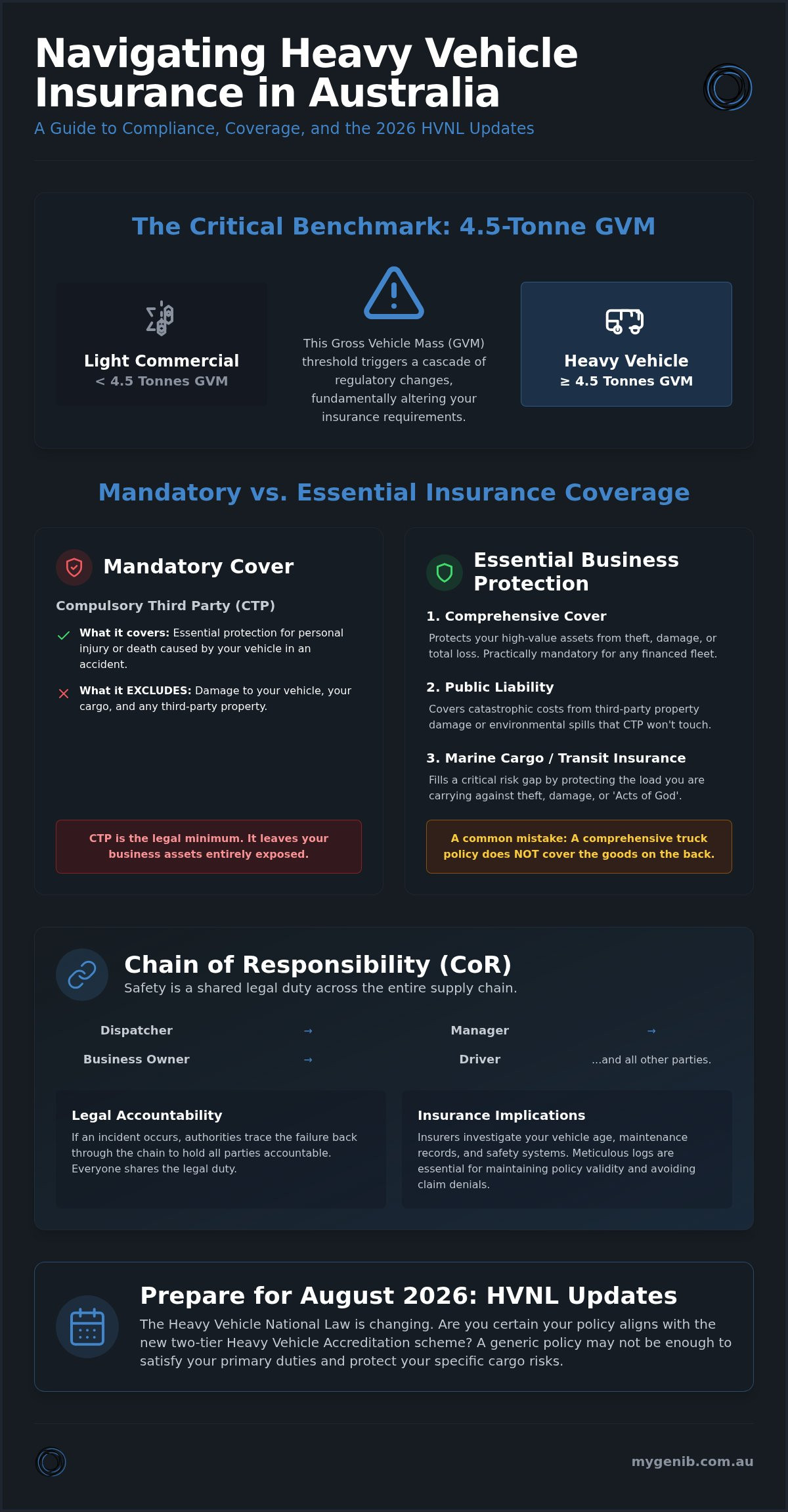
In Australia, the transition from a light commercial operator to a heavy vehicle specialist occurs at the 4.5-tonne Gross Vehicle Mass (GVM) threshold. This specific figure triggers a cascade of regulatory changes that fundamentally alter your heavy vehicle insurance requirements Australia wide. It’s a point where the law recognises that the potential for damage and the complexity of safety management increase significantly. We see this as the moment your business moves from standard transport into a more scrutinized, high-stakes environment.
To better understand how these categories affect your business, watch this helpful video:
Insurers distinguish between vehicle configurations because each carries a unique risk profile. Rigid trucks, articulated vehicles, and even standalone heavy trailers are assessed differently by underwriters. For instance, an articulated B-double faces different stability risks compared to a rigid box truck. We often find that a standard commercial vehicle insurance policy lacks the depth needed for these assets. These generic policies frequently exclude high-cost items like heavy-duty recovery, which can cost tens of thousands of dollars, or specialised cargo protections for hazardous materials.
The NHVR and Your Insurance Obligations
The National Heavy Vehicle Regulator (NHVR) oversees the majority of Australian states under the National Heavy Vehicle Law. This framework ensures that your insurance coverage aligns with your Chain of Responsibility (CoR) duties. Understanding these heavy vehicle insurance requirements Australia enforces is vital for any logistics firm operating across state lines. Modern insurers investigate your vehicle age and maintenance records with precision. Keeping meticulous logs isn’t just about compliance; it’s essential for maintaining policy validity. If your maintenance history is incomplete, you may face higher premiums or find that your insurer denies a claim based on unroadworthy conditions.
Mandatory vs Recommended Coverage Requirements
While the administrative side of transport can feel like a maze, the legal baseline for heavy vehicle insurance requirements Australia mandates is relatively straightforward. Compulsory Third Party (CTP) insurance is the only universal legal requirement, tied directly to your vehicle registration. It provides essential cover for personal injury or death resulting from an accident, yet it leaves your actual equipment and third-party property entirely exposed. For any operator with a financed fleet or high-value assets, Comprehensive Cover becomes practically mandatory. Lenders require it to protect their security interest; we believe it’s the only way to safeguard your business from a total loss event.
Beyond the vehicle itself, Public Liability is a non-negotiable safeguard. A single incident involving property damage or environmental spills can trigger catastrophic costs that CTP simply won’t touch. We often suggest that operators look deeper into their liability limits to ensure they meet the standards set by the National Heavy Vehicle Regulator (NHVR). If you’re unsure if your current limits are sufficient, speaking with a specialist to review your commercial motor insurance can provide the clarity needed for long-term security.
The Critical Role of Marine Cargo and Transit Insurance
A common misconception is that a comprehensive truck policy protects the load on the back. It doesn’t. This creates a significant risk gap that only Marine Cargo or Transit insurance can fill. These policies protect against “Acts of God,” theft, and loading accidents that could otherwise bankrupt an owner-driver. For specialised logistics, “Damage to Goods in Custody” clauses are vital. They ensure that even if a pallet is dropped during unloading, your relationship with the client remains intact and your bottom line stays protected.
Navigating Compliance and Chain of Responsibility (CoR)
In the Australian transport industry, safety isn’t just the driver’s burden. The Chain of Responsibility (CoR) framework ensures that everyone from the dispatcher to the business owner shares the legal duty for heavy vehicle safety. If an incident occurs, authorities trace the failure back through the supply chain to hold all parties accountable. This legal reality directly impacts your heavy vehicle insurance requirements Australia wide. We often see insurers invoke “Non-compliance Exclusions” when a regulatory breach occurs. If a vehicle is found to be overloaded or a driver has exceeded fatigue limits, your insurer may refuse the claim entirely, leaving your business to face massive legal and financial liabilities alone.
Working with an expert insurance broker allows us to align your policy with your specific safety management systems. We don’t just look at the vehicle; we investigate your operational processes to ensure your cover remains valid when you need it most. It’s about creating a protective shield that acknowledges the inherent risks of the road while providing a clear path to recovery.
Why Consultative Risk Assessment Beats Automated Quotes
Generic “tick and flick” automated tools can’t account for the nuances of your specific routes or cargo risks. We prefer a methodical investigation that looks beneath the surface of your daily operations. A tailored business insurance strategy adapts to your reality, whether that includes seasonal fluctuations in volume or changing state regulations. This partnership approach ensures that as the heavy vehicle insurance requirements Australia mandates continue to evolve, your protection remains robust and responsive. We’re here to do the heavy lifting, turning complex compliance into a source of professional confidence.
Securing Your Fleet’s Future in a Regulated Landscape
Managing a transport business in 2026 requires more than just keeping trucks on the road; it demands a deep understanding of how safety and insurance intersect. We’ve explored how the 4.5-tonne threshold changes your legal landscape and why relying on CTP alone leaves your livelihood vulnerable. By aligning your coverage with the latest heavy vehicle insurance requirements Australia mandates, you transform compliance from a burden into a competitive advantage. At MyGen Insurance Brokers, we bring over 20 years of industry expertise to help you look beneath the surface of your operations. We provide personalised risk management solutions and national Australian service to ensure your policy actually holds firm when it matters most. It’s time to trade the anxiety of “what if” for the certainty of professional protection.
Organise a consultation with MyGen Insurance Brokers to review your fleet risks and move forward with confidence.
Frequently Asked Questions
Is Public Liability insurance legally required for heavy vehicles in Australia?
No, Public Liability isn’t a legal requirement for vehicle registration in Australia, but it’s practically essential for any transport operator. While CTP covers personal injury, it won’t protect you if your vehicle damages a third party’s property or causes an environmental spill. Most contracts with major logistics firms won’t even let you on the road without proof of high-limit liability cover.
Does standard truck insurance cover the cargo I am carrying?
Standard commercial motor insurance generally excludes the goods you transport, focusing only on the vehicle itself. To protect your load against theft, loading accidents, or fire, you need specific Marine Cargo or Transit insurance. This ensures that a total loss of the goods doesn’t result in a catastrophic debt or a permanent loss of trust with your clients.
What happens to my insurance if I breach NHVR fatigue regulations?
Breaching NHVR fatigue regulations can lead to your insurer denying a claim entirely under “non-compliance” or “illegal act” exclusions. If an accident occurs while a driver has exceeded legal work hours, the insurer may argue the policy was voided by the breach of safety duties. This highlights why aligning your heavy vehicle insurance requirements Australia mandates with robust safety management is so vital.
How does the Chain of Responsibility impact my insurance requirements?
The Chain of Responsibility (CoR) means legal liability extends beyond the driver to include managers, loaders, and dispatchers. Your insurance needs to be deep enough to cover these broader risks, particularly regarding Public Liability and Professional Indemnity. We look beneath the surface of your operations to ensure your policy reflects these shared duties, providing peace of mind for everyone in the chain.