
A denied claim does not mean you are permanently blacklisted, even if automated quote forms keep slamming the digital door in your face. If you are struggling with getting insurance after a claim denial, you already know the sinking feeling of being rejected within seconds by an algorithm that never bothered to review the actual context. It is an exhausting experience that leaves many Australians wondering whether they can ever secure dependable protection again.
You don’t have to stay trapped in automated rejection loops. In this guide, you will discover how to overcome a past claim denial and successfully secure reliable insurance cover across Australia. We will walk through your statutory disclosure obligations under the Insurance Contracts Act, explain how to present your risk favourably to manual underwriters, and reveal why consultative advocacy makes all the difference.
Key Takeaways
- Understand the precise reason behind your past refusal, distinguishing between straightforward policy exclusions and more complex disclosure concerns.
- Discover why successfully getting insurance after a claim denial begins with securing formal written declinature records and demonstrating proactive risk mitigation.
- Learn how transparent statutory disclosure under Australian law builds credibility and positions your profile favourably for manual assessment.
- Bypass rigid automated quote engines by working with an experienced broker who presents your genuine risk context directly to senior underwriters.
Understanding Why Claim Denials Impact Future Insurance Applications
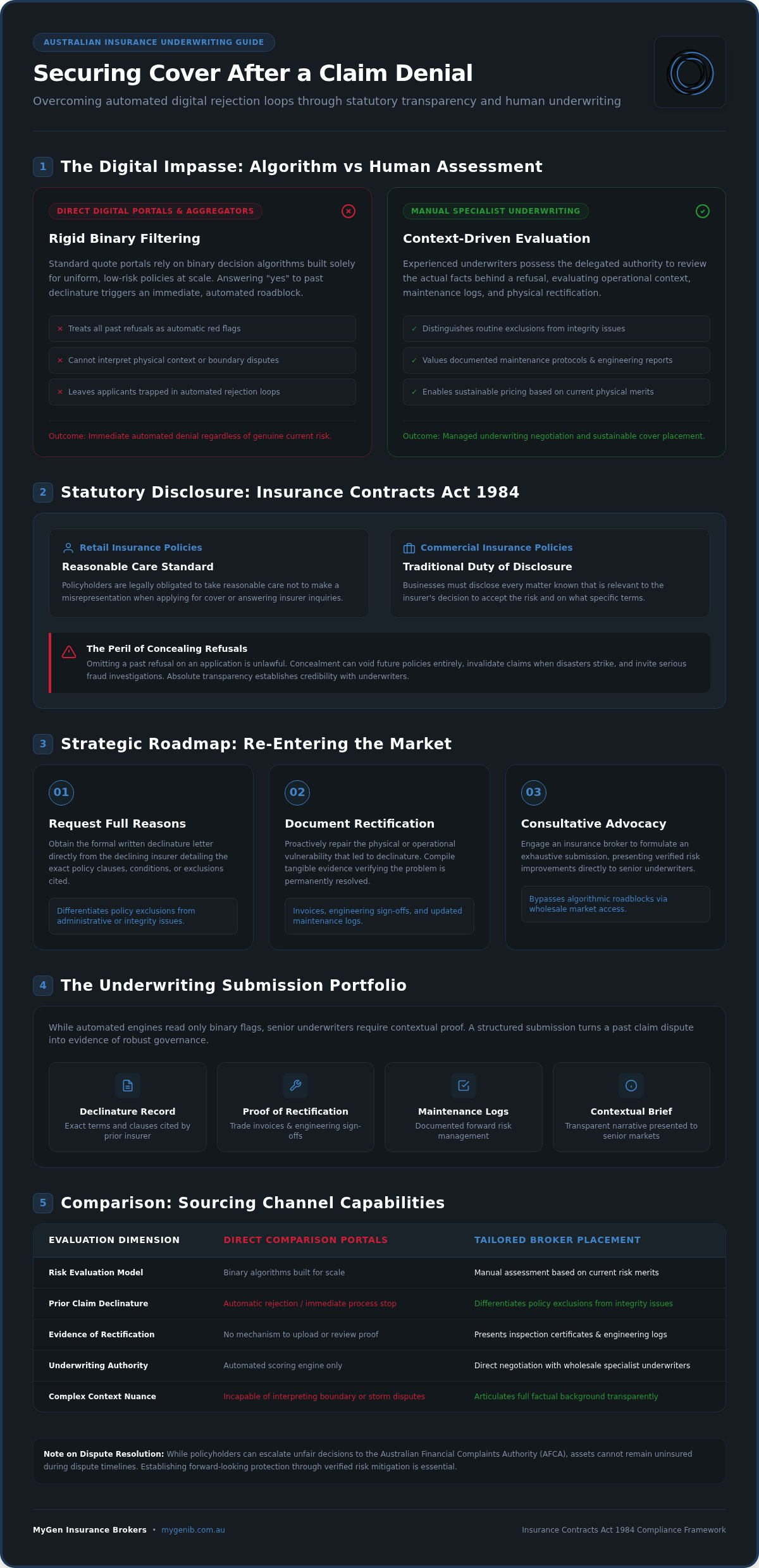
When an insurer declines a claim, that decision creates an immediate ripple effect across standard underwriting channels. Mainstream digital aggregators rely on rigid algorithms that treat any past declinature as an automatic red flag. Instead of assessing whether the refusal stemmed from a minor policy exclusion or an unendorsed asset, automated platforms simply issue an instant rejection. For domestic and commercial policyholders, getting insurance after a claim denial through standard direct websites quickly turns into an exercise in frustration.
To better understand how Australian insurers assess claim disputes and evaluate risk, watch this helpful breakdown:
Your Duty of Disclosure Under the Insurance Contracts Act
Australian insurance law demands absolute honesty. While retail contracts require you to take reasonable care not to make a misrepresentation, business policies still enforce the traditional statutory duty of disclosure under the Insurance Contracts Act 1984. It’s tempting to omit a past refusal when digital quote engines reject you, but concealing that history can void future policies entirely and invite serious fraud investigations.
Securing sustainable protection starts with transparency. Experienced human underwriters look beyond the initial refusal; they distinguish between routine policy exclusions, administrative lapses, and genuine integrity concerns. When you articulate the exact background calmly and accurately, getting insurance after a claim denial shifts from an insurmountable barrier into a manageable underwriting negotiation.
Steps to Secure Insurance After a Denied Claim
Securing new cover after a refusal requires a proactive, evidence-based approach rather than repeatedly testing online portals. While you can lodge an escalation with the Australian Financial Complaints Authority if a decision was unfair, you cannot leave your assets uninsured while waiting through dispute timelines. Instead, focus immediately on establishing forward-looking protection:
- Request full written reasons: Obtain the formal declinature letter detailing the specific policy terms, conditions, or exclusions cited by the insurer.
- Document corrective actions: Rectify whatever physical or operational defect triggered the rejection, keeping clear invoices, engineering sign-offs, or updated maintenance logs.
- Seek professional advocacy: Collaborate with an adviser who understands why expert insurance brokers provide more value than automated quotes in 2026.
Preparing a Strong Underwriting Submission
Automated forms cannot evaluate nuance, but human underwriters can. When getting insurance after a claim denial, your broker presents an exhaustive risk submission that proves the previous vulnerability is resolved. Whether you are arranging tailored commercial property protection or broad business insurance, presenting transparent maintenance protocols turns past adversity into demonstrated risk management.
Direct underwriting algorithms see only a binary risk flag. In contrast, an experienced broker negotiates directly with specialist markets that value governance and context. If you need steady guidance to rebuild underwriter confidence, partnering with MyGen Insurance Brokers ensures your situation is represented with clarity and care.
Choosing Tailored Broker Placement Over Direct Online Portals
Direct comparison portals rely on binary algorithms built to process low-risk, uniform applications at scale. The moment you answer “yes” to having a past declinature, those automated filters immediately stop the process. They can’t interpret whether your issue was a boundary dispute, a storm-damage maintenance disagreement, or a resolved commercial risk. This leaves applicants feeling stranded, but it’s simply the operational limit of digital quote engines.
Consultative insurance broking bypasses these digital roadblocks entirely. Rather than relying on rigid online forms, your adviser approaches wholesale underwriting agencies and senior decision-makers directly. These industry specialists possess the delegated authority to review physical inspection certificates, evaluate rectification work, and price risk based on its current merits rather than an automated score. Just as someone searching for an independent medicare agent near me seeks personalised guidance for complex health plans, relying on a qualified broker ensures your unique circumstances are evaluated with genuine human oversight.
Protecting Complex Domestic and Commercial Risks
A past refusal doesn’t prevent you from securing comprehensive protection across your personal and commercial assets. Experienced brokers can structure tailored terms, specialised deductibles, or specific endorsements that give underwriters the reassurance they need while keeping essential coverage intact. This consultative placement ensures resilient, long-term defence for your primary residence through specialised home and contents insurance, as well as high-value commercial properties, plant, and inventory.
Successfully getting insurance after a claim denial comes down to human advocacy, thorough documentation, and market access. If you’re ready to move past automated rejections and secure lasting certainty, book a consultation through MyGen Insurance Brokers to review your coverage options with an experienced professional.
Rebuild Your Cover With Confident Human Advocacy
A prior claim denial does not permanently lock you out of the market. By clarifying declinature reasons, proving genuine risk remediation, and fulfilling statutory disclosure duties transparently, you can shift the conversation in your favour. Successfully getting insurance after a claim denial simply requires stepping away from inflexible quote engines and presenting your true risk profile to decision-makers who evaluate real context.
With over 20 years of dedicated industry experience across Australia, we replace rigid automated forms with personalised consultative assessments. We leverage direct access to leading Australian underwriting agencies and specialty markets to secure robust domestic and commercial protection. You don’t have to navigate complex underwriters alone. Speak with MyGen Insurance Brokers to explore tailored coverage options and restore lasting peace of mind.
Frequently Asked Questions
Do I legally have to disclose a past denied claim in Australia?
Yes. Under Australian insurance law, you must disclose past claim refusals when asked by an insurer. For consumer contracts, you hold a duty to take reasonable care not to make a misrepresentation, while commercial covers require strict statutory disclosure. Hiding a previous declinature breaches these legal duties, potentially voiding your cover entirely when you need it most.
Why do direct online insurance websites reject me immediately?
Direct insurance websites rely on automated decision engines built strictly for standard risks. When an applicant declares a prior denial, the algorithm triggers an automatic declinature rule without human review. These platforms cannot assess whether your past issue was a minor technical exclusion, a resolved property repair, or an administrative dispute, leading to an immediate online rejection.
Can an insurance broker find cover after an insurer declinature?
Yes, partnering with an experienced broker is the most effective approach for getting insurance after a claim denial. Brokers bypass rigid online algorithms and take your submission directly to specialist underwriting agencies. By explaining the context of the prior denial and proving active risk mitigation, a broker can negotiate tailored terms with underwriters who review the full picture.
Will my insurance premium increase significantly after a denial?
Not necessarily, as pricing depends on how effectively your current risk profile is presented. Underwriters often prefer applying a higher excess or introducing specific risk management requirements rather than simply loading premiums, provided you can prove the root vulnerability is repaired. Clear documentation and professional advocacy help keep terms fair while securing essential protection.