
Could a policy that meets a minimum requirement still miss risks in your day-to-day work? For accountants, exposure can arise from tax or bookkeeping advice, payroll services, client data and work delivered through contractors. Choosing insurance for accountants in Australia means matching cover to what your practice actually does, not just its job title.
Price and headline limits matter, but so do exclusions, claims-made wording, defence costs and continuity of cover. This 2026 buying guide explains the types of cover accounting practices commonly consider, what to check in policy terms and how to compare options against your services, clients and operating arrangements. MyGen Insurance Brokers takes a personalised, consultative approach to assessing business risks and considering suitable cover, helping you make an informed review rather than rely on a generic quote.
Key Takeaways
- Insurance for accountants in Australia should reflect the services you provide and the information you handle, not just your job title.
- Consider Professional Indemnity, Cyber and Business Insurance as distinct types of cover, each addressing different practice risks.
- Compare policy definitions, exclusions, excesses, retroactive dates and notification requirements, as well as limits and conditions.
- A tailored review of your clients, staff, systems and existing policies can help you assess cover for your practice.
Insurance for accountants in Australia: which risks should your cover address?
Accounting practices combine professional advice, sensitive client information and everyday business operations. An alleged error in a tax calculation or payroll process may raise a professional liability issue. A compromised system or damaged office equipment presents a different exposure. Rather than assume one policy covers every risk, consider each type of cover in relation to the work and assets involved.
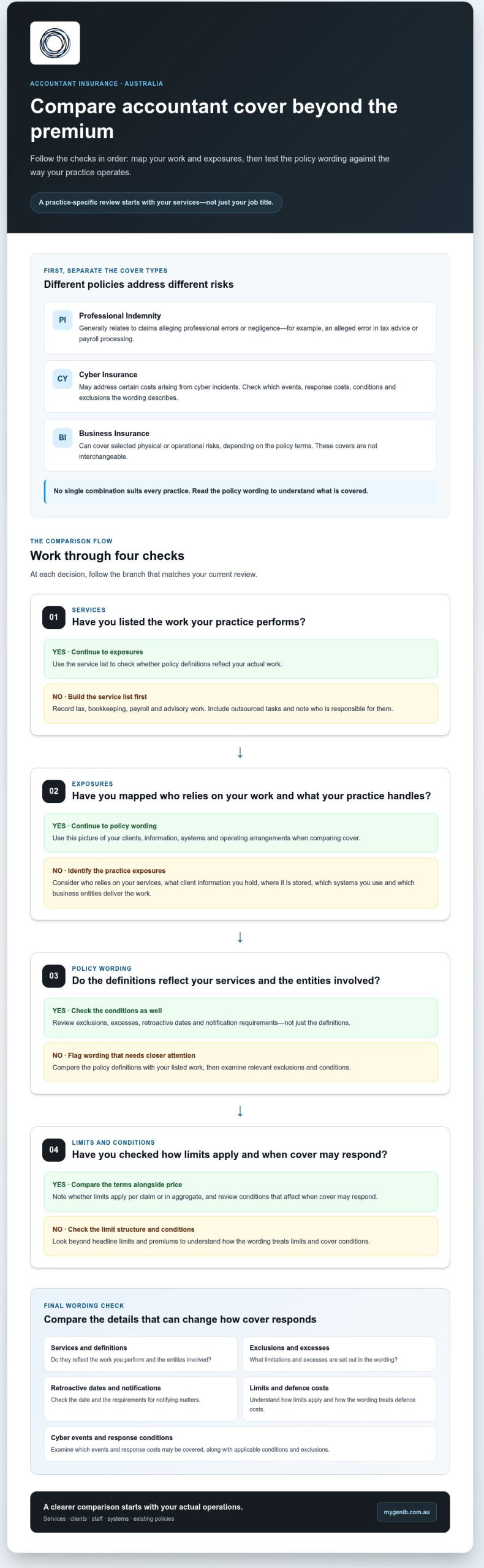
For insurance for accountants in Australia, Professional Indemnity (PI), Cyber and Business Insurance have different roles. PI generally relates to claims alleging professional errors or negligence. Cyber Insurance may address certain costs arising from cyber incidents, while Business Insurance can cover selected operational risks, subject to its terms. For a general introduction, see Professional liability insurance. Read the policy wording to understand what is covered; no single combination suits every practice.
For an overview of business insurance types, watch this video:
How accounting services shape the cover to consider
Tax and advisory work can lead to allegations about the accuracy or suitability of guidance. Bookkeeping and payroll services have their own potential exposures, including errors in records or processing. List the services your practice provides, who relies on them and how the work is delivered. Include outsourced tasks and the business entities involved, then use that picture to assess which PI definitions and exclusions deserve attention.
Client files, accounting platforms and email systems create separate cyber exposures. Consider what information you hold, where it is stored and which systems are used to access it. Business Insurance addresses another layer, such as specified physical or operational losses, depending on the policy. These covers aren’t interchangeable. Choose cover by assessing the practice’s work, operations and information risks. MyGen Insurance Brokers can help you relate those exposures to business insurance options through a consultative review.
How to compare accountant insurance policies before choosing
Premiums and headline limits alone can hide important differences. Start with how your practice operates, then check whether the policy wording reflects the services and exposures you have identified. Use this sequence to compare insurance for accountants in Australia on more than price:
- 1. List your services. Record the work you perform, such as tax, bookkeeping, payroll or advisory services. Note any outsourced tasks and who is responsible for them.
- 2. Identify exposures. Consider who relies on your work, what client information you hold, which systems you use and which business entities deliver your services.
- 3. Compare policy wording. Check definitions against your actual work, then review exclusions, excesses, retroactive dates and notification requirements.
- 4. Review limits and conditions. Check whether limits apply per claim or in aggregate, and note any conditions that affect when cover may respond.
For a closer look at professional indemnity insurance and business insurance in Australia, explore these guides. Members can also refer to CPA Australia’s PII guide for information relevant to public practice.
What to check in professional indemnity and cyber cover
For PI, check that the policy definitions reflect the professional services you provide and the entities involved. Review the retroactive date and notification requirements, and understand how the wording treats defence costs and limits. For Cyber Insurance, examine which events are described, what response costs may be covered, and the conditions and exclusions that apply. The exact wording matters.
Comparison checklist: services covered, definitions, exclusions, excesses, retroactive dates, limits, notification requirements and cyber response conditions. A personalised review can connect these details with your practice’s risks. MyGen’s insurance advice takes a consultative approach to assessing business exposures and considering suitable options.
Choosing insurance for your accounting practice with a tailored review
A useful insurance review starts with the practice as it operates today, not a generic profile of an accounting firm. Set out your services, client types, business structure, staffing arrangements and systems. This makes it easier to relate potential exposures to relevant options, including Professional Indemnity, Cyber and Business Insurance.
MyGen Insurance Brokers takes a consultative approach to assessing business risks and considering suitable cover. Broker Anthony Simpson brings more than 20 years of industry experience to these conversations. The focus is on understanding how your work and operations fit together, rather than relying on a quick, generic quote. For more on the value of personalised advice, read our guide to expert insurance broker guidance.
What to prepare for an insurance review
Gather a summary of your services, client types and revenue activities, along with staffing details and current policy documents. Include outsourced work, where and how client data is stored, and any recent or planned changes to your services. Bringing these details to the review helps keep the discussion grounded in your actual operations.
Use the information to compare policy wording and conditions with your practice’s work, systems and existing policies. Check where definitions match your services and where exclusions or conditions may affect cover. There’s no single arrangement that suits every firm; a considered review can help clarify which exposures need attention and which terms warrant closer examination.
If you’d like to explore insurance for accountants in Australia in the context of your practice, discuss your business insurance needs with MyGen.
Make your next insurance review practice-specific
Start with the work your accounting practice performs and the information it handles. Assess Professional Indemnity, Cyber and Business Insurance as distinct covers, then compare definitions, exclusions, limits and conditions against your services, clients and operations. This is a more useful way to approach insurance for accountants in Australia than relying on a job title alone.
MyGen Insurance Brokers takes a personalised, consultative approach to assessing business risks rather than relying on instant automated quotes. Broker Anthony Simpson brings more than 20 years of industry experience to the process, helping you consider options in the context of your practice.
Ready to review your cover in light of your actual business needs? Discuss your accounting practice’s insurance needs with MyGen.
Frequently Asked Questions
Does an accountant in Australia need Professional Indemnity insurance?
Not necessarily. An accountant’s obligation to hold Professional Indemnity insurance can depend on professional-body membership, registration, contractual terms and the services performed. Check the requirements that apply to your practice with the relevant body or regulator, then review the policy wording carefully. Confirm its definitions and exclusions reflect your accounting services before relying on it.
What insurance should an accounting practice consider?
Insurance for accountants in Australia may include Professional Indemnity for professional advice and services, alongside Cyber and broader Business Insurance for different exposures. The right options depend on your practice’s operations, the client information you handle and the policy wording. These covers aren’t interchangeable, and there’s no single package that suits every accounting firm. Assess each against your work and business risks.
Does Professional Indemnity insurance cover cyber incidents for accountants?
Professional Indemnity and Cyber Insurance address different types of risk, so don’t assume one automatically covers a cyber incident. The exact protection depends on the policy’s definitions, exclusions, conditions and other terms. Examine the wording for each policy and consider both professional and cyber exposures in your practice review. Whether a particular incident is covered depends on the relevant policy terms.
How can accountants compare insurance policies?
Compare the professional services covered, policy limits, exclusions, excesses, notification requirements and relevant dates in the wording. Premiums alone won’t show whether cover fits your practice. Consider how the terms relate to your clients, services, staff and systems, and note any differences between policies. MyGen Insurance Brokers can help assess options against the details you provide about your practice and operations.