
A cyber policy’s headline limit can look substantial, while the response expenses your business needs are subject to much smaller sub-limits. Cyber event response costs coverage depends on the incident, the expense and the policy conditions. Forensic investigation, legal advice, customer notification, public relations and data restoration may each be treated differently in the wording.
Policies can be difficult to compare when exclusions, approval requirements and limits sit beneath the headline figure. The right questions depend on your business’s systems, data and exposure, not just the size of the overall limit.
This article explains common response-cost categories and policy conditions that can affect cover. It also sets out how to compare policy terms against your business’s needs and what information to prepare for an insurance discussion.
Key Takeaways
- Cyber event response costs coverage can treat different incident expenses in different ways, so check how the policy defines eligible costs.
- Compare the insured event, limits, sub-limits, excess and exclusions, not just the headline limit.
- Review approval, notification and documentation requirements before an incident, as these can affect how costs are handled.
- Map your business operations, data and response dependencies to compare policy wording against your actual exposure.
What does cyber event response costs coverage mean for an Australian business?
A cyber incident can create several expenses at once. A business might need specialists to investigate what happened, legal advice on next steps, help restoring data and systems, or support to notify affected people. Knowing which costs a policy may respond to can bring clarity during an already pressured situation.
Cyber event response costs coverage is insurance cover that may pay eligible expenses incurred to manage an insured cyber event, subject to the policy wording, limits, excess and conditions. It is different from cyber security tools that help prevent or detect attacks, routine IT maintenance and general operating expenses. Costs are not automatically covered just because they relate to technology or follow an incident.
Which expenses may form part of an insured cyber response?
Policies may address different parts of the response process, including investigation and containment. The broad stages of computer security incident management provide useful context, but insurance cover depends on the specific wording.
- Forensic investigation: examining systems to establish the incident’s nature and scope.
- Legal advice: guidance on response decisions and potential obligations.
- Data restoration: recovering or rebuilding affected information, where eligible.
- Notification support: helping prepare communications to affected individuals, if covered.
Business interruption losses and third-party claims may sit under separate policy sections, with their own limits, triggers or conditions. Check those sections rather than assuming these losses form part of a response-cost allowance.
An expense category alone doesn’t establish cover. The insured event, policy wording and conditions determine whether a cost may be covered.
How to compare cyber event response costs coverage in policy wording
A headline limit won’t show how a policy responds to your particular incident. Compare the wording side by side, including the event that triggers cover, eligible expenses, overall limits, sub-limits, excesses and exclusions. The Insurance Council of Australia’s overview of cyber risk and insurance in Australia provides broader context, but each policy’s terms determine the cover available.
What should a business check before relying on response-cost cover?
Start with the definition of a cyber event. Check whether accidental data loss, human error or incidents involving a third party are treated differently. Then look for waiting periods and separate sub-limits, particularly for business interruption. Note any consent requirements that apply before you incur costs.
- Eligible expenses: Which response services are included, and what exclusions could apply?
- Limits and excess: What is the overall limit? Do specific costs have lower caps or a separate excess?
- Claims process: Is prior approval required? Must you use panel providers? What notification timing and records does the policy specify?
These details matter in practice. If a policy requires insurer consent before engaging a specialist, acting without approval could affect how the expense is handled. Keep incident timelines, invoices and response records organised, and follow the policy’s notification instructions.
Australian businesses covered by the Privacy Act may also need to assess suspected breaches under the Notifiable Data Breaches scheme and notify affected individuals and the OAIC if a breach is likely to result in serious harm. That process is separate from insurance: meeting notification obligations doesn’t guarantee a policy will cover the related costs.
Broader business policies address other exposures, as outlined in this complete guide to business insurance in Australia. A broker-led review can help relate policy wording to your operations. For more information, read MyGen’s cyber insurance guidance.
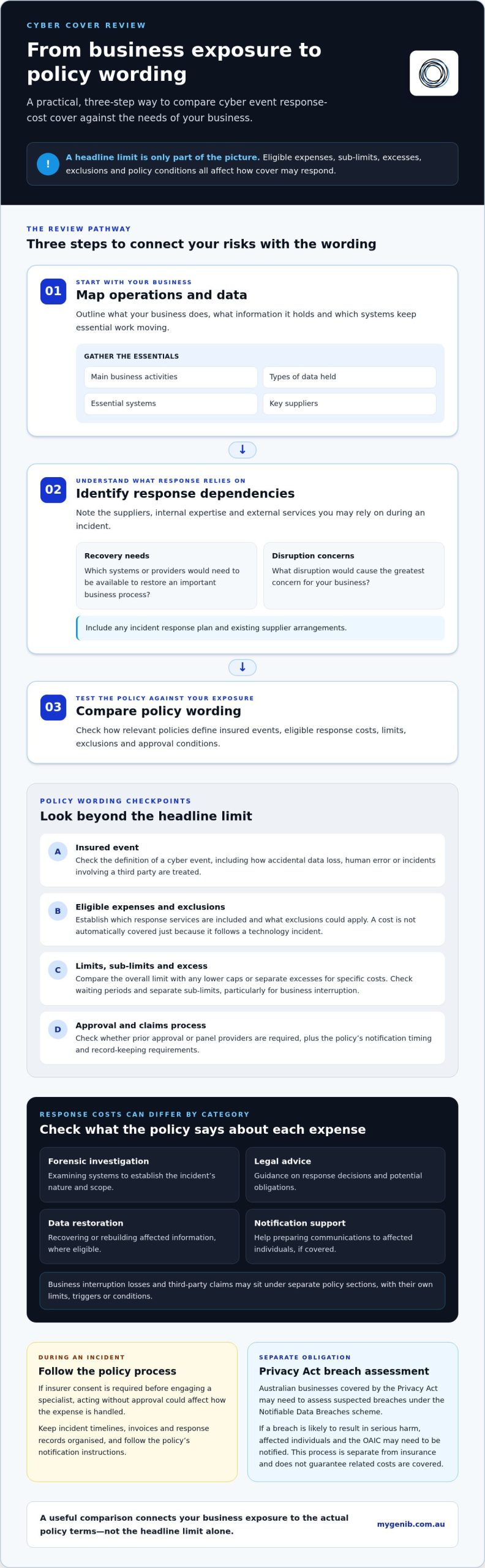
How a broker can help tailor cyber event response costs coverage
A useful review starts with your business, not a generic policy checklist. MyGen’s consultative brokerage approach connects your operations and risk profile with relevant policy wording, helping you understand differences between policies. The process can be broken into three practical steps:
- Map operations and data: outline what your business does, what information it holds and which systems keep essential work moving.
- Identify response dependencies: note the key suppliers, internal expertise and external services you may rely on during an incident, along with the disruption you’re most concerned about.
- Compare policy wording: consider how relevant policies define insured events, eligible response costs, limits, exclusions and approval conditions against your business’s operations and risks.
What information helps make a cyber cover review useful?
Start with a simple outline of your main business activities, the types of data you hold, key suppliers and essential systems. Include any incident response plan or existing supplier arrangements. Be specific about dependencies: which systems or providers would need to be available to restore an important business process, and what disruption would cause the greatest concern?
A useful comparison connects your business exposure to the actual policy terms, rather than relying on a headline limit alone.
MyGen arranges cover as an insurance broker, not a direct underwriter, and focuses on tailored advice and long-term relationships. A considered discussion can help bring your risks and policy options into clearer view. Policy terms and claim outcomes depend on the circumstances and applicable wording. For further context, read about expert insurance brokers versus automated quotes.
Make your next cyber cover review more considered
Use your policy review to consider whether the cover reflects how your business operates today, including changes to systems, suppliers and the information you hold. A clear picture of your exposure can guide a focused discussion about cyber event response costs coverage and relevant policy options.
MyGen offers personalised, consultative insurance advice rather than instant automated quotes. Anthony Simpson brings over 20 years of industry experience to conversations about business risks and insurance needs. You can explore relevant options with your business’s operations and exposures in view.
Discuss cyber insurance options for your business with MyGen and take a considered next step towards cover that reflects your needs.
Frequently Asked Questions
Does cyber insurance cover incident response costs?
Sometimes. A policy may meet eligible incident response expenses when the event satisfies its insured-event definition and the relevant cover applies. It isn’t automatic. For example, a compromised business email account could prompt investigation and recovery work, but the treatment depends on the wording and claims process. Read cyber event response costs coverage alongside the schedule and endorsements, not as a stand-alone promise.
Can a business claim for forensic and legal costs after a cyber incident?
Potentially, if the policy responds to the event and the forensic or legal work meets its terms. Keep the engagement scope and invoices, and record why each specialist was needed and when they were instructed. Separate incident-response advice from unrelated legal work or ordinary IT support, as those distinctions can matter. Before committing to non-urgent services, follow the insurer’s claims instructions.
Are ransomware payments covered by cyber insurance in Australia?
Possibly, but cover for a ransomware payment depends on the policy wording, exclusions, consent conditions and whether the event qualifies. Don’t assume reimbursement is available. Separately, Australian rules require organisations with annual turnover above A$3 million and entities regulated under the SOCI Act to report ransomware payments to the Department of Home Affairs within 72 hours. Reporting doesn’t establish insurance cover.
What should a business do first after discovering a cyber incident?
First, activate your incident response plan and alert the person responsible for IT or security. If safe to do so, isolate affected devices from the network, but avoid wiping, rebuilding or switching off systems before incident responders advise, as this may destroy useful evidence. Record when signs were first noticed, preserve relevant messages and logs, and notify your insurer using the process stated in your policy.