
A risk is not only a major disaster. It is anything uncertain that could affect your business’s operations, finances or reputation. Practical risk management advice for SMEs starts with identifying potential threats, assessing how likely they are and considering their consequences. Then decide whether to avoid, reduce, share or accept each risk.
Risk planning can feel like another demand on a small team. A clear, practical process helps you focus on the issues that matter most and prepare for disruption. This article explains how to assess likelihood and impact, involve the right people and give your team clear actions. It also covers how suitable insurance can help limit the financial consequences of events that other controls cannot prevent.
Key Takeaways
- Build a continuity plan around critical processes, key staff roles, emergency contacts and how your team will communicate during disruption.
- Compare each risk’s likelihood with its potential consequences, then direct attention to the exposures that could cause the greatest harm.
- Give named team members responsibility for recording risks, weighing financial and operational impacts, and keeping response actions accessible.
- Use suitable insurance as one part of your response plan to help reduce the financial impact of covered events; it won’t prevent the risks themselves.
1. How can insurance help small entrepreneurs or SMEs, or how it relates to risk management?
Insurance is one part of risk management: it can transfer some financial consequences of covered events, but it won’t prevent fires, theft, cyber incidents or injuries. Start by identifying threats across daily operations, staff, customers, suppliers, property, vehicles and data. Then decide which risks need prevention, a continuity strategy, insurance or acceptance.
A business continuity plan sets out how owners and staff will respond to unexpected events. Record critical processes, key staff roles, emergency contacts, communication steps and relocation arrangements. Include data backups and alternative suppliers if disruption could stop essential work.
For a practical overview, watch Strategies for Managing Risk as an SME from ConsumerCentriX:
Disaster recovery means restoring systems, records and operations after an incident. Name who activates the plan, where vital documents are stored and how staff can work if the usual site or systems are unavailable. Test the steps and update them as the business changes.
SME business insurance can help limit financial losses from insured events. Coverage varies by policy: property cover may protect buildings, contents, stock and equipment, while business interruption cover may help with ongoing fixed costs after insured property damage. Compare policy terms with your actual assets and exposures.
Which framework suits an Australian SME? ISO 31000 offers a voluntary structure for identifying, assessing, treating and reviewing risks. Keep the process proportionate: a simple risk register can support a practical risk management plan.
What workplace safety duties apply? Make hazard identification, risk assessment and controls part of everyday work, and involve staff in reporting hazards. Review controls when tasks or conditions change.
Which government resources can help? Australian Government business guidance and grant-search tools can help owners find planning resources and programs. Free risk-register and continuity-plan templates can help organise actions; eligibility for grants depends on each program.
2. Risk likelihood and consequence assessment
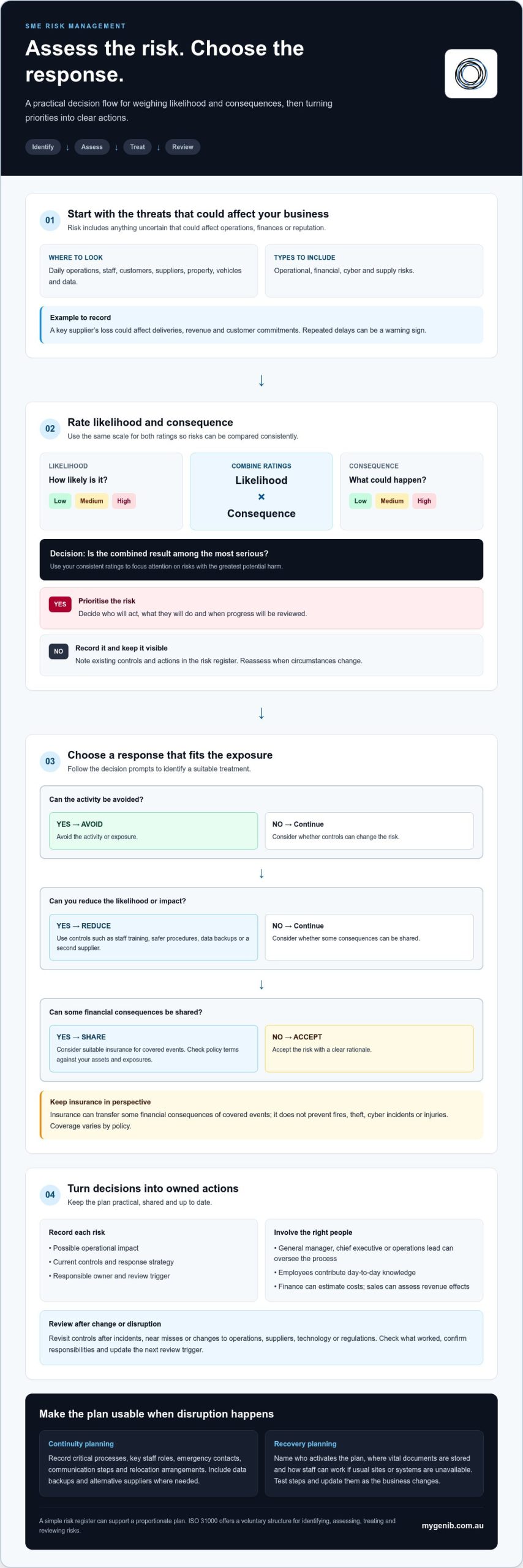
Assess each risk by considering how likely it is and what could happen if it occurs. A simple risk level is likelihood multiplied by consequence. Rate both consistently, such as low, medium or high, then prioritise risks with the most serious combined result. This gives owners a clear basis for deciding what to address first.
Useful risk management advice for SMEs starts with a straightforward assessment: list threats, estimate likelihood and impact, then record existing controls and actions. Include operational, financial, cyber and supply risks. For example, note how the loss of a key supplier could affect deliveries, revenue and customer commitments.
For each high-priority risk, identify who will act, what they will do and when they will review progress. If supplier disruption could halt deliveries, consider an alternative supplier and watch for warning signs such as repeated delays. A fire, equipment failure or customer injury may call for different controls, so tailor each response to its consequences.
For cyber risks, identify valuable data and systems, then assess threats such as phishing, scams, weak passwords and unpatched software. Set a cybersecurity policy covering password management, software updates, backups and staff reporting. Practise a data-breach response, including who isolates affected systems and informs relevant people. This turns risk management advice for SMEs into actions staff can follow.
Match your response to the exposure: avoid an activity, reduce its likelihood or impact, share the risk, or accept it with a clear rationale. Controls might include staff training, safer procedures, data backups or a second supplier. Assign an owner to each action and review controls after incidents, near misses or business changes.
Insurance can address residual financial exposure, but it doesn’t replace prevention or recovery planning. Consider whether cyber insurance cover fits the risks your assessment identifies, and compare policy terms with the events and losses you need to address.
3. Risk management teams and plans
A useful risk management plan turns assessment findings into assigned actions, not a document left on a shelf. Record each risk, its possible operational impact, current controls, response strategy, responsible owner and review trigger in one shared risk register. For example, a supplier disruption entry could name the affected process, alternative supply options and the person responsible for activating them.
Risk management does not require a separate department. An SME can assign oversight to a general manager, chief executive or operations lead, then involve employees who understand day-to-day work. Finance staff can estimate potential costs, while sales staff can assess revenue effects. Together, they can help owners decide whether to reduce, transfer, avoid or accept each exposure.
Share relevant plan instructions with employees responsible for response or recovery. For example, a staff member handling customer communications should know where approved contact details are stored and who authorises updates. Keep procedures, contact records and recovery actions together in an accessible place, with a backup employees can reach if usual systems fail.
Review the register regularly and whenever operations, suppliers, technology or regulations change. Revisit it after an incident or near miss, too. Check whether controls worked, responsibilities are still clear and any unexpected consequences emerged. Update the action owner and next review trigger so changes lead to practical follow-through.
Keep the plan proportionate: a small team may need only a shared register and clear role assignments. Take the next step in your business risk planning by considering how your identified exposures should shape your response.
MyGen Insurance Brokers: Business Insurance
MyGen Insurance Brokers can help connect your risk assessment with insurance options suited to your business. Its consultative approach considers the risks you have identified before recommending appropriate cover, rather than relying on instant automated quotes.
For example, a business may consider Business Insurance for its business exposures, Professional Indemnity Insurance for professional work, or Commercial Motor Insurance for business vehicles. The right option depends on the activity, assets and risks involved. Insurance can help address the financial consequences of covered events, but it does not replace staff training, cyber controls or a continuity plan.
If your operations, assets or professional responsibilities have changed, reviewing your insurance alongside your risk management plan can help keep decisions aligned. Contact MyGen Insurance Brokers to discuss your business insurance needs.
Make risk decisions part of everyday business
Make risk ownership a regular part of business decisions rather than a one-off exercise. As your work, customers or operating model change, reconsider what your business can absorb and where transferring financial risk may be appropriate. This keeps your protection connected to how you operate.
Sound risk management advice for SMEs connects those decisions with cover suited to identified exposures. MyGen Insurance Brokers offers Business Insurance, Professional Indemnity Insurance and Commercial Motor Insurance, helping businesses consider insurance as part of a broader risk approach. The right cover depends on your activities, assets and policy terms.
For a considered discussion about your business risks and insurance needs, contact MyGen Insurance Brokers. A clear next step can help you move forward with confidence.
Frequently Asked Questions
What is a risk?
A risk is uncertainty that could affect a business objective, positively or negatively. For an Australian café, refrigeration failure could spoil stock, interrupt trading and affect customer trust. Consider what might happen, which part of the business could be affected and how the team would respond. This helps owners distinguish routine issues from those needing prompt attention.
How can insurance help small entrepreneurs or SMEs, or how it relates to risk management?
Insurance can help cover financial losses from events included in a policy, supporting a business after damage or a claim. For example, a shop owner could compare policy terms with the effects of damaged premises and paused trading. Review limits, exclusions and excess alongside prevention measures, so the cover you consider relates to your business’s actual exposures.
What are the Risks to Identify?
Look for anything that could interrupt a process, reduce income, create liability or damage trust. Map a customer order from enquiry to delivery, then note where staff, payment systems, stock or delivery partners are essential. Complaints, incident records and supplier arrangements can reveal recurring problems. This practical review can uncover dependencies that are easy to overlook.
What are the main risks facing Australian small and medium-sized businesses?
Common exposures include property damage from fire, theft or vandalism; cyber incidents; legal claims; workplace or customer injuries; supply disruption; cash-flow pressure; and changes to laws or standards. The mix depends on the business. For risk management advice for SMEs, consider which events could interrupt key operations, then focus on those with serious consequences.
What steps should an Australian SME take to create a risk management plan?
Begin with your business objectives and the processes needed to achieve them. Ask employees where delays, errors or safety concerns arise, then record each exposure, its consequences, existing safeguards and an accountable owner. Set out response actions and recovery priorities. This risk management advice for SMEs turns observations into assigned tasks, with reviews after incidents or operational changes.