
A PDS can look complete and still be the wrong version for your policy. To learn how to read a PDS document and check whether it’s current, compare its issue or version details with the insurer’s latest PDS, then match it to the policy named on your schedule. The PDS sets out standard terms; your schedule shows the specific cover that applies to you.
It’s easy to focus on the cover summary and miss an exclusion, waiting period or claims requirement in the detail. A careful review can help you identify what’s covered, where limits apply and whether the policy fits your needs.
This guide walks you through the sections to review, how to compare them with your schedule and what to check when confirming the document’s currency. You’ll have a clearer way to assess the cover before relying on it.
Key Takeaways
- Compare the PDS version and issue details with the insurer’s current document before relying on its terms.
- Trace the cover, exclusions and claims steps that matter to your circumstances, including any evidence the policy requires.
- Look closely at waiting periods and benefit limits, then compare the PDS’s standard terms with the specific details on your schedule.
- If you need help assessing business cover against your risks, MyGen Insurance Brokers can help you consider Business Insurance options.
Reviewing policy coverage, exclusions and claims procedures
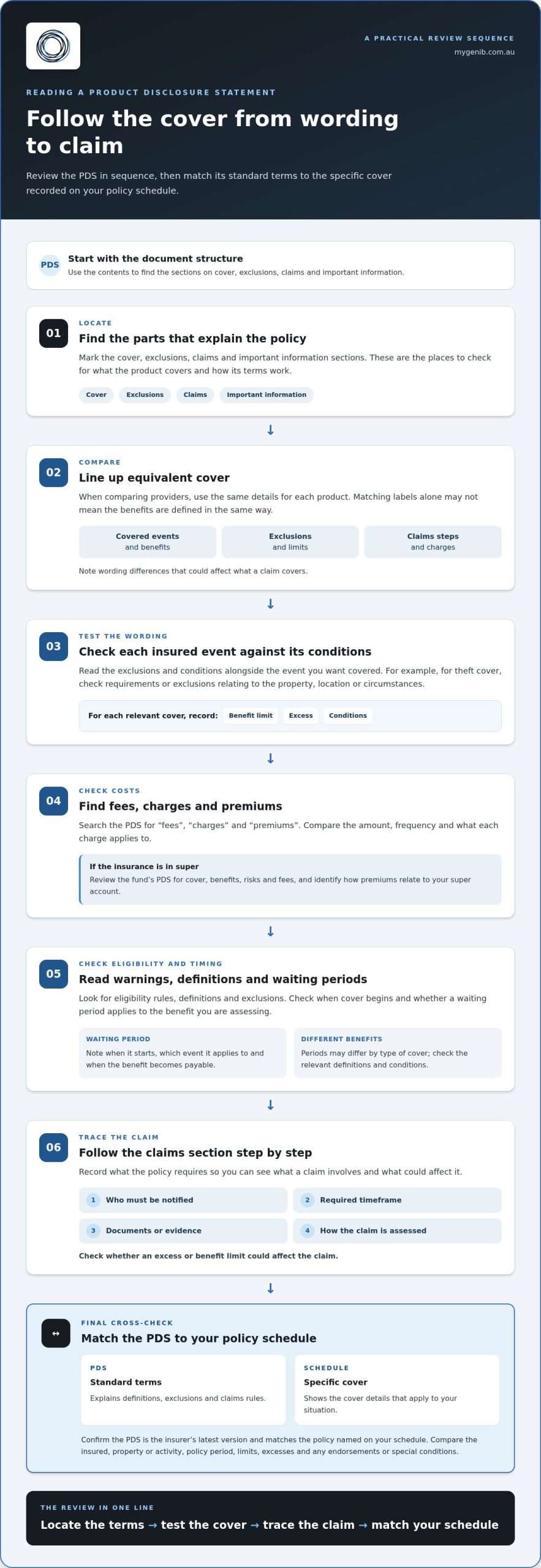
- Start with the PDS contents and locate the cover, exclusions, claims and important information sections. Australian financial product disclosure requirements are set out in the Corporations Act 2001, according to the Australian Government Federal Register of Legislation. Read the PDS before deciding whether to buy a financial product.
- To compare PDS documents from different providers, line up the same details side by side: covered events, benefits, exclusions, limits, claims steps and charges. Compare equivalent cover, not just matching labels, because each financial product may define benefits differently. Note where wording could affect what a claim covers.
- Check each insured event against its exclusions and conditions. For example, if a business policy covers theft, look for exclusions or requirements relating to the property, location or circumstances. Record the benefit limit and any excess beside the relevant cover. A PDS explains standard terms; your schedule identifies your specific cover.
- Find fees and charges by searching the PDS for “fees”, “charges” and “premiums”, then compare the amount, frequency and what each charge applies to. For insurance in super, review the fund’s PDS for the cover, benefits, risks and fees, and identify how premiums relate to your super account.
- Read the warnings and important information, including eligibility rules, definitions and exclusions. Check when cover begins and whether a waiting period applies to the benefit you’re assessing. For a super product, the PDS must include key features, fees, commissions, benefits, risks and complaints-handling information.
- Follow the claims section step by step. Note who must be notified, the required timeframe, documents or evidence, and how the claim is assessed. Check whether an excess or limit could affect a claim. These details help you understand how to read a PDS document beyond its summary.
Checking waiting periods and benefit limits
- Find the waiting period for each benefit in the product disclosure statement. Record when it starts, which event it applies to and when the benefit becomes payable. Waiting periods may differ by type of cover, so don’t assume one rule applies across the policy.
- Match each waiting period to the event you want covered. For example, note whether a benefit has a qualifying period after cover begins or after a specific change. Check the policy’s definitions and conditions, as these determine how the period is measured.
- Locate the benefit limit beside each covered event. Identify whether it applies per claim, per item or across the policy period. A limit for one item may sit within a broader overall limit, so record both before assessing the available cover.
- Look for sub-limits, caps and exclusions that narrow a headline benefit. For example, a policy may list a broad category of cover while applying a lower limit to a particular item or circumstance. Check the wording and schedule together.
- Compare the limits with your financial situation and the loss you need to manage. Consider your objectives, the value of relevant assets and whether a cap could leave a shortfall. This helps you assess whether the cover suits your circumstances.
- Make a simple comparison table with each benefit, waiting period, limit and related condition. Use the same categories for every policy, then mark differences that could affect a claim. If business risks shape your cover needs, you can review your cover requirements with a broker.
Differences between a PDS and a policy schedule
- Use the PDS to understand the policy’s standard terms and conditions. It explains how the financial product works, including cover definitions, exclusions and claims rules. Treat it as the wording framework, not a record of every detail selected for your policy.
- Use the schedule to identify the cover that applies to your situation. Compare the named insured, insured property or activity, policy period and stated limits with your records. For example, a business schedule may identify the premises or business activity covered.
- Match each schedule entry to the relevant PDS section. If the schedule lists a specific insured item, find its cover definition, conditions and exclusions in the PDS. This shows how the standard wording applies to the details recorded for you.
- Check for endorsements or special conditions listed on the schedule. Read any referenced wording alongside the PDS, because it may change how a standard term applies. Record the relevant section and schedule detail together so you can find them again.
- Compare dates, limits and excesses across both documents. If the schedule lists a premium, compare it with the premium information provided for your policy. Note any mismatch between the documents, as it could affect your understanding of the cover or a future claim.
- Before making a decision, write down the cover details that matter to your needs and the PDS clauses that explain them. An adviser can help you consider how the documents fit your circumstances. To discuss your policy details, speak with an insurance broker.
MyGen Insurance Brokers: Business Insurance
MyGen Insurance Brokers can help you consider Business Insurance when your PDS and schedule leave questions about how the cover relates to your business risks. A broker’s review brings the policy wording and your circumstances into the same discussion, including the activities, property or responsibilities you need to insure.
If your questions relate to professional advice or services, Professional Indemnity Insurance may be relevant. Commercial Motor Insurance may suit business vehicle risks, while Home Insurance addresses residential property needs. The right starting point depends on the risk you’re seeking to manage, not simply the policy label.
Before discussing your cover, gather your current PDS, policy schedule and a short list of questions about limits, exclusions or claims conditions. This gives the conversation a clear focus and helps identify which details need closer attention. To discuss your insurance needs, contact MyGen Insurance Brokers or visit the insurance brokerage website.
Make your next cover decision with clarity
Use what you’ve learned about how to read a PDS document to make your next policy discussion more focused. Keep your schedule and PDS together, and note the points that matter to your decision: the risks you need covered, wording you want clarified and what you need to understand before changing or renewing cover. A short list of questions can make the conversation more productive.
If you’re assessing business risks, MyGen Insurance Brokers offers Business Insurance, Professional Indemnity Insurance and Commercial Motor Insurance. Bring your priorities to the discussion to consider cover in the context of your work, rather than relying on a policy label alone.
Contact MyGen Insurance Brokers for help and take your next step with a clearer view of your insurance needs.
Frequently Asked Questions
Does the PDS change over time, and how do I know if mine is still current?
Yes, a PDS can be revised, so check its issue date or version details against the insurer’s current document. Compare the policy name and version with the documents provided when you took out or renewed cover. If you’ve kept an older PDF or printed copy, don’t assume it reflects the terms currently applying to your policy.
Is the PDS the same for everyone, or does it change based on my circumstances?
The PDS generally describes standard product terms, while your policy schedule records details specific to your cover. For example, two policyholders may have the same PDS but different insured property, limits or selected options on their schedules. Read both documents together to understand how the product wording relates to your policy.
Should I rely on the PDS alone or get help interpreting it before choosing cover?
Use the PDS as your source for the product’s terms, but seek help if a clause is difficult to apply to your situation. Knowing how to read a PDS document can help you frame specific questions about your risks, priorities and policy options. An adviser can help explain how those details affect your decision.
So what is a PDS and where do I find it?
A Product Disclosure Statement, or PDS, explains a financial product’s features, benefits, risks, fees and conditions. For insurance, look on the insurer’s website under the relevant product information or in the documents provided during an application. Check that the document names the product you’re considering, not a similar policy.
What is a PDS and why is it important?
A PDS helps you understand a financial product before deciding whether it suits your needs. It provides information to assess key features, costs, risks and complaint-handling arrangements. For example, when comparing two products, use their PDS documents to identify differences in definitions and conditions, rather than judging them by product names alone.