
A detail that seems minor to you can affect an insurer’s decision. In Australia, understanding your duty of disclosure means taking reasonable care to share information you know, or could reasonably be expected to know, that may affect whether an insurer accepts your application or the terms it offers. The duty can also apply when you renew, extend, vary or reinstate a policy.
It’s understandable to be unsure what you need to disclose, especially when rules differ between countries and the consequences can be serious. This article explains what disclosure means, what may happen if you breach the duty, and how insurance disclosure works in Australia and the United Kingdom. It also covers when the duty applies and what information may be relevant, so you can approach an insurance application with greater confidence.
Key Takeaways
- In Australian family law proceedings, breaching disclosure obligations can affect evidence, costs and whether a case proceeds; serious non-compliance may also amount to contempt.
- Disclosure duties in family law can continue throughout a case, and financial disclosure covers direct and indirect circumstances, including certain property disposals.
- Insurance disclosure rules differ between Australia and the UK. In Australia, the duty can apply when you apply for, renew, extend, vary or reinstate a policy.
- If you’re considering cover for your business, MyGen Insurance Brokers can help you explore Business Insurance and related cover options that fit your risks.
What are the consequences of breaching disclosure obligations?
A duty of disclosure requires you to provide relevant information. A duty of care concerns how you act, while a duty to notify means reporting a specified event or change. In Australian family law disputes, disclosure begins during pre-action procedures and continues until the case is finalised. Insurance disclosure periods differ and are explained in the insurance section.
In family law proceedings, failing to disclose information, filing a false undertaking or breaching an undertaking can affect the case. The Court may refuse to admit information or documents, stay or dismiss all or part of the case, or make a costs order against a party. A party found guilty of contempt for withholding documents or breaching an undertaking may be fined or imprisoned.
Non-compliance can also matter in property settlements. Sections 79(5) and 90SM(5) of the Family Law Act allow disclosure failures to be considered in property proceedings. The High Court of Australia has observed, at paragraph 24, that failure to disclose relevant evidence may sometimes require a guilty verdict to be quashed.
A Melbourne man concealed assets valued at more than $4 million. After proceedings began in September 2017, the Federal Circuit and Family Court found on 7 August 2020 that he had falsified documents and given false evidence. The Australian Federal Police charged him on 23 August 2023. He received an 18-month sentence: six months in prison, with the remaining 12 months subject to a Recognisance Release Order suspended for three years, subject to good behaviour.
To support compliance in family law proceedings, keep disclosure organised and current:
- Identify relevant financial and other documents, including records about direct and indirect circumstances.
- Provide required information and file the disclosure undertaking before the first court date.
- Update financial information when circumstances change, using the required court process.
- Retain records of what you provided and when, so omissions can be identified and corrected.
Legal advice about disclosure
In Australian family law, disclosure duties depend on whether proceedings concern parenting, finances or property. From 10 June 2025, sections 71B and 90RI of the Family Law Act 1975 set out disclosure duties for married and de facto parties respectively. Rule 6.05 of the Federal Circuit and Family Court of Australia (Family Law) Rules 2021 requires full and frank disclosure of relevant information in parenting cases.
Financial disclosure covers your total direct and indirect financial circumstances. That can include income, assets, liabilities, financial resources and relevant documents held by you or for you. It also includes property disposed of during the 12 months immediately before separation, or after separation and before settlement. Rule 6.06(7) requires parties in financial or property applications to exchange certain documents before the first court date.
Keep disclosure current. If your financial circumstances change after filing a Financial Statement, file an amended statement within 21 days of the change. A qualifying affidavit can report the change if its amendments can be set out clearly in 300 words or less. Rule 6.02 also requires parties, except an independent children’s lawyer, to file a disclosure undertaking before the first court date.
Rules 6.05 and 6.06 identify examples of documents relevant to parenting and financial matters. Rule 7.14 requires a party who obtains an expert report for a parenting case to provide it to the other parties and any appointed independent children’s lawyer. Organise records by topic and date, then compare them with your filed statements. If a document or changed circumstance could affect the case, include it in the disclosure process rather than assuming it is immaterial. Family law disclosure duties begin during pre-action procedures and continue until the case is finalised.
Insurance disclosure in Australia and the United Kingdom
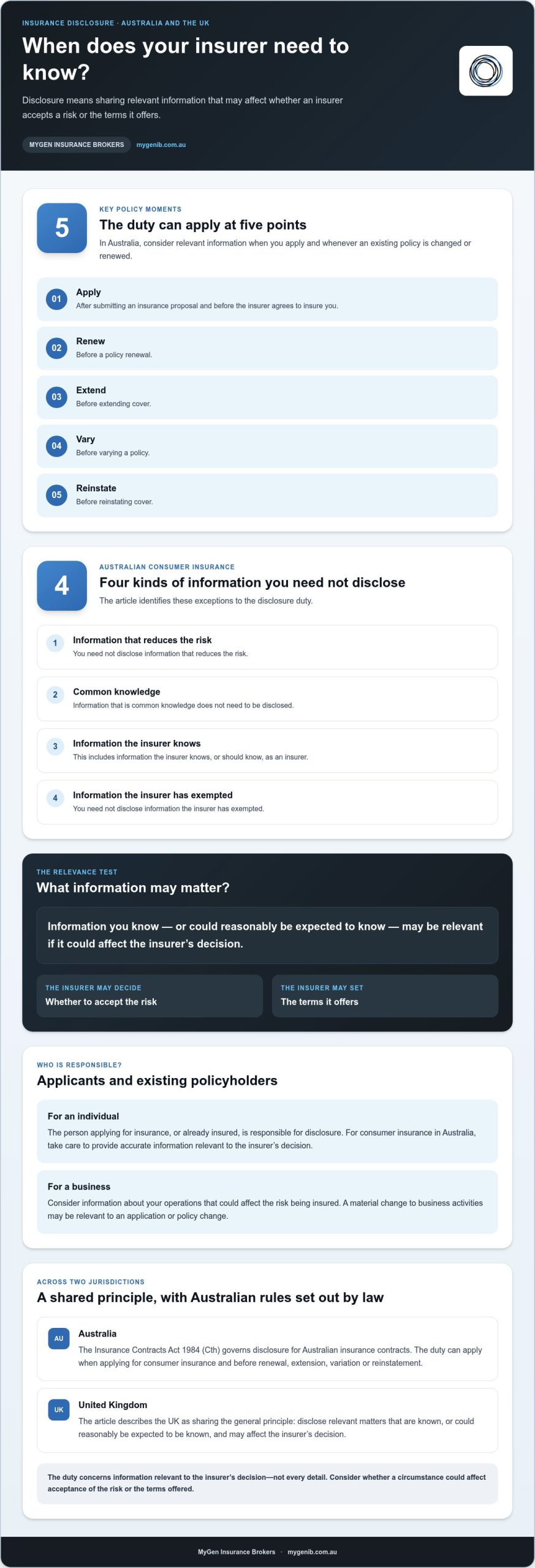
The Insurance Contracts Act 1984 (Cth) governs the duty of disclosure for insurance contracts in Australia. The Insurance Contracts Act 1984 governs Australian insurance disclosure, while the UK shares the general principle that relevant known or reasonably knowable matters must be disclosed.
Disclosure duties across Australia and the United Kingdom
Insurance disclosure means telling an insurer about matters that could affect its decision to accept a risk or set policy terms. In Australia and the United Kingdom, this may include information you know, or could reasonably be expected to know, is relevant to the insurer’s decision. What you disclose matters: an undisclosed circumstance may affect whether cover is offered and on what terms.
When applying for consumer insurance in Australia, take care to give the insurer information that may affect its decision or the terms it offers. The duty applies after you submit an insurance proposal and before the insurer agrees to insure you. It also applies before renewal, extension, variation or reinstatement. You need not disclose information that reduces the risk, is common knowledge, is known or should be known by the insurer as an insurer, or has been exempted by the insurer.
People required to disclose in Australia
The person applying for insurance, or already insured, is responsible for disclosure. For consumer insurance in Australia, applicants should take care to give the insurer accurate information relevant to its decision. A business applying for cover should consider information about its operations that could affect the risk being insured.
The duty also applies when an existing policy changes. Before renewing, extending, varying or reinstating cover, consider whether new circumstances could influence the insurer’s decision or policy terms. For example, a material change to a business’s activities may be relevant to its insurance application. If non-disclosure is fraudulent, an Australian insurer may refuse a claim and treat the contract as if it never existed.
For a clearer picture of business risks and suitable cover, explore Business Insurance options with MyGen Insurance Brokers.
MyGen Insurance Brokers: Business Insurance
MyGen Insurance Brokers can help you consider your business risks and insurance cover in light of your disclosure responsibilities. Its consultative approach focuses on understanding your circumstances and identifying relevant risks, rather than relying on instant automated quotes.
If your work involves providing advice or professional services, Professional Indemnity Insurance may be relevant. Businesses with vehicles can explore Commercial Motor Insurance, while Business Insurance can help address other business risks. What to consider depends on your activities, assets and the information an insurer needs to assess the risk.
Clear, complete information supports an informed discussion about cover and policy terms. MyGen Insurance Brokers also offers Home Insurance for individuals. When considering your options, describe the circumstances you want to insure and any changes that may affect them.
Contact MyGen Insurance Brokers to discuss your insurance needs.
Make your next insurance conversation clearer
Understanding your duty of disclosure also means building a clear picture of the risks you want to insure. Before discussing cover, prepare a concise outline of your activities, assets and any changes that could affect the risk. This provides a practical starting point and helps keep important details in view.
MyGen Insurance Brokers can help you consider how your circumstances relate to Business Insurance, Professional Indemnity Insurance or Commercial Motor Insurance. The discussion is tailored to your needs, rather than treating every application as identical. Clear information and considered advice can make it easier to assess the cover and policy terms under discussion.
If you’re reviewing cover or preparing for an insurance application, contact MyGen Insurance Brokers to discuss your needs. A thoughtful next step can help you move forward with greater clarity.
Frequently Asked Questions
What is duty of disclosure?
A duty of disclosure is a legal obligation to provide relevant information to another person or entity when you possess it. Its scope depends on the relationship and legal setting. For example, an insurance applicant must take care with information that could influence an insurer’s decision, while parties in court proceedings have disclosure obligations related to their case.
What Must Be Disclosed?
Disclose information relevant to the decision being made, including facts you know or could reasonably be expected to know. For an insurance application, consider whether a circumstance could affect the insurer’s assessment of the risk or proposed terms. Answer questions accurately, and don’t assume a detail is irrelevant just because it seems ordinary to you.
What are my legal obligations?
Your obligations depend on whether you’re applying for insurance or involved in legal proceedings. In a family law matter, disclosure covers relevant information throughout the case. Insurance applicants should consider what information may be relevant to an insurer’s decision. For example, a change to business activities could affect how an insurer assesses a proposed risk.
What does duty of disclosure mean in Australia?
In Australia, the phrase describes different obligations in different contexts. The Insurance Contracts Act 1984 governs disclosure for insurance contracts, while family law rules require parties to disclose relevant information in proceedings. So understanding your duty of disclosure starts with identifying the setting: an insurance application, a policy change or a court case each has distinct requirements.
What information must be disclosed under Australian law?
For Australian financial or property proceedings, disclosure covers your total direct and indirect financial circumstances. This can include information about assets, liabilities, income and financial resources. If your circumstances change after filing a Financial Statement, you must file an amended statement or qualifying affidavit within 21 days; an affidavit can set out changes in 300 words or less.