
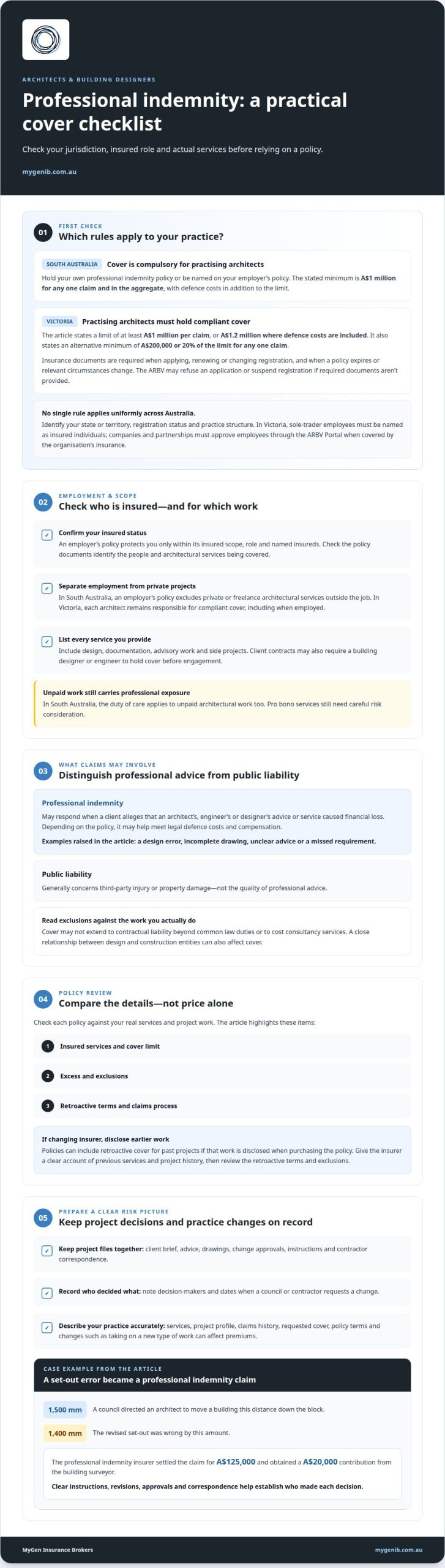
A design decision can create liability even when the work is unpaid. Professional indemnity for architects is compulsory in some Australian jurisdictions: in South Australia, practising architects must hold their own policy or be named on their employer’s, with at least A$1 million cover for any one claim and in the aggregate, plus defence costs in addition to the limit.
It’s understandable to want a clear answer before arranging cover, especially if you work for an employer, take on private projects or provide advice as a building designer. Professional indemnity for architects should reflect the services you actually provide and the risks attached to them.
This article explains what professional indemnity insurance may cover, when an employer’s policy may apply and why professional duties can arise even when no fee is charged. It also outlines the business and project information to prepare for a quote, so you can start the conversation with a clear picture of your work.
Key Takeaways
- Read your employer’s policy carefully and distinguish work done in your role from private or freelance projects.
- Understand how design errors, regulatory issues or incomplete documents can lead to allegations of financial loss.
- Remember that professional duties can apply to unpaid architectural work, so pro bono services still need careful risk consideration.
- Prepare a clear summary of your services, projects and business changes to help shape a relevant insurance quote.
What if my employer’s professional indemnity insurance covers me?
An employer’s policy protects you only within its insured scope, role and named insureds. South Australian architects must hold their own professional indemnity policy or be named on their employer’s. That policy excludes private or freelance architectural services outside the job. In Victoria, each architect remains responsible for compliant cover, including when employed.
Professional indemnity insurance can respond when a client alleges that an architect’s, engineer’s or designer’s advice or service caused financial loss. Depending on the policy, it may help meet legal defence costs and compensation. A design error or incomplete drawing could lead to a claim. Public liability is different: it generally concerns third-party injury or property damage, not the quality of professional advice.
Who needs cover depends on the work, jurisdiction and contracts. Architects may have registration requirements, while a client may require a building designer or engineer to hold cover before engagement. In South Australia, the duty of care also applies to unpaid architectural work, so pro bono projects still carry professional exposure. List every service you provide, including side projects, when assessing whether your existing cover fits.
Past projects can matter when a practice changes insurer. Professional indemnity policies can include retroactive cover for earlier work if you disclose that work when purchasing the policy. Give the insurer a clear account of your previous services and project history, then review the policy’s retroactive terms and exclusions.
To compare policies and insurers in Australia, examine the insured services, limit, excess, exclusions, retroactive terms and claims process, not price alone. Check that the wording fits your actual work, such as design advice or documentation for a building project.
Premiums are affected by the services you perform, your project profile, claims history, requested cover and policy terms. Present these details accurately, including changes such as taking on a new type of work, so the quote reflects your practice.
Professional indemnity insurance for architects and building designers
Requirements depend on your role and jurisdiction. In Victoria, practising architects must meet specific insurance and documentation obligations.
Insurance Needs for Professionals
Professional indemnity insurance can help respond to claims alleging that professional advice or services caused financial loss. Whether you need it depends on your profession, registration rules and client contracts. Architects should compare the services insured with their actual work, including design, documentation and advisory tasks. Building designers should also account for contract requirements before accepting a project.
Cover for Sole Traders and Organisations
In Victoria, sole-trader employees must be named as insured individuals under the relevant professional indemnity policy. Companies and partnerships must approve employees through the ARBV Portal when the organisation’s insurance covers them. Before relying on an organisation’s policy, identify who is insured and whether the documents describe the architectural services performed. A mismatch can leave an individual’s work outside the policy’s stated coverage.
Victorian Architects’ Insurance Obligations
Practising architects in Victoria must hold insurance meeting the Architects Insurance Ministerial Order (January 2020). The limit for each claim must be at least A$1 million, or A$1.2 million where defence costs are included. The stated alternative minimum is A$200,000 or 20 percent of the limit for any one claim. Architects must provide insurance documents when applying, renewing or changing registration, and when a policy expires or relevant circumstances change. The ARBV may refuse an application or suspend registration if required documents aren’t provided.
Requirements Across Australia
Is professional indemnity insurance mandatory for architects in every Australian state and territory? Requirements vary by jurisdiction, so there isn’t one national rule that applies uniformly. In Victoria, practising architects must hold compliant cover; in South Australia, they must hold their own policy or be named on their employer’s policy. First identify the relevant state or territory, registration status and practice structure.
For a clearer view of how cover may fit your work, explore professional indemnity insurance as you prepare your policy details.
Civil liability for professional design and advisory services
Civil liability may arise when a client alleges that professional advice caused financial loss. The work could involve drawings, project decisions or coordination with a contractor. An alleged breach may concern unclear advice or a missed requirement, not just a design error. The circumstances and scope of an architect’s duty shape any dispute.
A construction case shows how measurements and instructions can become central. A council directed an architect to move a building 1500 millimetres down the block. The revised set-out was wrong by 1400 millimetres. The professional indemnity insurer settled the claim for A$125,000. It obtained an A$20,000 contribution from the building surveyor. Keep instructions, revisions, approvals and contractor correspondence together. Those records help establish who made each decision.
Policy wording matters too. Cover may not extend to contractual liability beyond common law duties, and it may not apply to cost consultancy services. A close relationship between design and construction entities can also affect cover. Compare exclusions against your services, especially cost advice, contractual promises and shared interests with a contractor.
Build a project file from the client brief, advice, drawings and change approvals. Record decision-makers and dates whenever a council or contractor requests a revision. If a complaint arrives, preserve relevant documents and follow the policy’s claims notification process. MyGen Insurance Brokers can help you assess professional indemnity insurance against design and advisory exposures.
MyGen Insurance Brokers: Business Insurance
MyGen Insurance Brokers can help architects and building designers consider Professional Indemnity Insurance alongside broader Business Insurance needs. This is useful when you’re setting up a practice, changing your services or reviewing whether existing cover reflects your work. A clear summary of your design and advisory services, project types, business structure and any changes can help inform a tailored insurance discussion.
Professional indemnity cover addresses professional advice and service risks, while Business Insurance may help address other business exposures. The right combination depends on your practice and the risks you want to manage. MyGen takes a consultative approach to understanding those needs and discussing suitable insurance options.
Contact MyGen Insurance Brokers to discuss cover for your practice.
Take the next step with confidence
Start a cover review with your practice’s current work. Note any new services, project types or changes in how you work, then use that information to guide a discussion about suitable protection. Professional indemnity for architects should reflect the professional services and advice your practice actually provides.
MyGen Insurance Brokers offers Professional Indemnity Insurance and Business Insurance, as well as Commercial Motor Insurance for businesses with vehicle-related needs. A considered conversation can help you explore which cover suits your circumstances and how your business risks connect.
Contact MyGen Insurance Brokers to discuss insurance for your practice. A clear understanding of your work is a practical place to begin, and you can take the next step at your own pace.
Frequently Asked Questions
What documentation do I need to quote?
For a quote on professional indemnity for architects, prepare a clear snapshot of your practice and its work. Include your business structure, services, project types and values, claims history, and current insurance schedule if available. Add examples of specialist work, such as cost advice or construction coordination. Accurate details help the broker understand your activities and discuss cover suited to your practice.
Any common exclusions I should flag early?
Yes. Draw attention to cost consultancy, contractual promises that go beyond common law duties, and close links between design and construction entities. These circumstances can affect whether cover responds. Identify any service you’ve recently added or plan to provide, rather than relying on a broad description such as “design work”. Compare the exclusions with your actual contracts and project responsibilities.
Does this insurance cover past projects?
A policy can include retroactive cover for earlier work when that work is disclosed at purchase. For professional indemnity for architects, give a clear account of previous projects, services and relevant dates, then review the policy wording for its retroactive terms. Disclose completed work even if no complaint has arisen, rather than assuming new cover automatically applies to every past service.
How do I lodge a claim?
Follow your policy’s notification instructions and contact your broker as soon as a complaint or claim arrives. Keep the original correspondence, drawings, advice, contracts and project notes together. Record when the matter was received and who was involved. Avoid making admissions or agreeing to a settlement before understanding the policy’s claims process and getting guidance from your broker.
How do I place this?
To arrange cover, provide a broker with your practice details, services, project profile and current insurance documents, then discuss policy terms and options. MyGen Insurance Brokers takes a consultative approach to understanding your business risks and discussing suitable Professional Indemnity Insurance. Contact MyGen to begin a discussion about cover for your architectural practice.