
A policy label alone doesn’t tell you which cyber losses are covered. Cyber insurance’s third-party liability cover may respond when customers, suppliers or other parties claim they’ve suffered loss after a breach, including through legal costs, settlements or court judgments. First-party cover addresses the insured business’s own incident costs, while cyber risk insurance generally brings together both types of protection.
It’s understandable to want clarity before deciding what cover your business needs. This article explains what cyber insurance may cover in Australia, how third-party breach claims and legal costs may be handled, and how cyber risk insurance differs from cyber liability insurance. Policy wording matters because cover varies. Start by distinguishing protection for your own business from cover for claims made by others.
Key Takeaways
- Separate cover for your business’s own recovery costs from protection against claims brought by customers or other parties.
- Understand how legal fees, settlements and other claim-related costs may be handled after a data or network security breach.
- Compare cyber liability with broader cyber risk cover to see how each may address different exposures.
- Use the policy wording to identify limits and exclusions that could affect how well cover fits your business.
What does Cyber Liability typically cover?
Cyber insurance third-party liability cover may respond when customers, suppliers or other stakeholders claim losses after a cyber incident. For example, a breach exposing customer records could lead to a privacy claim. Depending on the policy, cover may include legal defence costs, settlements, court judgments and certain regulatory fines or penalties. Whether fines are covered varies by policy and jurisdiction.
First-party coverage addresses the insured business’s own costs, rather than claims from affected parties. It may help pay for forensic experts, data restoration, breach notifications, cyber extortion and lost revenue. Network business interruption cover may help with lost profits, fixed expenses and additional costs when an attack disrupts operations. For example, a business with disabled booking software may face both interruption losses and recovery expenses.
Cyber third-party liability differs from professional indemnity and public liability insurance. Professional indemnity generally addresses claims related to professional advice, services or errors, while cyber cover focuses on cyber incidents and data or network security failures. Public liability generally concerns bodily injury or property damage, both of which cyber liability policies may exclude. A claim after confidential client data is exposed is an example of a cyber-related claim.
Common limits and exclusions depend on policy wording. Cover may exclude known vulnerabilities left unaddressed, events that happened before purchase, or liabilities accepted under particular contracts. Limits, excesses, sub-limits and exclusions can narrow protection, including for fines and penalties. In Australia, the Office of the Australian Information Commissioner issues guidelines to help entities comply with the Privacy Act 1988.
To assess your cover, map the personal or confidential data your business stores, the software and network security it relies on, and the third parties that could be affected by an attack. Then compare those exposures with policy limits, exclusions and incident-response requirements. Businesses handling customer records, online transactions or supplier data may benefit from reviewing cyber cover. Revisit it as your systems, services and business relationships change.
Third-party legal costs and claims after a data or network security breach
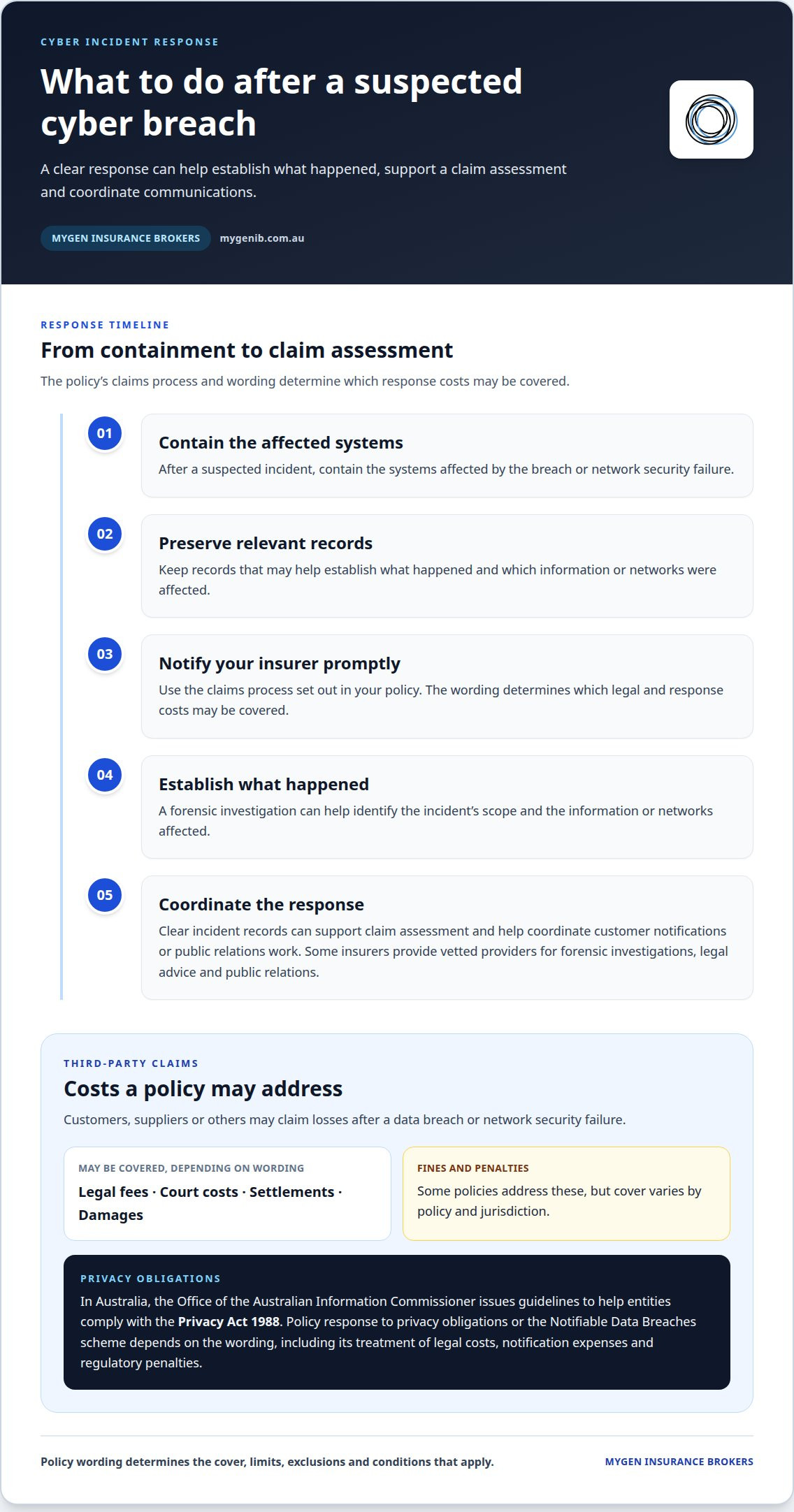
A third-party claim may follow a breach that exposes personal information or disrupts another organisation’s network. The policy wording determines which legal and response costs may be covered.
Breach-related claims and costs
Third-party cyber liability cover may help with claims from customers, suppliers or others who suffer loss after a data breach or network security failure. For example, malware reaching a supplier’s systems through your network could prompt a claim for resulting losses. Depending on the policy, covered costs may include legal fees, court costs, settlements and damages. Some policies also address fines and penalties, but cover varies by policy and jurisdiction.
Privacy liability and breach response
Privacy liability relates to claims arising when a cyber incident compromises customers’ or other stakeholders’ personal information. In Australia, the Office of the Australian Information Commissioner issues guidelines to help entities comply with the Privacy Act 1988. Policy response to claims involving privacy obligations or the Notifiable Data Breaches scheme depends on the wording, including its treatment of legal costs, notification expenses and regulatory penalties.
After a suspected incident, contain the affected systems, preserve relevant records and promptly notify your insurer through the policy’s claims process. A forensic investigation can help establish what happened and which information or networks were affected. Clear incident records can support the claim assessment and help coordinate customer notifications or public relations work.
Some insurers provide vetted providers for pre-breach and post-breach support, such as security assessments, legal advice, forensic investigations and public relations. These services may help businesses prepare for an attack and coordinate a response after a security breach.
Reviewing cyber insurance cover can help clarify how third-party claims and response expenses fit your business’s risks.
Cyber risk insurance versus cyber liability insurance
The labels can overlap, so the policy wording matters more than the product title. The key question is whether cover addresses your business’s losses, claims from others, or both.
Cyber risk insurance
Cyber risk insurance generally refers to broader protection combining first-party cover with third-party liability. For example, a policy may address your own response expenses and financial losses alongside a customer’s claim after information is exposed. That broader scope matters when one cyber incident creates separate costs for your organisation and affected parties. Check how the policy defines covered events and applies limits across those costs.
Cyber liability insurance
Cyber liability insurance may focus on claims against your business following a cyber incident, though the scope varies by policy. A customer could make a claim after a data breach, or a network security failure could affect a supplier’s systems. Cover may address legal expenses, settlements and damages. Some policies also address intellectual property infringement claims or regulatory fines and penalties, subject to the wording and jurisdiction.
The practical test is how a loss occurs. If ransomware interrupts your payment system, your business may face direct recovery costs while customers or suppliers bring separate claims. A liability-focused policy may not cover every first-party expense. Conversely, broader cyber risk cover does not mean every loss, investigation cost or penalty is covered. Exclusions, sub-limits and conditions still shape the response.
For Australian businesses, map the cyber security exposures that matter: sensitive data, payment processes, network dependencies and third-party relationships. Then match each exposure to the relevant cover in the insurance policy, including applicable limits and exclusions. Review cyber insurance options against the risks your business needs to manage.
MyGen Insurance Brokers: Cyber Insurance
MyGen Insurance Brokers helps businesses consider Cyber Insurance in light of their operations and cyber exposures. Its consultative approach considers how a business handles data, relies on digital systems and connects with customers or suppliers, then identifies suitable insurance options. This can clarify whether protection focuses on the business’s own incident costs, claims from affected parties, or both.
Policy wording still matters. Limits, exclusions and conditions shape how cover responds, so distinguishing direct losses from third-party claims is an important part of assessing your needs. Businesses providing professional services may also consider Professional Indemnity Insurance for advice-related exposures, which differ from cyber incident risks.
Contact MyGen Insurance Brokers to discuss Cyber Insurance for your business.
Make your next review a practical one
As your business changes, its data, systems and contractual relationships can change too. Use your next insurance review to consider how those changes affect the cover you need and whether your existing arrangements still reflect your operations. A clear picture of your exposures is a useful starting point for discussing cyber insurance third-party liability.
MyGen Insurance Brokers can help you consider Cyber Insurance alongside other relevant business protection. Its offerings include Business Insurance, Professional Indemnity Insurance and Commercial Motor Insurance. Each addresses different business risks, so consider them in the context of your operations rather than treating one policy as a substitute for another.
Take the next step at your pace. Contact MyGen Insurance Brokers to discuss your business’s insurance needs, and move forward with greater clarity.
Frequently Asked Questions
What is cyber insurance and why should you consider it?
Cyber insurance can help a business manage the financial consequences of cyber incidents, including costs affecting its own operations and claims from others. It may be relevant if your business stores customer information, relies on online payments or depends on connected systems to deliver services. For example, an attack could disrupt bookings while exposing information entrusted to your business.
How is the cost of insurance calculated?
The premium reflects the risk and cover being insured, rather than a standard price for every business. Factors may include your operations, the information you hold, reliance on digital systems, security practices, selected limits and excess. A business processing payments online may have different exposures from one with limited digital operations. The selected cover and policy terms also affect the premium.
What questions should I ask about cover?
Start by identifying what the policy treats as a covered cyber event, then review its limits, excesses, exclusions and claim conditions. Consider how the wording handles incidents involving suppliers, outsourced systems or information held by another organisation. Also check whether cover applies to your business’s own interruption losses, third-party claims, or both. These distinctions can reveal gaps between your operations and the policy protection.
Does Australian cyber insurance cover privacy breaches, data loss and network security failures?
Policies may respond to privacy breaches, lost or damaged data, and network security failures, but the wording defines the scope. For instance, a breach involving customer records could trigger notification and investigation costs, while corrupted files may need restoration. An incident affecting a supplier’s network can raise separate questions about third-party claims. Compare each scenario with the policy’s covered events and exclusions.
What legal costs, compensation and regulatory expenses are covered under Australian cyber liability policies?
Cyber insurance third-party liability cover may include legal defence costs, court costs, settlements or damages arising from a claim. Whether regulatory fines and penalties are covered varies by policy and jurisdiction, so do not assume they are included. For a claim involving personal information, review how the wording treats legal expenses, compensation, notification and regulatory proceedings alongside relevant privacy obligations.