
Comprehensive insurance may cover a commercial vehicle after an insured event, but it does not necessarily cover income lost while the vehicle is off the road. Loss of use coverage for commercial vehicles may help with replacement transport or business downtime, depending on the policy and selected cover. These protections are related, but they are not the same.
If a vehicle is essential to daily operations, it is natural to want to know what happens when it cannot be used. This article explains how loss of use differs from comprehensive motor insurance, what a replacement vehicle can mean for a claim, and when hire vehicle or downtime cover may help keep your business moving.
Key Takeaways
- Separate cover for damage to a vehicle from protection for the costs or income lost while it’s off the road.
- A suitable replacement vehicle may help keep work moving and support a loss-of-use claim.
- Optional hire vehicle or downtime cover can address different business needs, so understand what each benefit is designed to cover.
- Review how your commercial motor insurance fits your operations to identify where a vehicle outage could leave a gap.
Loss of use cover compared with comprehensive motor insurance
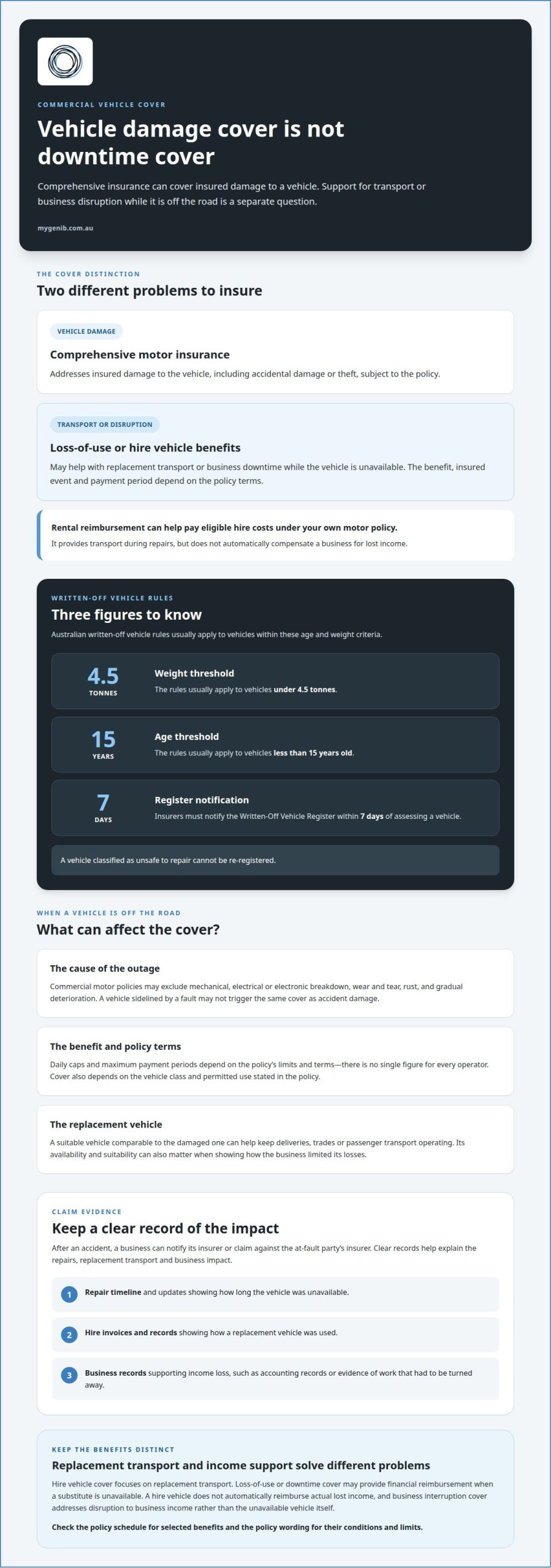
Comprehensive motor insurance addresses insured damage to the vehicle. Loss of use protection addresses transport needs or business disruption while the vehicle is unavailable. The distinction matters when repairs keep a work vehicle off the road.
Rental reimbursement and cover levels
Rental reimbursement helps pay eligible hire costs under the policyholder’s own motor insurance policy. It can provide transport during repairs, but it doesn’t automatically compensate a business for lost income. As at October 2026, the Australian Government’s Moneysmart guide explains the difference between compulsory third party, third party property damage and comprehensive insurance. These cover different risks, so the level selected affects which vehicle damage is insured.
Exclusions and written-off vehicles
Commercial motor policies may exclude mechanical, electrical or electronic breakdown, wear and tear, rust, and gradual deterioration. That distinction matters because a vehicle sidelined by a fault may not trigger the same insurance cover as accident damage. Australian written-off vehicle rules usually apply to vehicles under 4.5 tonnes and less than 15 years old. Insurers must notify the Written-Off Vehicle Register within 7 days of assessing a vehicle, and a vehicle classified as unsafe to repair can’t be re-registered.
Limits on loss-of-use payments
Daily caps and maximum payment periods for commercial vehicle loss of use cover depend on the policy’s limits and terms. There is no single figure that applies to every operator. Replacement vehicle benefits vary with policy wording, so the insurer’s name alone does not establish the available limit or period. Cover for trucks, vans, taxis and rideshare vehicles depends on the vehicle class and permitted use stated in the policy.
After an accident, a business can notify its insurer or claim against the at-fault party’s insurer, then provide repair timelines, hire invoices and records supporting any income loss. Accounting records or evidence of business that had to be turned away can help substantiate a lost-profit claim. The availability and suitability of a replacement vehicle also matter when showing how the business limited its losses.
Mitigating damages by obtaining a replacement vehicle
A replacement vehicle can keep deliveries, trades or passenger transport operating while a damaged vehicle is repaired. Hiring one, if suitable transport is reasonably available, can also reduce business losses. Keep hire invoices, repair updates and records showing how the replacement vehicle was used. It should be comparable to the damaged vehicle and suitable for the work.
Loss of use may still be claimed when no vehicle was hired. Reasonable rental value can help measure the period without use. For an income-earning vehicle, a claim may also include documented lost revenue as consequential loss. If another driver caused the accident, third-party property damage liability may provide a basis for seeking compensation from that party. The claim depends on establishing liability and reasonable losses.
When actual financial loss can’t be established, a claimant may seek damages based on interest on the vehicle’s capital value. In Arsalan v Rixon; Nguyen v Cassim [2021] HCA 40, the High Court of Australia discussed interest on a chattel’s capital value as a measure of loss-of-use damages. A vehicle’s market value and the time it was unavailable can therefore be relevant.
Loss of use after theft, a write-off or an at-fault accident is not automatically covered. An optional policy benefit applies according to its insured events and terms, while a separate claim against an at-fault party depends on liability and evidence. Comprehensive cover for accidental vehicle damage or theft is distinct from compensation for downtime.
If a claim for measurable loss fails, nominal damages may still be available for loss of use. For a particular accident, clear records of repairs, hire costs and business impact help explain the claim. Explore commercial motor insurance as part of considering how your vehicle risks are covered.
Optional hire vehicle or loss-of-use cover
Optional cover may provide a hire vehicle or financial help for vehicle downtime after an insured event. The key distinction is whether your business needs replacement transport, support for lost income, or both.
Optional hire vehicle cover
Hire vehicle cover helps with the cost of appropriate replacement transport when an insured vehicle is unavailable. Loss of use cover may instead provide financial reimbursement when no replacement vehicle is available. Which benefit applies, and for how long, depends on the policy terms and the event that caused the downtime.
For a fleet operator, a hire vehicle can keep transport moving, while a reimbursement benefit may address downtime without a substitute. Read the policy schedule alongside the wording: the schedule identifies selected benefits, while the wording sets their conditions and limits. A total loss can also affect how long a replacement benefit applies, since the vehicle may not return to service after repairs.
Comparing business interruption and hire car cover
Loss of use cover concerns an unavailable vehicle; business interruption cover addresses disruption to business income. Commercial motor insurance can include downtime cover, described as business interruption insurance for a fleet. Hire vehicle cover focuses on replacement transport and does not automatically reimburse actual lost income.
These covers are not interchangeable. A delivery business using a hire van may maintain transport but still lose income if the substitute cannot do the same work. Conversely, a downtime benefit may provide financial reimbursement when no vehicle is available. Keep the hire agreement, repair updates and business records. A clear account of the accident, vehicle use and resulting losses helps explain the claim. An injury claim is separate from vehicle downtime benefits.
Review your commercial motor insurance options to consider how replacement transport and downtime cover fit your operations.
MyGen Insurance Brokers: Commercial Motor Insurance
MyGen Insurance Brokers can help businesses consider Commercial Motor Insurance in the context of their daily operations. If a van, truck or fleet vehicle is essential to earning income, it is worth carefully considering the differences between vehicle damage cover, hire vehicle benefits and downtime protection.
A considered review can focus on your vehicles, how they are used for business and the financial impact of being unable to operate them. It can also clarify how policy terms, limits and exclusions relate to your needs, including whether the arranged cover includes replacement transport or loss of use benefits. This can be useful when arranging cover or reviewing it after your operations change.
Contact MyGen Insurance Brokers to discuss Commercial Motor Insurance for your business.
Plan cover around the work your vehicles do
At your next policy review, consider how a vehicle outage could affect more than transport. Ask practical questions: which operations rely on each vehicle, what work could continue without it, and where could delays affect customers or income?
Planning for loss of use coverage for commercial vehicles means matching protection to your operational dependencies. A clear picture of vehicle use and business priorities can help ensure the cover reflects how your business actually works, not just how it looks on paper.
MyGen Insurance Brokers offers Commercial Motor Insurance, Business Insurance and Professional Indemnity Insurance. Considering these protections together can help connect vehicle risks with wider business and professional responsibilities.
Contact MyGen Insurance Brokers to discuss your business’s insurance needs and take a considered next step.
Frequently Asked Questions
What Is Loss of Use Insurance?
Loss of use insurance may help address costs or financial impacts when an insured vehicle cannot be used. Depending on the arrangement, this may involve help with a replacement vehicle or compensation for vehicle downtime. It differs from cover for damage to the vehicle itself, and a claim may also be made against an at-fault party.
Will Insurance Pay for a Hire Ute While Mine Is Being Repaired?
Insurance may pay for a hire ute if the relevant policy includes a hire vehicle benefit and the repair situation meets its conditions. For example, a tradie whose work ute is being repaired may need a substitute with suitable carrying capacity. A standard passenger car may not meet that need, so vehicle type and permitted use matter.
What does loss of use coverage mean for commercial vehicles in Australia?
In Australia, loss of use coverage for commercial vehicles refers to a benefit or claim relating to the period a work vehicle is unavailable. It may address substitute transport or financial loss, depending on the policy or claim basis. Businesses should distinguish between these outcomes: keeping a vehicle operating does not necessarily replace income lost through disruption.
Does Australian commercial motor insurance cover hire vehicle costs while a vehicle is being repaired?
Australian commercial motor insurance can cover hire vehicle costs when the policy includes an applicable benefit and the claim meets its terms. For instance, a business may need a replacement vehicle to complete scheduled work while its insured vehicle is repaired. The benefit’s scope depends on factors such as the insured event, eligible vehicle and applicable limits.
What exclusions and conditions apply to commercial vehicle loss of use insurance in Australia?
Conditions and exclusions depend on the policy wording and the event that caused the vehicle’s downtime. Commercial motor policies may exclude mechanical, electrical or electronic breakdown, wear and tear, rust, and gradual deterioration. Distinguish accidental damage from a mechanical fault: the cause of the vehicle’s unavailability can affect whether a loss of use claim applies.