
If you’re relying on a “tick and flick” automated form to value your company’s equipment, you aren’t just saving time; you’re likely leaving your most vital assets exposed to a massive shortfall. We know how unsettling it is to stare at a generic questionnaire for business contents insurance and wonder if your unique business setup is actually being captured. Most Australian business owners feel a genuine sense of dread when choosing between “replacement value” and “market value,” fearing that a single misunderstanding could lead to a rejected claim during a crisis.
We believe your hard-earned assets deserve a more diligent approach than a computer-generated estimate. This guide will help you accurately value and protect your property with a methodical strategy that goes far beyond automated quotes. We’ll provide a clear framework for categorising your assets and explain the vital differences between basic and comprehensive cover. By the end, you’ll have the confidence that your policy is built on precision, ensuring that if the worst happens, your claim will be paid in full without the stress of unexpected gaps.
Key Takeaways
- Learn to distinguish between your building’s “shell” and the “engine” of your operations to ensure every vital asset is accurately accounted for.
- Master a methodical approach to categorising stock, plant, and fit-out so you can avoid the common trap of restrictive sub-limits.
- Discover why choosing “Replacement Value” over “Indemnity” is essential for your business contents insurance if you want the capital to fully restart after a loss.
- Build a claim-ready asset register using cloud-based records to ensure you have the evidence needed to get paid in full without the stress of a rejection.
- Understand how a seasoned expert identifies hidden risks, such as debris removal and record restoration, which generic automated forms frequently overlook.
What is Business Contents Insurance? Beyond the Basic List
Think of your premises as a body. Building insurance provides the skeleton, but business contents insurance protects the vital organs that keep the operation alive. It is a layer of security for the physical items you use every single day to serve your customers and generate profit. Within the wider framework of Property insurance, this cover is specifically tailored to protect your “engine” from sudden, unforeseen disruptions. Whether it’s a burst pipe in the ceiling or a break-in overnight, these policies are built to respond to fire, storm, theft, and accidental damage.
By 2026, the lines between physical and digital assets have blurred significantly. Modern Australian businesses often rely on “hybrid” assets, such as high-end tablets, portable diagnostic tools, or specialised mobile payment hardware. These items are often at higher risk because they are mobile. We take the time to look beneath the surface of your inventory to ensure these high-value, portable pieces are included in your total sum insured, rather than being left out of a generic, automated quote that only accounts for the basics.
Why a Standard Home Policy Won’t Cut It
Many local business owners who operate from home mistakenly believe their domestic policy has them covered. This is a dangerous assumption. Most home insurance contracts include a “commercial use” exclusion that can void a claim if the damage is linked to business activities or equipment. Beyond the physical items, the liability risks associated with business-grade machinery or frequent client deliveries are far higher than a standard household is designed to handle. A dedicated commercial review is the only way to ensure your home-based venture is actually protected against a total loss.
The True Cost of Underinsurance in Australia
The “average clause” is a standard insurance provision where the insurer can reduce your payout proportionally if the amount you’re insured for is less than the actual replacement value of your assets. In 2026, this is a major concern because inflation has sharply increased the cost of replacing specialised machinery and imported components. If your policy hasn’t been updated to reflect these new market realities, you’re effectively self-insuring a portion of your risk without even knowing it. We believe true peace of mind is only possible when your asset valuation is grounded in current data, ensuring your business can survive a major event without a crippling financial shortfall.
Defining Your Assets: Stock, Plant, and Fit-out
Many business owners view their inventory as a single, lump-sum figure. While this might seem simple, it often leads to significant frustration when a claim is lodged and restrictive sub-limits are discovered. We find that a more methodical approach involves breaking your assets into logical categories, allowing us to build a policy that mirrors the actual structure of your operation. When reviewing your business contents insurance, it’s essential to look beneath the surface of your daily activities to identify not just what you own, but what you are contractually responsible for, such as leased printers or specialised diagnostic tools. Understanding the various types of business insurance helps place these categories in context, ensuring no vital component of your business engine is left exposed.
Stock-in-Trade vs. Customers’ Goods
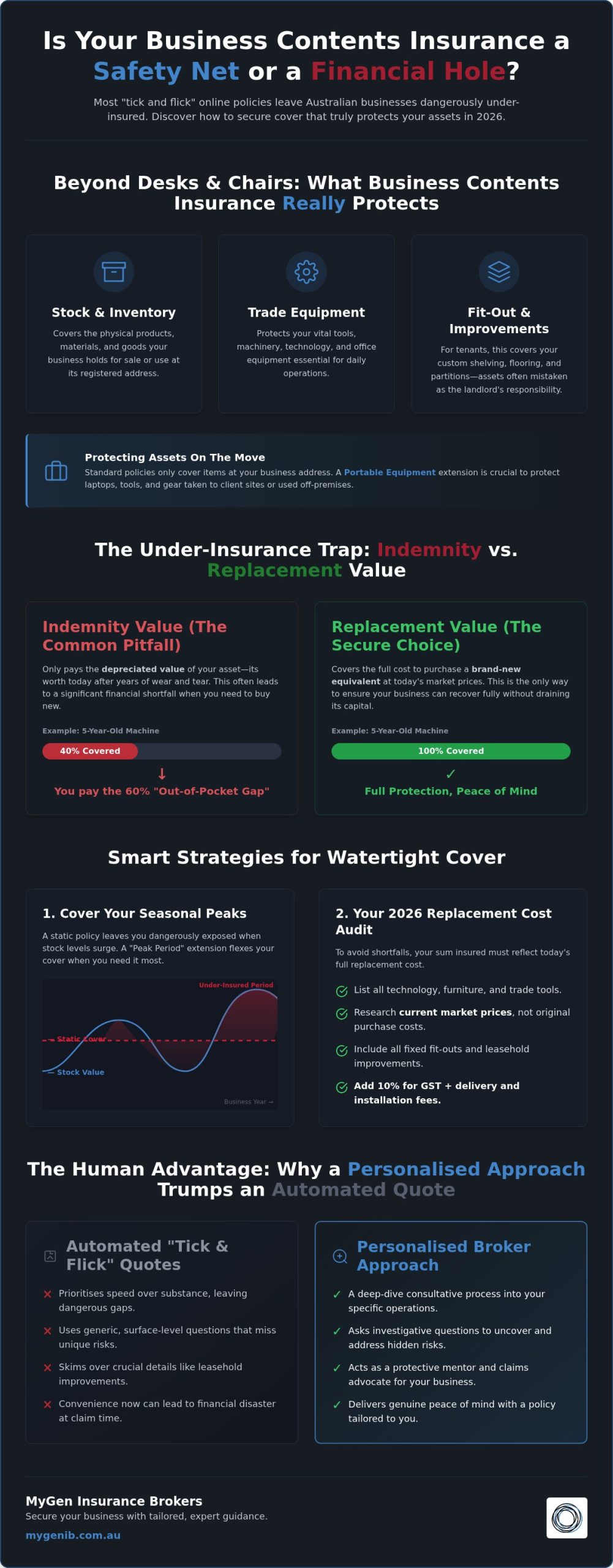
We categorise stock-in-trade as the raw materials, work-in-progress, and finished goods that constitute your inventory. However, if your business involves repairing or servicing items owned by others, you need a specific extension for “goods in care, custody, and control.” Without this, the items your customers have entrusted to you may not be covered. It’s also vital to account for seasonal fluctuations. If your stock levels double during the lead-up to the Christmas period, your policy needs to reflect that peak to avoid being underinsured during your most profitable months.
Plant, Machinery, and Electronic Equipment
In the insurance world, “plant” refers to the heavy, fixed equipment used to produce your goods or services. These assets are the workhorses of your business, yet they are often vulnerable to more than just fire or theft. Electronic equipment, from servers to specialised tablets, faces constant risks from power surges and accidental drops. We often recommend adding specific breakdown cover for vital machinery. This ensures that if a critical piece of gear fails mechanically, you aren’t just covered for the damage, but you have the support to get back up and running quickly. If you’re unsure how to categorise a specific piece of equipment, speaking with an experienced broker can provide the clarity you need.
Tenant’s Fit-out and Improvements
If you lease your commercial space, the “shell” belongs to the landlord, but the fit-out is usually your responsibility. This includes everything from the flooring and partitions to the custom lighting and cabinetry you’ve installed to make the space your own. Fit-out is frequently the most undervalued portion of a contents policy because owners forget how much it actually costs to rebuild a professional interior from scratch. We suggest reviewing your lease agreement carefully. It will often outline exactly which parts of the building’s interior you are required to insure, helping you avoid a costly misunderstanding with your landlord after an event.
Replacement Value vs Indemnity: Avoiding the ‘Regret Gap’
Choosing between Replacement Value vs Indemnity isn’t just a technicality; it’s a decision about your business’s future financial resilience. When you lodge a claim for business contents insurance, the basis of settlement you chose months earlier suddenly becomes the most important factor in your recovery. We call the difference between these two the “Regret Gap.” It’s the painful out-of-pocket expense that occurs when a policy only pays out the depreciated value of your assets, leaving you to find the extra capital to bridge the shortfall yourself. It’s a hard lesson to learn when you’re already dealing with the stress of a major loss.
We work closely with our clients to look beneath the surface of their balance sheets. We don’t believe in “tick and flick” forms that ignore the nuances of your operation. Instead, we help you understand whether your business has the cash reserves to absorb a depreciated payout or if you need the absolute security of a total replacement policy. Our goal is to ensure you move from a state of uncertainty to one of total clarity, knowing exactly how much capital will be available to you in a crisis.
The ‘New for Old’ Advantage
For most modern Australian businesses, “New for Old” is the only sensible choice. This covers the cost of replacing your lost items with brand-new equivalents at current 2026 prices. If your high-end laptops or specialised manufacturing tools are destroyed, you won’t want to go hunting for used replacements on a second-hand marketplace. You’ll need brand-new gear to maintain your competitive edge and operational speed. Because prices for technology and specialised hardware can fluctuate wildly, we encourage you to regularly update your sums insured. This ensures your business contents insurance keeps pace with actual retail costs, leaving no room for a shortfall.
When Indemnity Might Apply
Indemnity cover, or “Market Value,” is generally cheaper because the insurer only pays what the item was worth at the time of the loss. This calculation takes wear, tear, and age into account to arrive at an “actual cash value.” We rarely recommend this path unless you’re dealing with end-of-life assets that you don’t intend to replace like-for-like. Choosing indemnity solely to save on premiums is a high-risk strategy that often backfires. It leads to a situation where you have the insurance payout in your hand, but it isn’t nearly enough to get your doors back open and your team back to work.
How to Organise Your Business Inventory for a Claim
In the aftermath of a fire or a break-in, your memory is often your least reliable asset. We’ve seen many business owners struggle to recall every item they’ve lost, leading to a claim that only covers a fraction of the actual damage. To avoid this, we encourage you to adopt a detective’s mindset today, looking into every cupboard and corner of your premises. A methodical approach to your business contents insurance documentation ensures that when the time comes to lodge a claim, you aren’t guessing. You are presenting a clear, undeniable case for recovery.
A well-organised inventory speeds up the claim process significantly. It allows the loss adjuster to verify your losses quickly, which means your payout arrives sooner and your business can return to normal operations faster. This level of preparation provides a sense of calm during an otherwise chaotic period. It turns a high-friction experience into one that feels managed and professional.
The Digital Asset Register
Your asset register must be stored off-site or in a secure cloud-based environment. If your physical records are destroyed in the same event that took your equipment, they’re of no use to you. We recommend taking a high-resolution video walkthrough of your entire premises every six months. Open every drawer and storage area to capture the small items like stationery, specialised tools, and cabling that collectively add up to thousands of dollars. Alongside these visuals, maintain a spreadsheet that tracks serial numbers, purchase dates, and prices. It is also the perfect time to review your Business Contents Insurance: Covering Your Digital Assets to ensure your software licences and critical data are protected as thoroughly as your physical gear.
Proof of Value and Ownership
The burden of proof rests with you. Insurers generally accept a range of evidence, including digital receipts, bank statements, and formal contracts. For unique or high-value plant equipment, a professional valuation is often vital to ensure you aren’t underinsured. You should also understand the distinction between “specified” and “unspecified” items on your policy schedule. High-value items, such as expensive artwork or specific mobile tech, often need to be listed individually to ensure they are covered for their full value. If you’re feeling overwhelmed by the paperwork, our team can guide you through the process of creating a claim-ready register that leaves nothing to chance.
Why a Consultative Broker Outperforms an Automated Quote
While the promise of a fast, automated quote is tempting, it often ignores the intricate realities of your operation. We act as a steady, experienced hand; someone who looks deeper than a standard online form to ensure your protection is grounded in reality. Selecting business contents insurance through a digital portal might save you ten minutes today, but it can cost you months of recovery time later if the policy doesn’t account for the true complexity of your assets. We believe in a partnership approach where we work for you, not the insurer, acting as your advocate during the claims process to ensure you receive every cent you’re entitled to.
Our role involves uncovering the hidden risks that automated systems frequently overlook. For example, a generic quote might cover the cost of a desk, but it rarely accounts for the significant “removal of debris” costs after a fire or the specialised “re-writing of records” cover needed to restore your digital archives. These are the “beneath the surface” expenses that can bankrupt a business if they aren’t identified during the initial advice phase. We take the time to investigate these nuances, moving you from a state of anxious uncertainty to one of managed clarity.
The ‘Tick and Flick’ Danger
Automated quotes often default to the lowest and riskiest coverage levels to keep premiums appearing competitive. These generic templates lack the nuance required for specialised Australian industries, often leaving gaps in cover that only become apparent when you try to lodge a claim. We’ve seen how a simple 15-minute conversation can save a business from a catastrophic underinsurance event. By asking the “what if” questions that a computer cannot, we help you recognise where your current setup is exposed. Relying on a “tick and flick” form is a gamble with your business’s continuity; we prefer a more diligent, human-centric approach.
Personalised Risk Assessment with MyGen Insurance Brokers
Our process is built on a foundation of investigation and discovery. We don’t just skim the surface of your requirements; we dive deep into your inventory, your lease obligations, and your operational risks to build a tailored shield around your assets. This methodical strategy ensures that your business contents insurance is perfectly suited to your specific needs, rather than being a one-size-fits-all compromise. We invite you to experience the relief that comes from knowing your life’s work is protected by experts who truly care about your long-term security. Contact MyGen Insurance Brokers for a personalised business insurance review to ensure your vital assets are protected for the years ahead.
Move Beyond Automated Estimates to Lasting Security
Protecting your business engine requires more than a simple guess at its value. We’ve explored how the “Regret Gap” can derail even the most successful operations, which is why a methodical approach to your asset register is so vital. By moving away from automated estimates and toward a precise valuation, you ensure your business contents insurance actually performs when you need it most. It’s about turning a complex, high-friction task into a state of total clarity and professional certainty.
Our team brings over 20 years of industry expertise to every client relationship, offering a personalised consultative approach that generic forms simply cannot match. We act as your dedicated claims advocate, providing the steady hand you need to navigate complex recoveries with confidence. Secure your business assets with a tailored review from MyGen Insurance Brokers. You’ve worked tirelessly to build your legacy; we’re here to help you protect it for the long term.
Frequently Asked Questions
Does business contents insurance cover my building as well?
No, business contents insurance does not cover the physical building structure. Building insurance protects the “shell,” such as the walls and roof, while contents insurance covers the “engine” or the items kept inside. If you own the premises, you’ll need a separate building policy. If you lease, the landlord usually insures the structure while you remain responsible for your own fit-out and equipment.
Can I insure my business equipment if I work from a home office?
Yes, you can insure your gear, but you’ll likely need a dedicated commercial policy rather than relying on home insurance. Most domestic policies include a “commercial use” exclusion that can lead to rejected claims for professional equipment. A specific business policy ensures your high-end computers and inventory are protected under professional-grade terms that a standard household policy doesn’t provide.
What is the difference between ‘specified’ and ‘unspecified’ items?
Unspecified items are covered under a general total limit, while specified items are listed individually on your policy schedule with their own specific values. We recommend specifying any high-value assets, such as specialised diagnostic machinery or expensive electronics, to ensure they aren’t capped by a lower “per-item” limit. This methodical approach ensures your most vital assets are protected for their true replacement cost.
Does contents insurance cover stock that is being delivered to a customer?
Standard contents policies typically cover items only while they are at your insured premises, not while they are in transit. To protect stock being delivered to a customer, you’ll generally need “Goods in Transit” cover. This extension provides peace of mind that your products are protected against damage or theft from the moment they leave your warehouse until they reach their final destination.
What happens if I forget to add a new piece of equipment to my policy?
If you forget to add a new asset, you risk being underinsured, which can trigger the “average clause” and reduce your payout during a claim. Some policies offer a small “automatic additions” grace period for new purchases, but this is often limited to a small percentage of your total sum. It’s always safest to notify your broker immediately when you invest in significant new plant or equipment.
Is theft by an employee covered under a standard contents policy?
Theft by an employee is generally excluded from a standard business contents insurance policy. To protect against internal dishonesty, you typically need “Fidelity” cover or a broader Management Liability policy. We can help you identify if your current setup leaves you exposed to these internal risks, ensuring your business has a comprehensive shield that goes beyond external threats like break-ins or storm damage.
How often should I review my business contents sum insured?
You should review your sum insured at least once a year or whenever you make a significant purchase. In 2026, inflation and fluctuating costs can quickly make old valuations obsolete. A regular review ensures your cover keeps pace with the actual cost of replacing your equipment at current retail prices, preventing a financial shortfall if you ever need to lodge a major claim.
Does this insurance cover my data and digital files?
Business contents insurance primarily covers the physical hardware, such as servers and laptops, rather than the data itself. While some policies include a small limit for the “re-writing of records” to help restore lost files, true protection for digital assets usually requires Cyber Insurance. This ensures you have the resources to recover from a digital breach or total system failure where hardware remains intact but data is lost.