
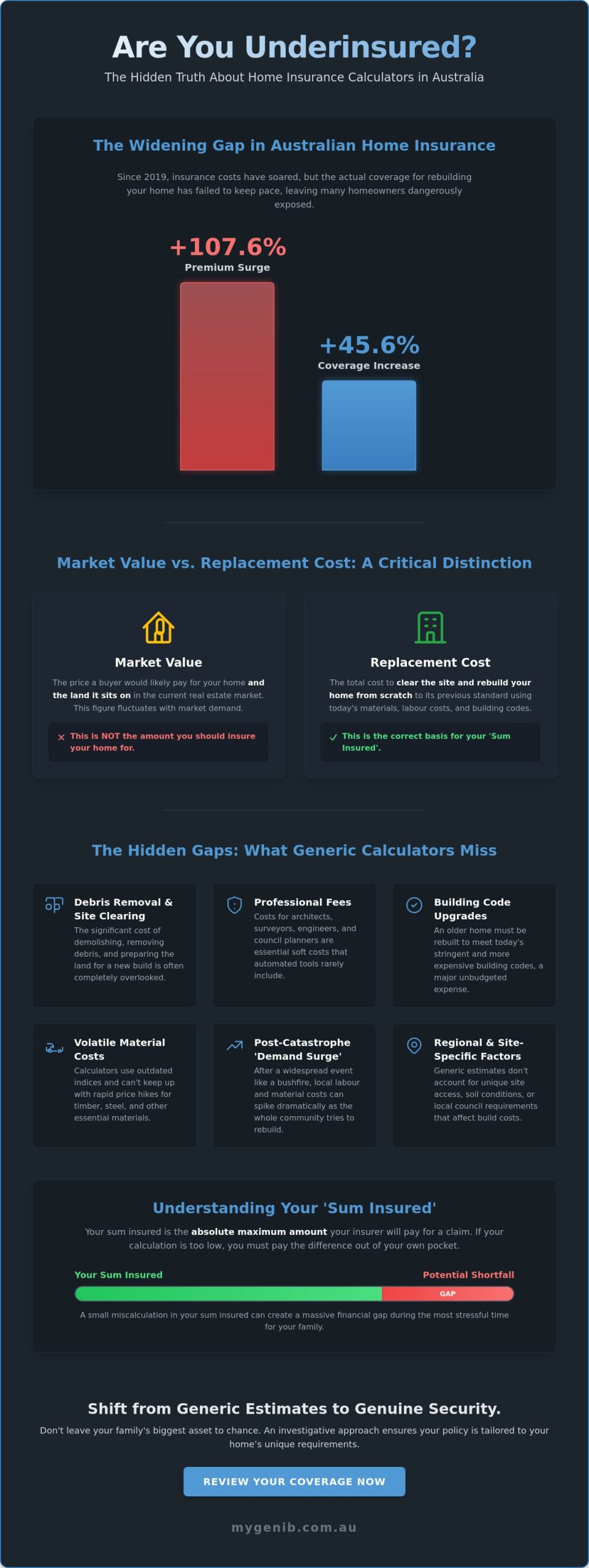
If you lost your home to a bushfire or a sudden storm tomorrow, would the figure you generated on a generic home insurance calculator actually cover the cost to rebuild? It is a sobering question for many Australian homeowners, especially given that since 2019, insurance premiums have surged by 107.6% while dwelling coverage has only increased by 45.6%. We know how frustrating it is to navigate online forms that treat your unique property like a line on a spreadsheet. It’s an experience that often leaves you with a nagging sense of anxiety about being underinsured when it matters most.
You deserve to know that if the worst happens, your policy will perform exactly as you expect it to. We are going to explain why automated estimates often miss the mark and show you how to calculate a rebuild cost that reflects today’s rising labour and material prices. We will also clarify the vital difference between market value and replacement cost. This guide ensures you understand exactly which ‘extras’ must be included in your sum insured to provide true security for your family’s future.
Key Takeaways
- Understand the vital distinction between your property’s market value and its actual replacement cost to avoid a significant financial shortfall during a claim.
- Discover why a standard home insurance calculator often misses the mark by failing to account for Australia’s rapidly shifting construction costs and supply chain pressures.
- Learn to identify the hidden expenses, such as professional fees and debris removal, that must be included in your sum insured for a complete rebuild.
- Shift from a generic ‘tick and flick’ estimate to a thorough, investigative approach that ensures your policy is tailored to your home’s unique requirements.
Why a Home Insurance Calculator is Only the Starting Point
Most of us want a quick answer for the protection of our biggest asset. A home insurance calculator provides exactly that; it is a digital estimator that produces a rebuild figure based on generic data and broad industry averages. We understand why these tools are popular. They offer a low-friction, immediate way to get a ballpark figure without needing to spend hours researching local construction rates. However, relying solely on these automated results can create a false sense of security that leaves many Australians significantly underinsured.
The primary trap lies in the confusion between market value and replacement cost. Market value is what a buyer might pay for your home and land in the current real estate climate. In contrast, replacement cost is the actual price of clearing the site and rebuilding the structure from scratch using today’s labour and materials. Gaining a clear understanding of these fundamental property insurance concepts is vital. If you only insure for what you think the house is worth on the street, you might find yourself short by hundreds of thousands of dollars when the builders’ quotes come in.
To better understand how these digital tools function, watch this helpful video:
The Lure of the ‘Instant’ Estimate
We live in a ‘tick and flick’ culture where speed is often prioritised over accuracy. Online insurance forms are designed to be finished in minutes, but this convenience often comes at the expense of detail. While a home insurance calculator is a helpful starting point, many of these tools rely on outdated construction cost indices. They don’t always account for the rapid price hikes in timber, steel, and specialised trade labour that have impacted the Australian building industry recently. A figure that seemed reasonable six months ago could be completely obsolete by the time you actually need to claim.
What is a ‘Sum Insured’ Anyway?
Your sum insured is the absolute maximum amount your insurer is obligated to pay if your home is destroyed. It’s a figure you choose when you take out the policy, and it’s easy to underestimate it if you aren’t looking beneath the surface of generic estimates. Your sum insured represents the maximum limit of liability for your insurer, meaning any costs beyond this figure must be paid out of your own pocket. If your estimate is too low, you aren’t just missing a few dollars; you’re facing a massive financial gap during one of the most stressful experiences a family can endure.
The Hidden Gaps: What Most House Insurance Calculators Miss
Rebuilding a home is far more complex than simply tallying up the price of bricks and a few weeks of labour. It is a common misconception that if you know the current price of timber, your estimate is solid. In reality, the Australian construction market is notoriously volatile. A home insurance calculator often fails to keep pace with rapid shifts in national supply chains. If your estimate relies on data that is even six months old, you might find yourself facing a significant financial shortfall when you can least afford it.
Beyond Bricks and Mortar: The Soft Costs
Many digital tools overlook the ‘soft costs’ that accumulate long before the first slab is poured. To accurately determine your home’s replacement cost, you must account for several essential expenses that are frequently omitted from automated results:
- Professional fees for architects, surveyors, and structural engineers.
- The substantial cost of debris removal and site clearing, particularly if hazardous materials like asbestos are present.
- Local council permit fees and mandatory planning costs.
There is also the sobering reality of ‘demand surge’. Following a major catastrophe, the cost of local trades and materials often spikes as an entire community competes for the same limited resources. A generic home insurance calculator cannot predict these localised price jumps. If you want to ensure your coverage is truly fit for purpose, it is often worth reviewing your specific property risks with a professional who looks beneath the surface.
Regional Realities and Building Code Compliance
If you own an older property, it likely doesn’t meet today’s stringent building standards. In the event of a total loss, you cannot simply rebuild the structure exactly as it was; you must comply with 2026 regulations. This might involve installing expensive bushfire shutters or upgrading to modern flood-resilient materials. Automated algorithms rarely ask the detailed questions required to identify these mandatory upgrades. This oversight can leave a massive gap in your safety net, as your policy may only cover the cost of a home that no longer meets legal requirements. To understand how these new standards affect your insurance home and contents coverage, reviewing the latest 2026 Australian buying guide can help you identify where your current policy may fall short.
From Estimates to Security: Organising Your Coverage Properly
While a home insurance calculator serves as a convenient entry point, it cannot replace the depth of a professional risk assessment. We view insurance as a long-term relationship rather than a fleeting digital transaction. Our philosophy at MyGen centres on moving away from rigid automation and toward a model of tailored risk management. This means we take the time to understand the unique characteristics of your home and your lifestyle, ensuring that your safety net is robust enough to catch you when it matters most.
Maintaining a well-organised physical record of your policy documents and property valuations is a crucial part of home management; for quality filing products, Mega Office Supplies offers the essential equipment to keep your administration in order.
By acting as a ‘deep-diver’ into your specific circumstances, a broker identifies the nuances that a simple algorithm is designed to ignore. We believe in doing the heavy lifting on your behalf, investigating everything from local construction trends to the specific features of your property. This thoroughness transforms a generic estimate into a reliable shield, giving you the professional confidence that your policy will perform exactly as expected during a total loss.
The Value of a Consultative Approach
A consultative approach allows us to identify the subtle risks that a generic ‘tick and flick’ form will always overlook. By acting as your protective mentor, a broker evaluates your specific situation to recommend a sum insured that reflects your actual needs rather than a broad industry average. To understand more about how we help you navigate these complexities and secure your assets, read The Essential Guide to Protecting Your Australian Property.
Taking the Next Step Toward Peace of Mind
The ultimate objective isn’t just to find a number; it’s to provide the absolute certainty that your family’s lifestyle is protected. When you move beyond the limitations of a standard home insurance calculator, you gain a partner who is emotionally invested in your long-term security. We encourage you to ask an expert to review your current policy for hidden gaps. This small step can be the difference between a stressful financial struggle and the calm relief of knowing you are truly covered.
Secure Your Future Beyond the Estimate
Protecting your family’s sanctuary shouldn’t rely on a generic algorithm. We’ve seen how a home insurance calculator can provide a helpful ballpark figure, but it often stops short of accounting for the true complexities of rebuilding in Australia. From the hidden surge in material costs to the mandatory upgrades required by modern building codes, the gaps in automated estimates can be substantial. You deserve a safety net designed specifically for your property rather than a broad industry average.
With over 20 years of industry expertise, we take a deep-dive approach to ensure every professional fee, council permit, and unique architectural feature is included in your sum insured. We move beyond the “tick and flick” culture to provide personalised risk management rather than generic, automated quotes. Let our experts help you secure your home properly with tailored solutions for even the most complex Australian properties. Taking this step today ensures that if the worst happens, you can focus on rebuilding your life with absolute certainty and professional confidence.
Frequently Asked Questions
Is a home insurance calculator accurate enough for a total loss claim?
A home insurance calculator is rarely accurate enough to serve as your sole guide for a total loss claim. These tools provide a helpful baseline, but they often rely on national averages that don’t account for specific local building conditions or sudden price spikes in your suburb. Relying solely on a generic tool can leave you with a significant financial gap that you would have to cover personally during a rebuild.
What is the difference between replacement cost and market value in Australia?
Market value represents the price a buyer is willing to pay for your property, including the land and the location’s desirability. In contrast, replacement cost focuses exclusively on the expense of rebuilding your home from scratch on the existing site. This includes labour, materials, and professional fees. In many parts of Australia, the cost to rebuild can actually exceed the market value; this is especially true for older homes with heritage features.
Why is my house insurance calculator estimate different from my bank’s valuation?
These two figures serve entirely different purposes. A bank’s valuation is primarily concerned with the security of their loan and what the property would fetch at a forced sale. An insurance estimate, however, must account for the logistical reality of clearing a destroyed site and constructing a new home to current building codes. Because a bank valuation includes the land value while insurance focuses on construction, the figures will rarely align.
Can an insurance broker help me calculate my sum insured more accurately than a website?
A broker acts as a protective mentor who looks beneath the surface of a generic online form. Unlike a standard home insurance calculator, a broker investigates the “soft costs” like debris removal, architect fees, and the specific risks associated with your local area. This methodical approach ensures your sum insured reflects the actual reality of a rebuild; it provides the peace of mind that a digital transaction simply cannot offer. For a comprehensive overview of what a complete policy should cover, our insurance home and contents 2026 Australian buying guide walks you through every essential consideration.