What if the “quick quote” you just received is actually the most expensive mistake your business will make this year? Most Australian business owners feel the weight of rising premiums and the nagging worry that a generic policy might contain hidden exclusions that only surface during a crisis. It’s exhausting to deal with impersonal, automated services when you’re trying to protect a legacy you’ve spent years building. We understand that you need more than just a policy; you need a partner who’ll stand in your corner when things go wrong.
Finding that level of security starts with knowing the right questions to ask your insurance broker to move beyond the surface level. We’ve developed this guide to help you identify a broker who acts as a seasoned mentor, someone who dives deep into your specific industry risks rather than just skimming the basics. You’ll learn how to navigate the 2026 regulatory landscape, including the updated General Insurance Code of Practice, while ensuring you have a dedicated advocate for your claims. This checklist provides the clarity you need to stop feeling underinsured and start feeling truly protected.
Key Takeaways
- Distinguish between a consultative expert and “tick and flick” services by asking questions that reveal deep risk insight.
- Avoid the underinsurance trap by learning how to calculate a realistic sum insured that reflects 2026 costs rather than obsolete valuations.
- Master the essential questions to ask your insurance broker to ensure you have a dedicated advocate who manages the heavy lifting during a claim.
- Gain the confidence that your specific industry risks are covered, moving from a state of anxiety to one of calm certainty.
Vetting the Expert: Questions to Reveal Deep Risk Insight
Many business owners settle for “tick and flick” automated quotes because they’re fast, but speed often masks a lack of precision. We believe that true protection requires a consultative approach that looks far beyond a standard questionnaire. Before diving into the specifics of your policy, it’s helpful to understand the foundational role of the professional you’re hiring by considering What is an insurance broker? and how they differ from a simple sales agent.
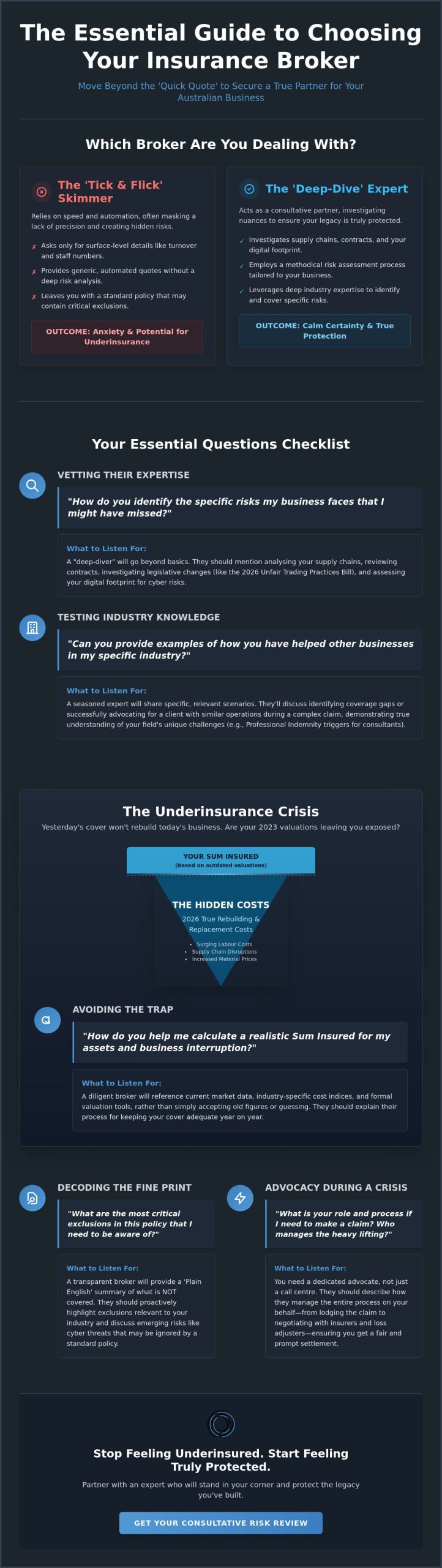
A “skimmer” broker might only ask for your turnover and staff count, whereas a “deep-diver” investigates the nuances that could lead to a claim being denied. To ensure you aren’t just buying a generic policy, there are specific questions to ask your insurance broker that reveal their level of commitment to your security.
To better understand this concept, watch this helpful video:
When you first meet, ask them: “How do you identify the specific risks my business faces that I might have missed?” This forces the broker to explain their investigative process. They should mention things like reviewing your supply chains or checking for legislative changes, such as the 2026 Unfair Trading Practices Bill, which targets predatory operators in the accident management sector. You also need to understand their investigative depth by asking: “What is your process for investigating risks that sit beneath the surface of a standard policy?”
Testing Industry Knowledge
Industry-specific expertise is often the difference between a generic policy and true protection. If you’re a consultant, for example, your broker should understand the specific triggers for professional indemnity insurance in your field. Ask them: “Can you provide examples of how you have helped other businesses in my specific industry?” A seasoned expert will recount scenarios where they identified a gap or successfully advocated for a client during a complex claim.
The “Deep-Dive” Methodology
A mentor-style broker will walk you through a clear risk assessment checklist rather than just emailing a form. They won’t just look at your physical premises; they’ll investigate your contracts and your digital footprint to ensure your liability risks are fully mapped out. This methodical approach is one of the most vital questions to ask your insurance broker because it turns a high-friction transaction into a managed partnership that evolves as your business grows.
Ensuring Suitability: Questions About Coverage and the Underinsurance Trap
The current economic climate has created a perfect storm for Australian businesses. If you haven’t updated your asset valuations since 2023, you’re likely walking a tightrope. Rising labour costs and supply chain disruptions mean that yesterday’s cover won’t rebuild today’s business. This is why one of the most critical questions to ask your insurance broker involves how they address the growing gap between your policy limits and reality.
Navigating the Underinsurance Crisis
Replacement costs for assets like property and those covered under commercial vehicle insurance have surged significantly over the last few years. It’s vital to realise that your Sum Insured must reflect 2026 rebuilding and replacement costs rather than original purchase prices. Ask your broker: “How do you help me calculate a realistic Sum Insured for my assets and business interruption?” A diligent partner will use current market data and industry-specific indices to ensure you aren’t left with a shortfall during a claim.
Identifying Policy Exclusions
Every insurance contract contains boundaries. Your broker’s role is to ensure you aren’t blindsided by fine print during a crisis. We recommend asking for a “Plain English” summary of what is NOT covered. Specifically, you should ask: “What are the most critical exclusions in this policy that I need to be aware of?” and “Are there emerging risks, like cyber threats, that my current plan ignores?”
A professional who adheres to the NIBA Insurance Brokers Code of Practice will be transparent about these gaps. They’ll help you look beneath the surface to find a solution that fits your unique risk profile. If you’re feeling uncertain about your current level of protection, you can always reach out to us for a thorough review of your existing portfolio to find where those hidden gaps might be hiding.
The Partnership: Questions on Claims Advocacy and Ongoing Service
When the dust settles after an incident, the value of your policy is determined by the person standing beside you. An insurance broker should be more than a middleman; they should be your protective voice in a complex system. This relationship is tested most during a claim, which is why your initial questions to ask your insurance broker must focus on their level of advocacy and long-term commitment.
A true partnership moves at a pace that suggests careful consideration and attention to detail. It isn’t just about the transaction at renewal. It’s about having a steady, experienced hand to guide you through the inevitable friction of the insurance world. We believe that a broker who does the heavy lifting for you is the only way to achieve genuine peace of mind.
Claims Advocacy: Your Protective Voice
A dedicated broker manages the insurer on your behalf, turning a high-friction experience into a managed outcome. If you choose “direct” insurance, you’re often left to negotiate with a faceless underwriter alone. This can be overwhelming when you’re already dealing with the stress of a business disruption. Ask your broker: “What is your role and level of involvement if I need to lodge a claim?” You want to hear that they will act as your advocate, from gathering evidence to challenging unfair denials.
This level of support aligns with the Australian Government’s guide to managing business insurance, which emphasises the importance of understanding your policy details and seeking expert advice. A broker who understands the duty of utmost good faith will ensure the insurer handles your claim fairly and transparently.
The Value of Insurance Brokers Beyond the Quote
Your business isn’t static, so your protection shouldn’t be either. Regular reviews are essential for maintaining business insurance suitability as you scale and evolve. To ensure your broker is a “deep-diver” who stays invested in your success, consider these questions:
- “How do you stay accessible to me throughout the year, not just at renewal?”
- “How will you help me adapt my coverage as my business evolves and scales?”
- “What is your process for mid-year risk adjustments if I purchase new assets or change my services?”
A seasoned expert will offer proactive advice to account for changes in your operations. This methodical approach ensures your safety net is always the right size, giving you the confidence to focus on growing your business while we handle the complexities of your protection.
Securing Your Business Legacy for 2026 and Beyond
The landscape of Australian business is shifting, and your insurance strategy must evolve with it. By using these questions to ask your insurance broker, you move from being a passive policyholder to an empowered partner. You now have the framework to distinguish between a superficial transaction and a deep-dive methodology that uncovers hidden risks. You also understand why 2026 valuations are essential to avoid the underinsurance trap and how a broker’s true worth is proven through dedicated claims advocacy when you need it most.
We’ve spent over 20 years acting as protective mentors for local businesses, providing a personalised, consultative approach that generic algorithms simply can’t match. Our team is here to do the heavy lifting, providing expert claims advocacy and support so you can focus on what you do best. If you’re ready for a partner who prioritises your long-term security over quick transactions, we invite you to speak with MyGen Insurance Brokers for a personalised risk consultation.
You don’t have to navigate these complexities alone; with a steady, experienced hand in your corner, you can face the future with calm certainty and the knowledge that your business is truly protected.
Frequently Asked Questions
Why shouldn’t I just use an automated online insurance quote?
Automated quotes are built for speed, not suitability. They rely on rigid algorithms that often overlook the unique risks of your specific operation. While they seem convenient, they frequently result in generic coverage with hidden exclusions. A broker provides a methodical, human-led investigation to ensure your safety net is actually fit for purpose, protecting the legacy you’ve worked hard to build.
Is a broker more expensive than going direct to an insurer?
Working with a broker is often more cost-effective because they have access to wholesale markets and specialist underwriters unavailable to the public. While there may be a service fee, brokers use their industry leverage to negotiate competitive premiums and better policy terms. The true financial benefit is realised at claim time, where expert advocacy ensures you aren’t left out of pocket due to a technicality.
What is the difference between an insurance broker and an insurance agent?
An insurance broker acts as your independent advocate, whereas an agent represents the interests of the insurance company. This is a fundamental distinction to remember when preparing questions to ask your insurance broker. Brokers dive deep into the entire market to find the most suitable protection for you. In contrast, an agent can only offer products from the specific insurer they work for, which limits your choices.
How often should I review my business insurance policies with my broker?
We recommend a formal review at least once a year, though you should contact your broker whenever your business evolves. If you’ve moved premises, invested in new equipment, or changed your service offerings, your risk profile has shifted. Regular communication with your protective mentor ensures your coverage reflects 2026 replacement costs and regulatory requirements, keeping your business secure as it scales and grows.