
What if the “comprehensive” policy you clicked through in five minutes online is actually just a paper shield that offers no real protection when a tenant defaults on rent or leaves your property in disarray? We understand the frustration of trying to decipher a complex PDS or waiting on hold for an automated call centre just to find out if your assets are truly safe. You’ve worked hard to build your property portfolio, and it’s only natural to feel a sense of unease when you aren’t certain if your rental property insurance is tailored to your specific house or strata unit.
We believe you deserve better than a generic transaction that leaves your wealth exposed. This guide will show you how to move beyond “tick and flick” insurance to secure a strategy that actually protects your long-term financial goals and provides genuine security. We’ll look beneath the surface of standard coverage to explore the critical differences between strata and landlord cover, the nuances of tenant-related risks, and why professional guidance is the key to achieving total peace of mind.
Key Takeaways
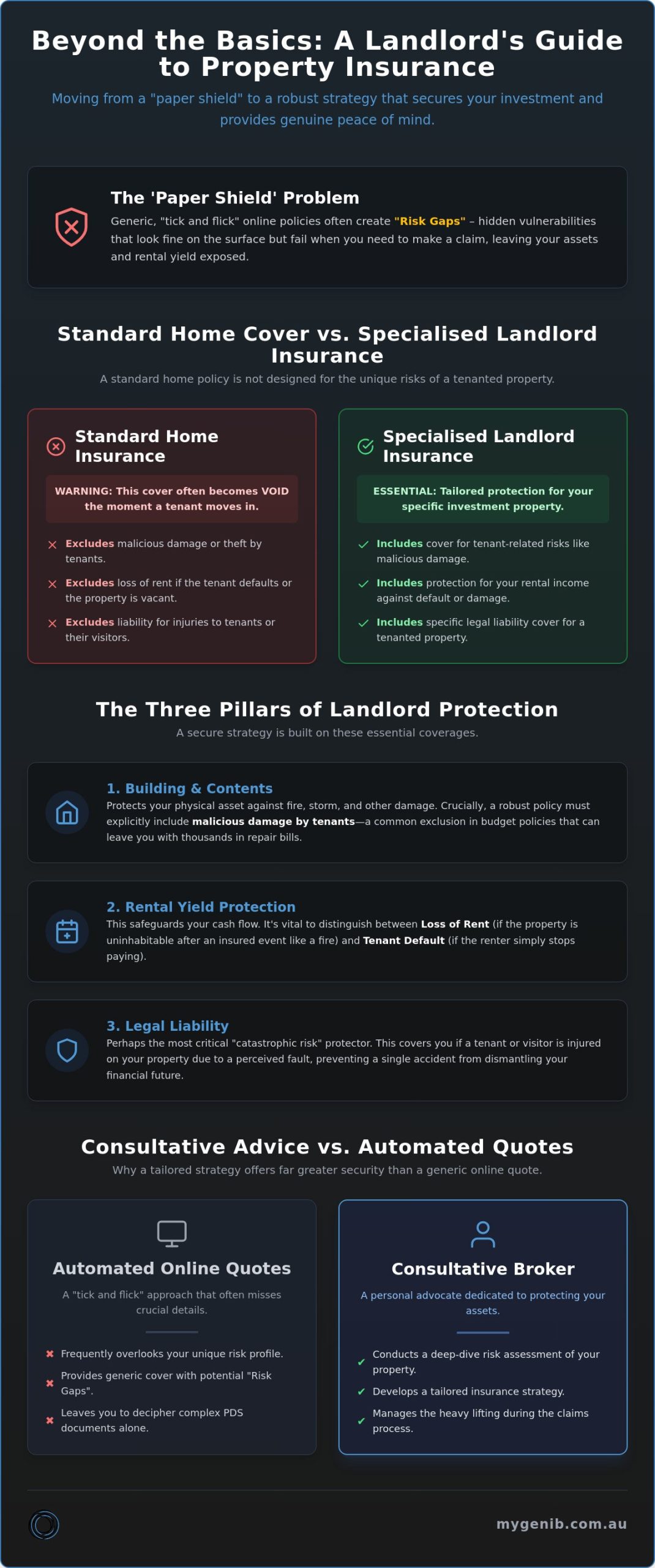
- Learn why standard home policies often become void once a tenant moves in and how specialised cover protects both your physical building and your financial yield.
- Uncover the “Big Three” essential protections every landlord needs to avoid the common pitfalls and hidden exclusions of malicious tenant damage.
- Discover how a tailored strategy for rental property insurance offers far greater security than automated online quotes that frequently overlook your unique risk profile.
- Understand the importance of a deep-dive risk assessment to ensure your policy aligns perfectly with whether you own a standalone house or a strata-managed unit.
- Gain peace of mind by learning how a consultative broker acts as your personal advocate, handling the heavy lifting during the complex claims process.
Understanding Rental Property Insurance: Why Standard Home Cover Falls Short
We often see investors who view their policy as a simple box to tick for the bank. However, rental property insurance is actually a sophisticated financial safeguard based on fundamental property insurance principles that go beyond just the physical structure. It is a contract specifically designed to protect your physical assets and your ongoing financial yield; a standard policy simply isn’t built for the complexities of a tenanted home. This creates what we call “Risk Gaps.” These are the hidden vulnerabilities found in generic, automated policies that look fine on the surface but fail when you actually need to make a claim. In the Australian regulatory environment, the Product Disclosure Statement (PDS) is your roadmap, but many people find it impenetrable. Without a deep dive into these documents, you might find that your cover is effectively a paper shield.
To better understand the core differences between these policy types, watch this helpful video:
The Difference Between Homeowners and Landlord Insurance
A common mistake is assuming that a standard home insurance policy will suffice for a rental. It won’t. Most home policies become void the moment a tenant moves in because the risk profile has fundamentally shifted. Key exclusions often include tenant theft, malicious damage, and liability for injuries to renters. You also need to understand the difference between “defined events” and “accidental damage.” A cheap policy might only cover specific events like fire or storm, leaving you exposed if a tenant accidentally floods the kitchen or damages the floorboards. We believe in looking beneath the surface to ensure your policy covers the reality of property management.
Identifying Your Specific Risk Profile
Essential Coverages: Bridging the Gap Between Basic and Secure
Moving from a generic policy to a secure strategy requires a focus on the “Big Three” pillars of protection: Building and Contents, Loss of Rent, and Legal Liability. While most investors focus on the physical structure, the true value of rental property insurance lies in how it safeguards your cash flow. In our volatile Australian climate, flood and storm cover are non-negotiable, yet many budget policies bury restrictive definitions in the fine print. We’ve seen too many landlords discover a “nasty surprise” when they realise malicious damage by tenants wasn’t included in their basic cover, leaving them with thousands of dollars in repair bills that the bond won’t even begin to touch.
Legal liability is perhaps the most critical “catastrophic risk” protector. If a tenant or visitor is injured on your property due to a perceived maintenance failure, the financial fallout can be life-changing. Understanding your rights and the available dispute resolution for landlords through bodies like AFCA is vital if a claim becomes complex. A robust policy acts as your first line of defence, ensuring that a single accident doesn’t dismantle years of wealth building.
Protecting Your Rental Yield: Loss of Rent and Tenant Default
There’s a significant difference between “loss of rent,” which applies if the home becomes uninhabitable due to a fire or storm, and “tenant default,” which covers you when a renter simply stops paying. A high-quality policy shouldn’t just replace the missing income; it should handle the heavy lifting of the legal process. Look for cover that includes:
- Legal representation costs for tribunal hearings
- Bailiff or Sheriff service fees
- Eviction order expenses
- Loss of rent during the re-letting period after an eviction
Strata vs Torrens Title: Who Covers the Building?
If you own a unit or townhouse, don’t fall into the “strata gap.” While your body corporate insurance typically covers the building’s shell and common areas, it won’t protect your internal fixtures. You need “Landlord Contents” cover for items like carpets, blinds, light fittings, and split-system air conditioners. For Torrens Title (freestanding) houses, you are responsible for everything from the roof tiles to the front fence. Ensuring your policy matches your specific property type is the only way to achieve true peace of mind. If you’re unsure where your current cover ends and your risk begins, getting professional eyes on your current policy can reveal the gaps before they become costly lessons.
The Broker Advantage: Why Consultative Advice Beats Automated Quotes
While many direct insurers encourage a “tick and flick” approach through automated forms, we believe your investment deserves a more rigorous investigation. Choosing insurance brokers over an algorithm means choosing a partner who looks beneath the surface of your property portfolio. We don’t just skim for the lowest premium. Instead, we perform a deep-dive risk assessment to identify the specific vulnerabilities associated with your property type, location, and tenant profile. This methodical process ensures that when you secure rental property insurance, it is a precise fit rather than a generic guess. At MyGen, we act as the steady hand, handling the heavy lifting of risk management so you can focus on growing your wealth with total confidence.
Navigating Complex Claims with a Personal Advocate
Dealing with a major claim is stressful enough without the added frustration of an automated call centre. When things go wrong, you shouldn’t have to explain your history to a different stranger every time you pick up the phone. A dedicated broker acts as your personal advocate, ensuring your claim is presented accurately and persuasively to the underwriter from the very beginning. This professional guidance often makes the difference between a rejected claim and a successful settlement. We stand by you throughout the entire process, providing the relief and clarity you need during high-friction moments.
Integrating Landlord Cover into Your Holistic Business Portfolio
For high-net-worth individuals, a rental property is rarely an isolated asset. It is a vital component of a broader wealth strategy that often includes business insurance and other commercial interests. We look at your situation holistically, ensuring your landlord cover complements your existing protections without leaving dangerous gaps or expensive overlaps. We invite you to experience a human-centric way of securing your assets that values accuracy over volume. By moving away from superficial online transactions, you gain the certainty that your entire financial future is managed with diligence, care, and local expertise.
This holistic approach to asset management often extends to luxury lifestyle investments; for instance, those looking to balance cost and enjoyment in the maritime sector can visit Neptune Oceanic to explore premium yacht sharing and management.
Securing Your Financial Future with Precision
Owning a rental property is a significant achievement, but it shouldn’t be a source of constant anxiety. We’ve explored how standard home policies often leave dangerous risk gaps and why the nuances of strata vs Torrens title require a specialised approach. By prioritising the “Big Three” coverages and understanding the true value of loss of rent protection, you move from a state of vulnerability to one of genuine security. A robust strategy for rental property insurance is about more than just a policy document; it’s about ensuring your hard-earned wealth is protected by a steady, experienced hand.
We believe every Australian investor deserves professional guidance that looks beneath the surface. With over 20 years of industry expertise and a personalised consultative approach, we provide national coverage that replaces the frustration of automated call centres with real human advocacy. You don’t have to handle the heavy lifting of risk management alone. We invite you to speak with a MyGen expert to organise a tailored risk assessment for your property. Let’s work together to ensure your investment remains a stable foundation for your future.
Frequently Asked Questions
Do I need rental property insurance if my property is managed by an agent?
Yes, you absolutely need your own cover because a property manager’s role is purely administrative and does not include insuring your assets. While an agent handles inspections and rent collection, they aren’t responsible for replacing your income if a tenant stops paying or repairing the building after a storm. Having your own rental property insurance ensures you have a direct safety net that protects your equity and legal liability regardless of who manages the lease.
What is the difference between tenant default and loss of rent?
Tenant default occurs when a renter fails to meet their lease obligations and stops paying rent while still occupying the property or after vacating unexpectedly. In contrast, loss of rent cover typically triggers when the property becomes uninhabitable due to a physical event like a fire or flood. It’s vital to ensure your policy includes both; the financial impact of a long-term vacancy during repairs can be just as damaging as a non-paying tenant.
Is landlord insurance tax-deductible in Australia?
Generally, yes, the premiums you pay for landlord insurance are tax-deductible in Australia as they are considered a cost of earning assessable income. This deduction helps offset the annual cost of your policy, making professional protection more accessible for investors. We always recommend consulting with a qualified tax professional to ensure you’re claiming all eligible expenses correctly according to current ATO guidelines for the 2025-26 financial year.
Does strata insurance cover my rental property contents?
No, strata insurance typically only covers the building’s structure and common areas like hallways or lifts. It doesn’t extend to the internal fixtures and fittings that you own as a landlord, such as carpets, curtains, light fittings, or split-system air conditioners. To protect these assets and secure your liability as a landlord within the unit, you need a specific landlord contents policy to bridge the gap left by the body corporate cover.
How much does rental property insurance typically cost?
The cost of your policy depends on several variables including the property’s location, the type of dwelling, and the level of cover you choose for contents and liability. While national averages exist, your specific premium will reflect the unique risks of your suburb and the current replacement value of the building. We focus on conducting a thorough risk assessment to ensure you aren’t overpaying for unnecessary extras while still maintaining robust protection for your investment.
Can I get landlord insurance for a short-term holiday rental?
Yes, you can, but it requires a specialised policy because standard long-term landlord cover often excludes short-term stays like those on Airbnb or Stayz. Short-term rentals carry unique risks, including higher turnover and different liability requirements; therefore, it’s essential to disclose the nature of your rental to your broker. We can help you navigate these nuances to ensure your holiday investment is protected against the specific challenges of the transient rental market.