
If you’ve ever stared at your professional indemnity renewal and wondered if the ATO sees it as a legitimate expense or a personal luxury, you aren’t alone. One of the most frequent questions we hear at MyGen is: is business insurance tax deductible in Australia? We know that EOFY paperwork often feels like a complex puzzle where one wrong move might trigger an unwanted audit. We’ve spent years helping locals navigate these exact complexities to find peace of mind.
In this 2026 guide, we’ll show you exactly which premiums you can claim to maximise your returns while keeping your protection rock-solid. You’ll learn how to identify deductible policies, handle the tricky apportionment of mixed-use assets like vehicles, and build a risk management strategy that the tax office respects. Let’s turn that pile of paperwork into a clear path for your business’s financial health.
Key Takeaways
- Confirm the fundamental rule that is business insurance tax deductible in Australia whenever premiums are incurred as a necessary expense for earning your assessable income.
- Master the process of apportionment for mixed-use policies, such as commercial motor insurance, to ensure you only claim the portion directly related to your professional activities.
- Identify the critical distinction between operating and capital expenses to ensure your EOFY paperwork remains compliant and reflects a precise risk management strategy.
- Discover why a personalised risk assessment from a consultative broker provides the robust documentation needed to justify your “business purpose” far better than a generic, automated quote.
Understanding Insurance Premiums as Deductible Operating Expenses
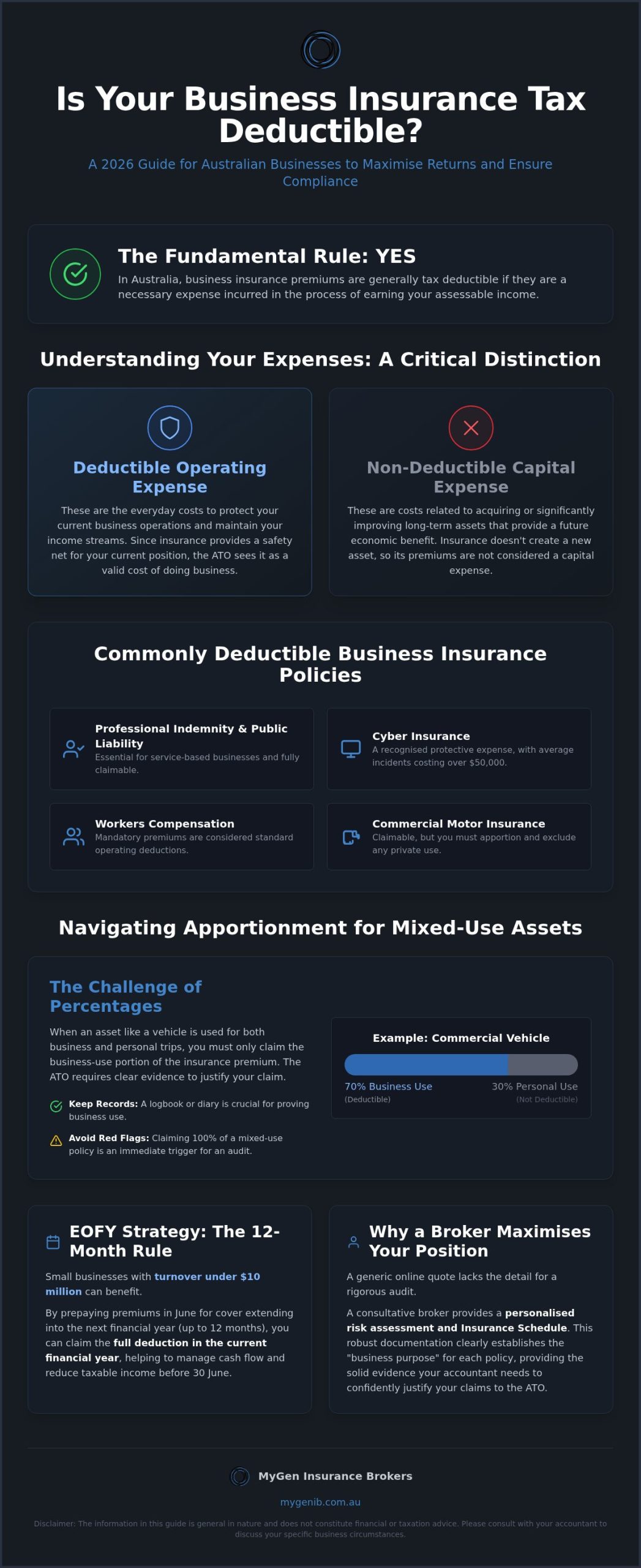
The Australian Taxation Office generally views insurance premiums as a standard operating expense. If you’ve incurred a cost to protect your income or business assets, it’s typically claimable. This is a foundational principle within Insurance in Australia; it provides the safety net that allows SMEs to operate with confidence. We often tell our clients that if a policy protects a business asset or a revenue stream, it’s likely a valid deduction.
Distinguishing between “operating expenses” and “capital expenses” is vital for a clean tax return. Operating expenses are the everyday costs of keeping your doors open. Capital expenses usually relate to acquiring or improving long-term assets. Since insurance protects your current operations rather than creating a new permanent asset, the ATO considers it a necessary cost of doing business. It’s about maintaining your current position, not building a new one.
To better understand how these tax rules apply to your specific situation, watch this helpful video:
Which Business Insurance Types Can You Claim?
When asking is business insurance tax deductible in Australia, it helps to look at the specific covers you hold. Most standard business policies are fully deductible. These include:
- Professional Indemnity and Public Liability: These are essential for service providers and are fully claimable.
- Cyber Insurance: With the average small business cyber incident now costing over $50,000, this is a recognised protective expense.
- Workers Compensation: These mandatory premiums are standard operating deductions.
- Commercial Motor Insurance: These are claimable, though you must account for any private use.
For a deeper dive into these policies, check out our The Complete Guide to Business Insurance in Australia. We’ll help you organise the right cover so your tax position remains rock-solid and your business stays protected.
Navigating Apportionment and Mixed-Use Policies
Splitting personal and professional use is where many business owners feel the most pressure during tax season. When you use a personal vehicle for client visits or run a consultancy from a home office, the question of is business insurance tax deductible in Australia becomes a matter of precise percentages. The ATO requires clear evidence, like a logbook or a diary, to justify the business portion of your premium. We often find that keeping these records throughout the year provides the ultimate peace of mind when auditors come knocking.
Claiming 100% of a mixed-use policy is an immediate red flag. Auditors look for realistic apportionment rather than blanket claims. It’s often simpler to maintain separate policies for dedicated business assets to create a cleaner paper trail. You can review common deductible business insurance policies to see how professionals categorise these splits. If you’re feeling overwhelmed by the paperwork, reaching out for a consultative review can help clarify your position.
Prepaid Premiums and EOFY Timing
Small business entities with an aggregated turnover of less than $10 million can often benefit from the “12-month rule”. This allows you to claim a full deduction in the current financial year for premiums paid in June, even if the cover extends into the next year. It’s a strategic way to manage cash flow while confirming that is business insurance tax deductible in Australia for the current financial year. This timing is particularly beneficial for Commercial Vehicle Insurance, where an upfront payment can significantly reduce your taxable income before June 30.
How a Consultative Broker Maximises Your Tax Position
While an online quote might take minutes, it rarely provides the deep documentation required to satisfy a rigorous audit. We believe that the real value of a broker lies in the personalised risk assessment. This process establishes a clear, documented business purpose for every policy you hold. When your accountant asks is business insurance tax deductible in Australia for a specific premium, a broker-prepared Insurance Schedule provides the definitive answer. It serves as superior evidence compared to a generic receipt from an automated system.
Automated platforms often bundle coverages without distinguishing between deductible and non-deductible components. By working with a seasoned expert, you ensure that every line item is justified. Professional Indemnity insurance, for example, is a cornerstone for many Australian professionals; it protects your expertise while remaining a transparent tax write-off. This level of diligence transforms your insurance from a confusing expense into a managed, compliant asset that protects your livelihood.
Beyond the Premium: Are Broker Fees Deductible?
We often get asked if the professional service fees charged by brokers are also claimable. The short answer is yes. Because these fees are incurred in the course of securing your business protection, they are typically treated as deductible operating expenses. Professional advice ensures you aren’t just guessing whether is business insurance tax deductible in Australia; you’re certain of it. Paying for expert advice is often more tax-efficient than opting for “cheap” direct policies that may leave you underinsured. To see how this applies to your specific field, read our Professional Indemnity Insurance: A Comprehensive Guide. We’ll help you organise cover that stands up to scrutiny.
Securing Your Business Future and Your EOFY Returns
Navigating tax time doesn’t have to be stressful. We’ve explored how most premiums are claimable and why precise apportionment is the key to a compliant return. We know your main question is business insurance tax deductible in Australia, but the real value lies in having a rock-solid paper trail that protects you from ATO scrutiny. Our team brings over 20 years of industry experience to help you look beneath the surface of your risks.
We ensure every policy is fit-for-purpose and clearly documented for your accountant. Instead of relying on a generic quote, you deserve a strategy that offers both financial security and peace of mind. Organise a personalised risk consultation with MyGen Insurance Brokers today to ensure your coverage is as efficient as it is effective. We’re here to help you move forward with clarity and confidence.
Frequently Asked Questions
Is Public Liability insurance tax deductible for sole traders?
Yes, Public Liability insurance is generally tax deductible for sole traders because the ATO views it as a necessary operating expense. Since you’re protecting your business from the financial impact of third-party claims, the premium is considered a cost of doing business. We recommend keeping your tax invoice as evidence that the policy was taken out for a clear business purpose.
Can I claim the GST component of my insurance premium?
If your business is registered for GST, you typically claim the GST component as an input tax credit on your Business Activity Statement (BAS). This means when you’re considering is business insurance tax deductible in Australia, you should only claim the net premium amount as a deduction on your income tax return. Non-registered businesses generally claim the full, GST-inclusive amount as a deduction.
Are life insurance premiums tax deductible for business owners?
Generally, life insurance premiums aren’t tax deductible because the ATO considers them a private or domestic expense rather than a business operating cost. While we focus on protecting your commercial assets through covers like Professional Indemnity or Cyber insurance, life insurance typically falls outside the scope of deductible business expenses. It’s always best to consult your accountant regarding specific personal insurance structures.
What happens if I pay my business insurance premium in monthly instalments?
When you pay via monthly instalments, you claim the deductions in the financial year each payment is actually made. This differs from paying an annual premium upfront, where you might claim the entire amount at once. We help you organise policies that fit your cash flow while ensuring your broker-managed documentation clearly shows each payment’s business purpose for your EOFY records.