
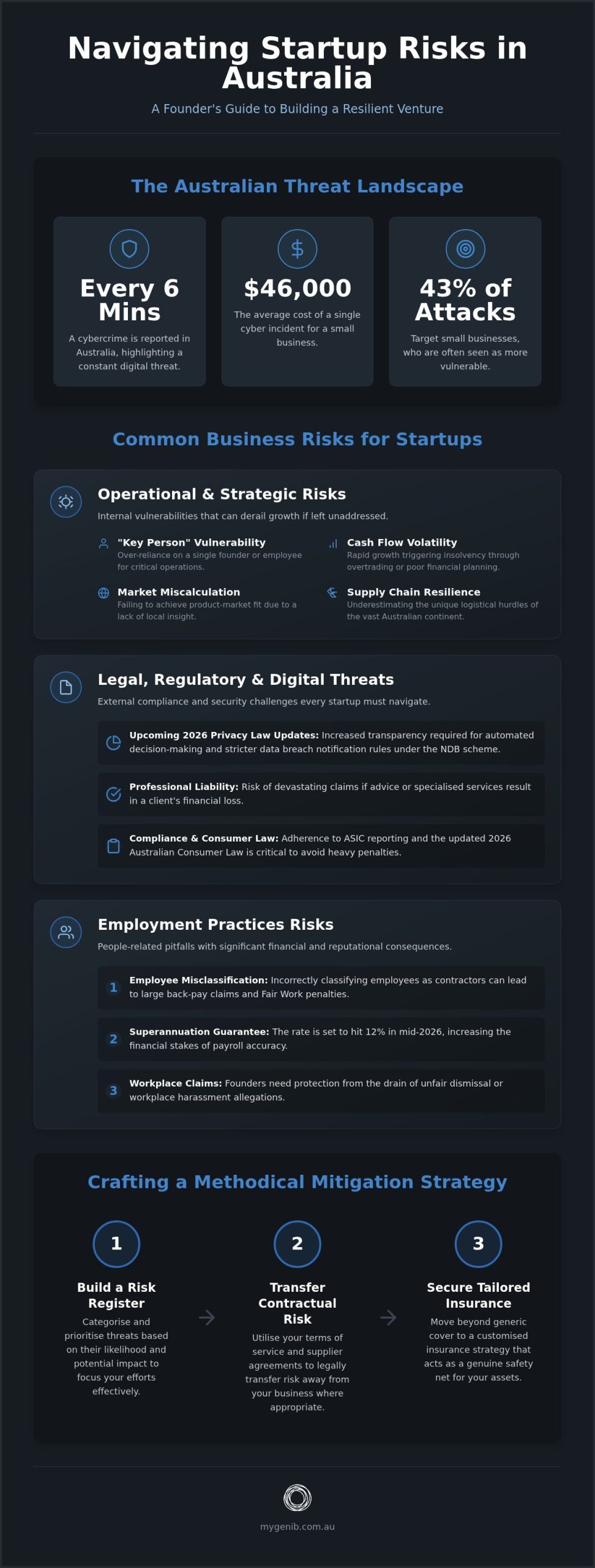
Did you know that a cybercrime is reported every six minutes in Australia, with the average incident costing a small business around $46,000? Identifying the common business risks for startups in Australia is the first step towards avoiding these costly pitfalls. While launching a new venture is exhilarating, the weight of regulatory requirements and the fear of a single legal slip-up can quickly turn that excitement into sleepless nights.
This guide shows you how to build a protective shield around your venture through methodical risk management. We’ll examine the latest 2026 privacy law updates, prioritise the threats you can’t ignore, and help you find the peace of mind that comes from knowing your assets are secure. You’ll gain a clear path forward, replacing uncertainty with the confidence of a seasoned founder.
Key Takeaways
- Identify the operational “key person” vulnerabilities and market miscalculations that often derail new ventures before they find their footing in the local market.
- Navigate the complex landscape of common business risks for startups in Australia, including the latest 2026 regulatory shifts in data privacy and consumer law.
- Learn to build a robust risk register that categorises threats by impact, allowing you to prioritise your protective efforts where they matter most.
- Discover how to transition from generic, automated cover to a tailored insurance strategy that acts as a genuine safety net for your personal and business assets.
Operational and Strategic Vulnerabilities in the Australian Startup Ecosystem
Identifying common business risks for startups in Australia requires looking past your pitch deck to the nuts and bolts of daily operations. Many founders focus entirely on growth while ignoring the structural cracks that can widen under pressure. It’s vital to adopt a methodical approach to risk management to ensure your foundation is solid enough to support your long-term vision.
Market miscalculation often stems from a lack of local insight. You might have a brilliant tech solution, but if it doesn’t account for Australian consumer habits or the “tyranny of distance” in logistics, your costs will spiral. Shipping goods across our vast continent presents unique hurdles that international models often overlook, making domestic supply chain resilience a non-negotiable priority.
To better understand the financial and operational realities of starting a business locally, watch this helpful video:
The Risk of Underestimating Product-Market Fit
A “global” product often hits a wall when it meets specific Australian standards or cultural nuances. We’ve seen countless ventures sink capital into services that the local market simply doesn’t value. Iterative testing isn’t just a buzzword; it’s a survival strategy. By launching small and listening to local feedback, you avoid the devastating financial blow of a failed wide-scale rollout.
Operational “Key Person” risk is another silent threat that founders frequently overlook. If your entire operation relies on one developer’s code or a single founder’s relationships, you’re one illness away from a standstill. Understanding these common business risks for startups in Australia allows you to build redundancy into your team early. When you pair this with cash flow volatility, where rapid growth can trigger insolvency through overtrading, the need for precision becomes clear.
Navigating Legal, Regulatory, and Digital Threats for New Ventures
Digital vulnerabilities represent some of the most pressing common business risks for startups in Australia. With a cybercrime reported every six minutes, small businesses are now the target of 43% of all attacks. By December 2026, new privacy laws will require even more transparency regarding automated decision-making. In this environment, Cyber Insurance acts as a critical financial buffer, covering the mandatory notification costs and forensic investigations required under the Australian Notifiable Data Breaches (NDB) scheme.
Beyond digital threats, professional liability remains a significant hurdle. If your startup provides advice or specialised services, a single error that leads to a client’s financial loss can trigger a devastating claim. Staying compliant with ASIC reporting and the updated 2026 Australian Consumer Law is equally vital to avoid the heavy penalties associated with unfair trading practices. If you’re feeling overwhelmed by these requirements, a deep-dive risk assessment can help clarify your obligations.
Employment Practices and the Fair Work Act
Misclassifying employees as contractors is a frequent pitfall that can lead to back-pay claims and Fair Work penalties. As the superannuation guarantee rate hits 12% in mid-2026, the financial stakes of getting your payroll wrong have never been higher. While professional indemnity insurance protects against service errors, it often works alongside management liability to shield founders from the emotional and financial drain of unfair dismissal or workplace harassment claims. Protecting your team and your reputation requires a proactive, methodical approach to workplace culture and compliance.
Crafting a Methodical Risk Mitigation and Insurance Strategy
Building a resilient venture requires moving from reactive fire-fighting to a methodical strategy. We recommend developing a comprehensive risk register to categorise and prioritise threats based on their likelihood and potential impact. This process transforms the overwhelming landscape of common business risks for startups in Australia into a prioritised list of actionable items. Alongside this, ensure your terms of service and supplier agreements utilise contractual risk transfer to protect your interests. Remember that business insurance is a dynamic tool rather than a “set and forget” expense. As your business scales, regular reviews are essential to maintain a state of certainty and ensure your coverage evolves with your operations.
Why Consultative Broking Trumps Automated Quotes
The temptation to use a “tick-and-flick” online portal is high when you’re busy, but automated quotes often leave dangerous gaps. A generic algorithm doesn’t understand the nuances of your specific industry or the unique commercial vehicle insurance requirements for a mobile startup. We see the value of an expert insurance broker as a deep-diver who uncovers what others miss. Scaling a startup is a period of high friction. What worked for a team of three won’t suffice for a team of thirty. This methodical habit ensures that common business risks for startups in Australia don’t catch you off guard as you grow. This consultative approach turns a simple transaction into a protective partnership, allowing you to focus on growth while we handle the heavy lifting of your security.
Securing Your Startup’s Future in 2026
Building a successful business in Australia’s dynamic landscape requires more than just a great idea. It demands a methodical approach to managing the common business risks for startups in Australia. Understanding how operational vulnerabilities, shifting 2026 regulations, and cyber breaches impact your momentum is essential for survival. By prioritising a risk register and moving beyond generic insurance, you create a foundation of certainty that allows you to scale with confidence.
You don’t have to navigate these complexities alone. With over 20 years of industry experience, we specialise in deep-dive assessments that uncover the specific threats unique to your venture. We invite you to organise a personal risk consultation with MyGen Insurance Brokers to ensure your assets remain protected. Your hard work deserves a tailored shield, and we’re here to help you build it.
Frequently Asked Questions
What is the most common risk for startups in Australia?
Market misjudgment and cash flow volatility are historically high, but cyber threats are rapidly becoming the most frequent external risk. Addressing the common business risks for startups in Australia requires a dual focus on internal operational stability and external digital security. We recommend starting with a risk register to identify which threat poses the most immediate danger to your specific business model.
Is business insurance compulsory for Australian startups?
While most forms of business insurance aren’t legally mandated like Workers’ Compensation, they’re often contractually required by landlords or clients. For example, many professional service contracts demand Professional Indemnity Insurance before you can begin work. Skipping these protections leaves your personal assets vulnerable to lawsuits, making “optional” cover feel essential for the long-term survival of your venture.
How much does cyber insurance typically cost for a new business?
The cost of Cyber Insurance varies based on your industry, the volume of sensitive data you handle, and your existing security protocols. Because every startup has a unique digital footprint, we move away from generic price estimates in favour of a deep-dive assessment. This personalised approach ensures you aren’t paying for unnecessary extras while keeping your specific vulnerabilities fully protected against breaches.
Can I rely on my personal car insurance for business activities?
Generally, personal car insurance policies exclude coverage for vehicles used primarily for business purposes. If you use your car to deliver goods or visit clients, you likely need Commercial Motor Insurance to ensure you’re protected during a claim. Relying on a domestic policy for business activities often leads to declined claims, creating a significant financial gap when you’re most vulnerable.